

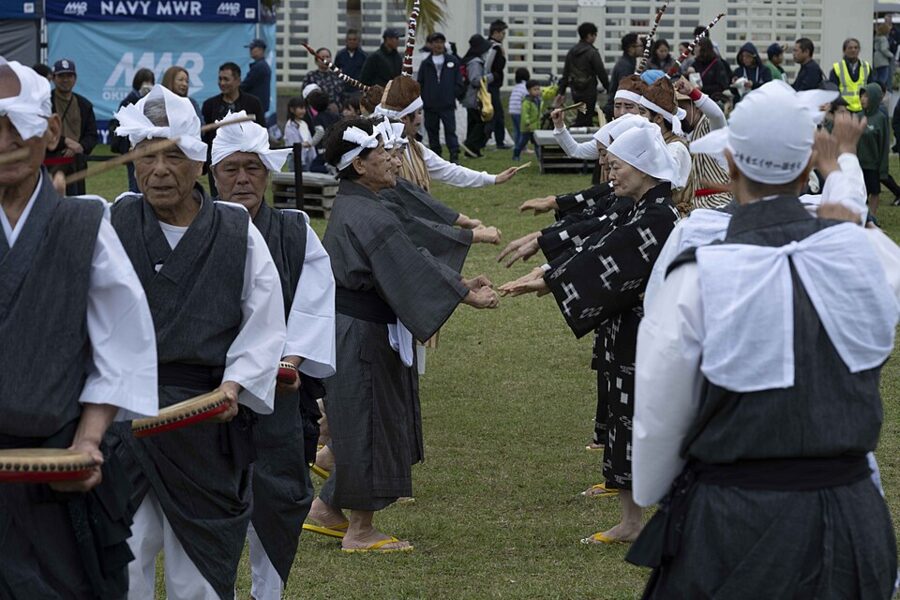
The last song of the night in an Okinawan folk-song bar is nearly always a fast one, and when it starts the room gets up. Arms go above heads, wrists turn, feet tread on the spot as if crushing barley; the men keep their hands in loose fists and the women let their fingers open. Nobody teaches it. You copy the person next to you, and by the second verse you are dancing kachashi (カチャーシー), from an old word meaning to stir together.
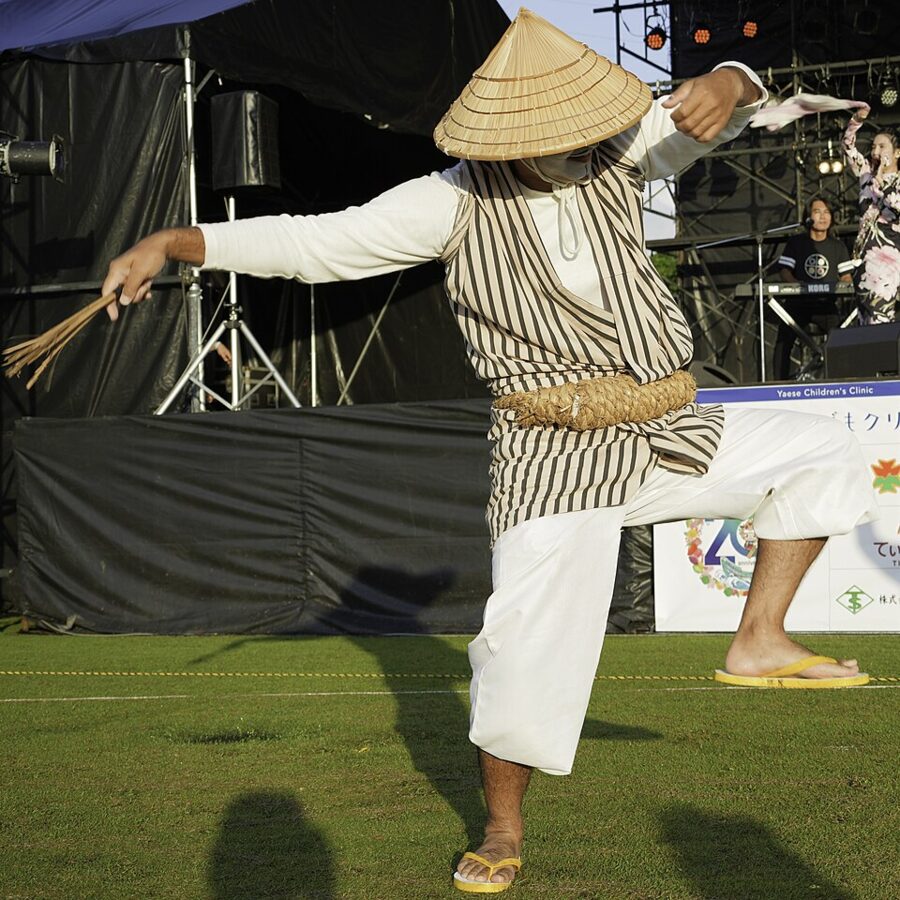

The song is often “Tooshin Doi”, usually explained as the shout that went up in Naha when a ship from China was sighted. That is a fair place to start, because almost everything in Okinawan culture arrived by sea and was then made local: the three-stringed sanshin from Fujian, distilling from Siam, the stone lions from China, the dyes from the trade routes, the hamburger and the canned pork from the American bases.
What came of it is still practised more than displayed. Okinawa (沖縄) and the rest of the Ryukyu Islands (琉球諸島) have their own music, martial art, cloth, pottery and gods, and the place to meet most of it is a car park in August, a family tomb in April or a bar in Naha at 22:00, not a glass case.

In this guide
Four layers on one island
Okinawa was a kingdom before it was a prefecture. For 450 years Ryukyu traded between China, Japan and Southeast Asia from Shuri, paying tribute to China and, after 1609, to Satsuma as well; its court and history are in the Ryukyu Kingdom guide. What it left in ordinary life was a gentleman’s instrument, Fujianese families and customs in Naha, and Chinese ideas about ancestors, geomancy and evil spirits laid over a much older religion led by women.
Japan came next, and harder. After 1879 schools pressed standard Japanese and Japanese manners, and much Okinawan practice went quiet. Then the battle of 1945 destroyed most of what the islands owned, from Shuri’s palace to the dyers’ stencils and the old named sanshin.
The third layer is American. The islands were under US administration until 1972, and the bases stayed after reversion. Occupation gave Okinawa its rock bands, taco rice and canned luncheon meat, and it turned the old customs into a statement: dancing eisa or playing the sanshin was a way of saying who you were. The Okinawa guide covers the wider story and travel round the islands.
Okinawan and its neighbours are separate Ryukyuan languages, not dialects, and all are listed as endangered; the Japanese dialects guide places them in the family. They survive best in song.
The sanshin
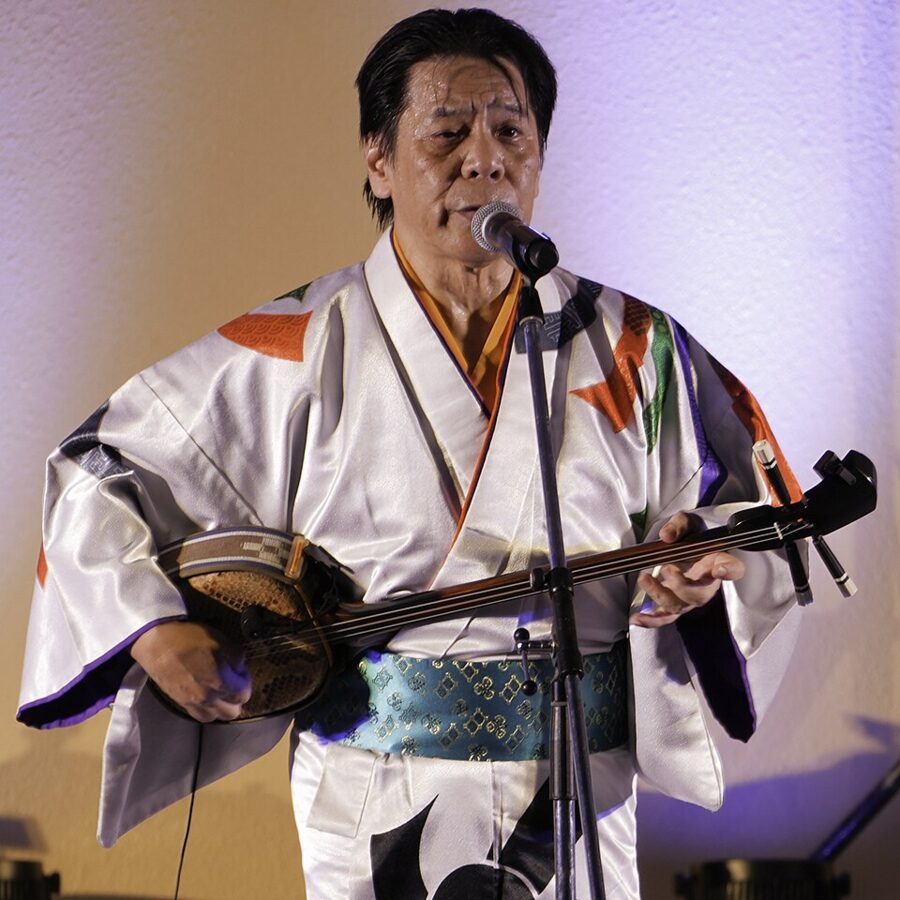
The sanshin (三線), “three strings”, is a long-necked lute with a body covered in python skin. It came from the Chinese sanxian of Fujian during the trading centuries, and from Ryukyu it reached Sakai, near Osaka, around 1558, where it grew a longer neck, lost the snake and became the shamisen. Among Japanese counters, the one a sanshin takes is sao, the word for a pole, after its long neck.
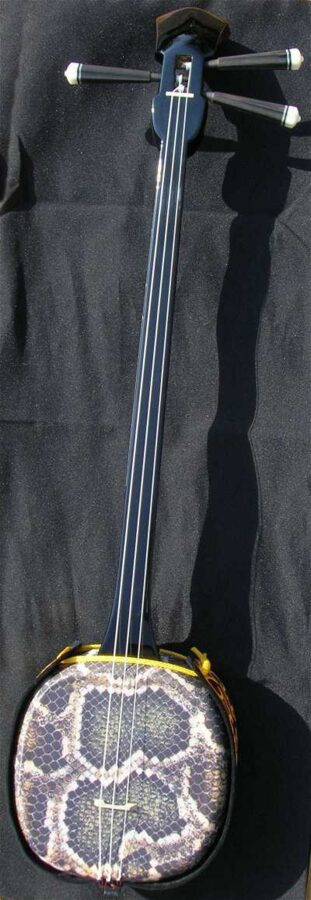

How a sanshin is made
The neck is the instrument. Makers sort necks into seven historical shapes, each named after a master of the kingdom’s time whose original every modern neck copies. Makabe, balanced and elegant, is the one most makers produce; the heavier Yonaa is the classical players’ favourite. The finest old instruments, the keejo, are all Makabe.
The ideal wood is kuruchi, Ryukyu ebony, which grows so slowly that a tree planted now will be ready for necks in about a hundred years. Most old stock went in the war, and the 1990s boom pushed prices so high that cheap necks are now often painted to look like ebony.
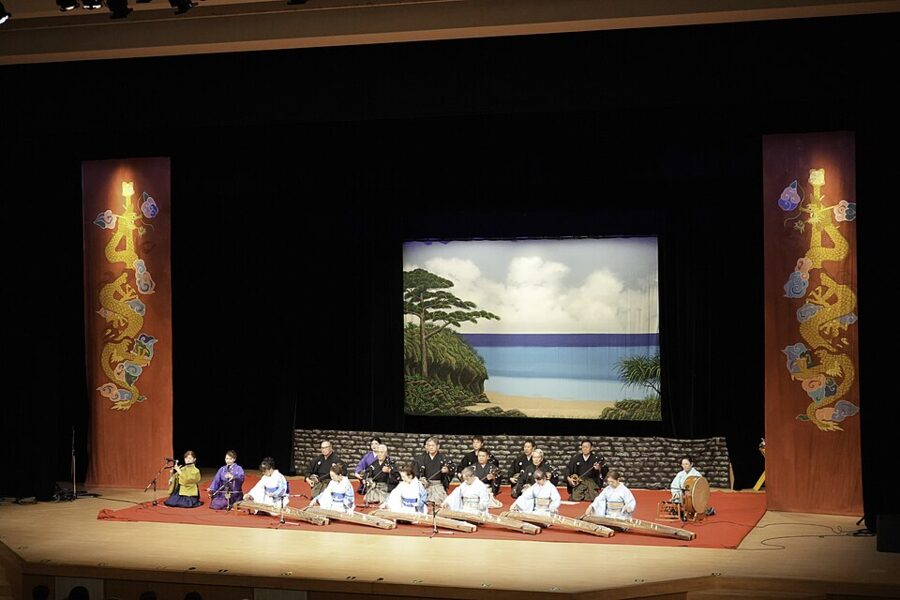

The player strikes the strings with a pick worn on the index finger, mostly downwards, reading from kunkunshi, a grid of Chinese characters for string positions. The sanshin became a national traditional craft in 2018. The Amami islands, now part of Kagoshima, play a larger version picked upwards with a thin bamboo stick.
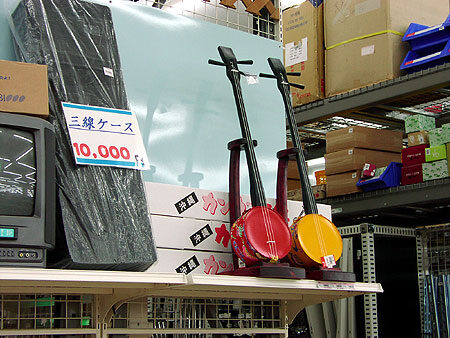
The best story is about its poorest form. In the camps after the battle, with almost every sanshin burned, people made the kankara sanshin: a body from an American food tin, a neck from scrap timber or a bed frame, strings from parachute cord. It is still built and played.
Min’yo and the folk-song bars
Okinawan folk song, min’yo, uses a scale that drops re and la from the Western major scale, which is why one phrase sounds unmistakably of the islands. It never froze: new min’yo are written every year, and songs purists once rejected, such as Shokichi Kina’s “Haisai Ojisan”, are now standards.
After the war the music went where the money was, to the bars for American servicemen in Koza, now Okinawa City. Seijin Noborikawa’s “Pesto Parkin Mama” of 1948 set Okinawan words to a country hit heard on the base radio, and that mix is still part of the sound.
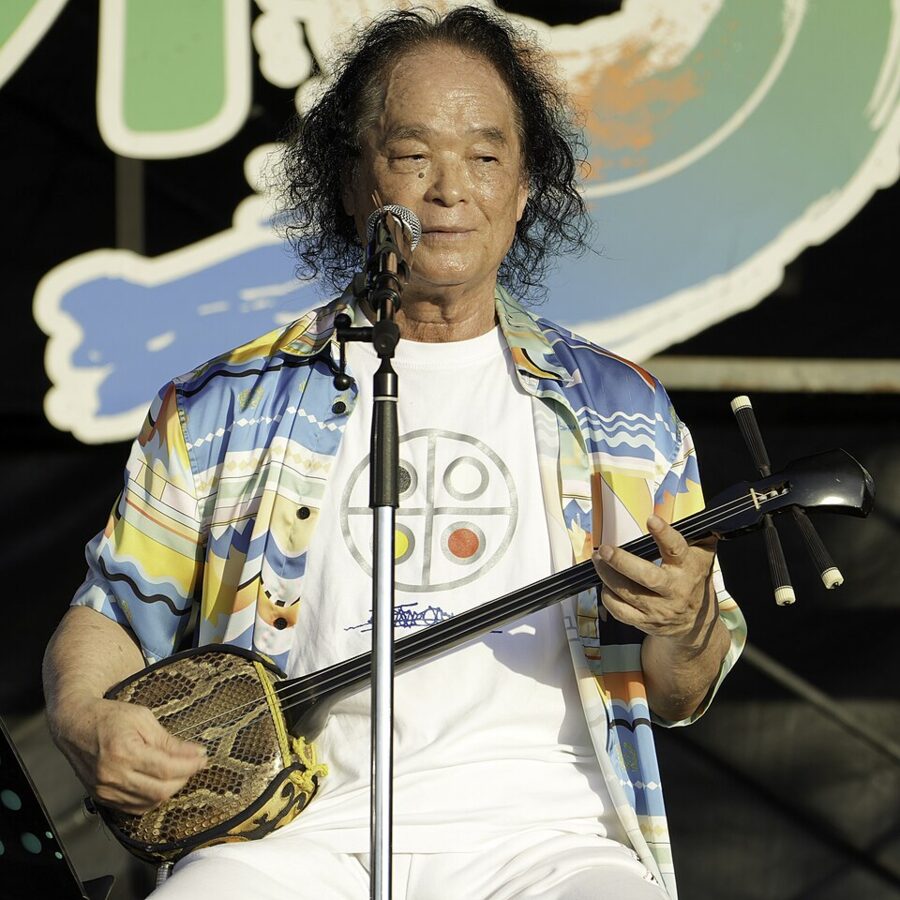

The place to hear it is a min’yo sakaba, a folk-song bar, of which there are several around Kokusai-dori in Naha and in Okinawa City. An evening means two or three sets by a resident singer, a cover charge on top of food and drink, requests from regulars and kachashi to finish. Names and timetables change often, so I’d ask at your hotel that week rather than trust any list.
Arrive for the first set, when the slower songs are played. When the singer calls iya sasa in the fast songs, shout it back.
From Koza to the charts
Okinawan pop reached the mainland in waves. After 1972 came the Nenes, four women singers produced by Sadao China, and the Rinken Band; in 1992 “Shima Uta”, by THE BOOM, a band from Yamanashi, sold close to 1.5 million copies with a sanshin up front. The television drama Churasan (2001) made it a national craze.
Ishigaki gave the country Begin and Rimi Natsukawa, Naha gave it Namie Amuro, and Okinawa City sent Orange Range north.
Eisa: drumming the ancestors home
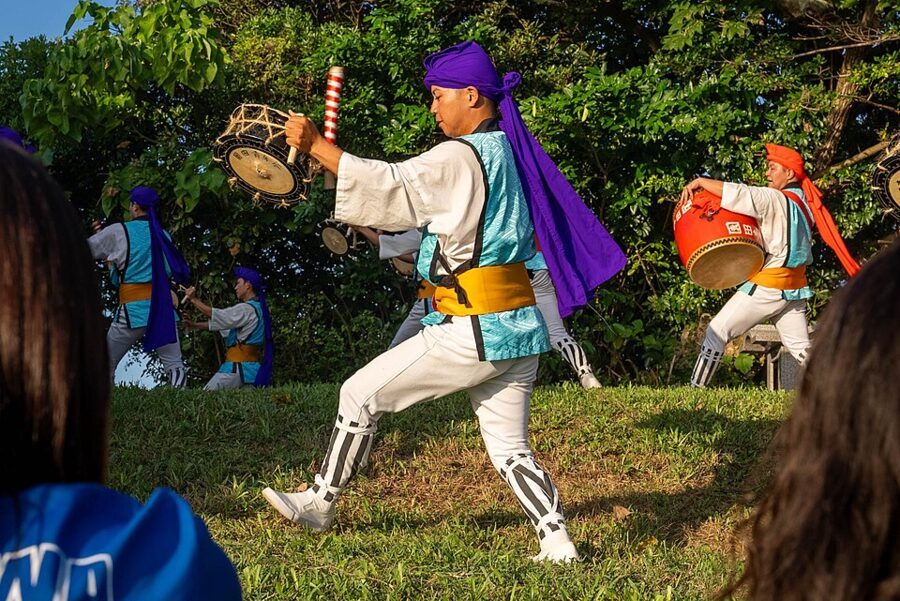
For the three days of Obon, the festival of the dead, the ancestors come home, and on the last night they are sent back. In Okinawa the dates follow the lunar calendar, so Obon falls somewhere between early August and early September, and the sending-off is done with eisa (エイサー): young people moving through the streets of their district with drums, singers and sanshin, stopping at each house to dance.
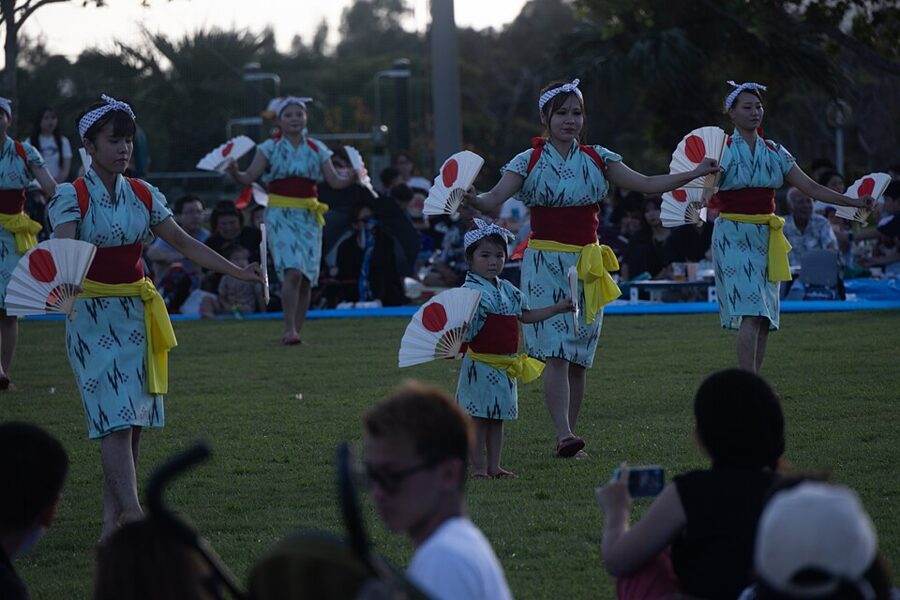
It began as Buddhist chant. The Pure Land monk Taichu, from northern Japan, spent three years in Shuri from 1603 and spread the nembutsu among the gentry, and by the eighteenth century wandering chanters were hired at Obon to sing for the dead. After 1879 the village youth took the job over, and the chanting became dancing to folk songs. The word eisa is usually traced to a refrain in those chants.
Each district’s youth association owns its eisa: drum patterns, songs, costumes and route. Practice starts weeks ahead in car parks after dark, and drums behind a supermarket are the first sign of the season. The rounds of the houses, the michi-junee, collect gifts of money; some districts once paid for reservoirs with them.
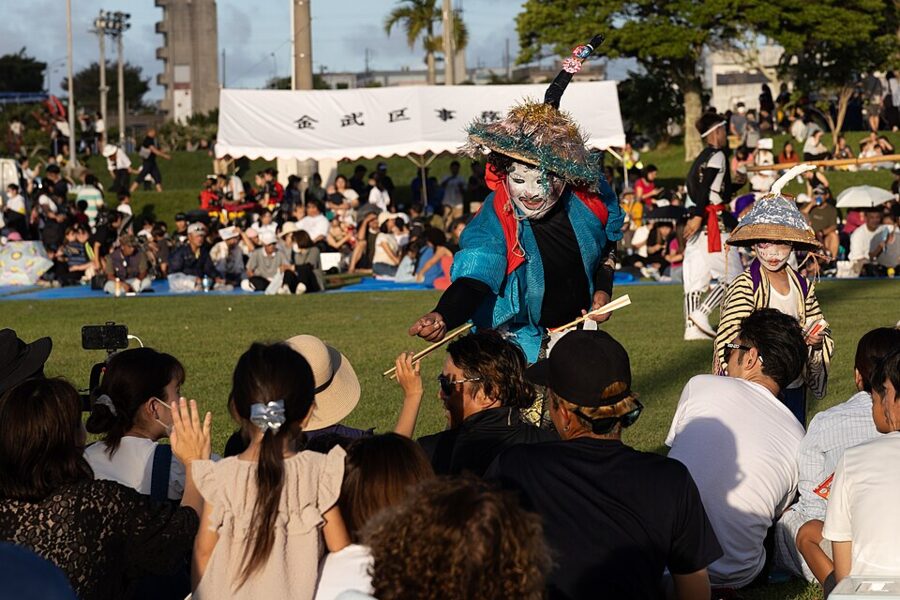
The big modern style, with dozens of large drums swung and struck in unison, grew up in Koza. In 1956, with the US authorities declaring the town’s businesses off-limits to servicemen and its economy on its knees, the city held an all-island eisa contest to lift spirits. Competition made the groups bolder, the costumes brighter and the drumming more athletic. The contest became the All-Island Eisa Festival in 1977, and Okinawa City declared itself the “city of eisa” in 2007.
The festival is held over the first weekend after Obon at the city’s stadium and on nearby streets; the 71st, in September 2026, opened with a Friday-evening street parade. It shows the best groups in one night. It does not show what eisa is for: for that, find a district dancing on the last night of Obon and follow it through its own streets. Older styles survive in Uruma, where Yakena traces its eisa to 1890.
Karate, the empty hand
Karate was born in Okinawa, and people still come from all over the world to learn it at the source. On the island it is taught in small neighbourhood dojo, often in a room on the ground floor of the teacher’s house.
Te, toudi, karate
Its roots are a local fighting art called simply te, “hand”. In the early nineteenth century Kanga Sakugawa of Shuri is said to have studied Chinese boxing in Qing China, and the blend became toudi, “Tang hand”, written 唐手. Teachers were grouped loosely by town, Shuri-te, Naha-te and Tomari-te. Sokon Matsumura, bodyguard to King Sho Iku, also studied the Satsuma sword school Jigen-ryu, so Japan is in the art too.
The popular story says karate grew because weapons were banned; historians now read the inscription of 1509 behind it as recording weapons gathered for defence, not confiscated. What is certain is that karate outlived the kingdom because Anko Itosu got it into the schools in 1905 and wrote new beginners’ forms, the Pinan kata, still learned everywhere.

Gichin Funakoshi demonstrated karate for Jigoro Kano, judo’s founder, in Tokyo in 1922; the same year in Kyoto, Choki Motobu, aged 52, knocked out a Russian boxer with one blow, which did more for its fame than any lecture. On 25 October 1936 the leading masters met in Naha and agreed to write the name 空手, “empty hand”; Okinawa keeps the date as Karate Day. Most Okinawan dojo, whether Goju-ryu, Uechi-ryu or Shorin-ryu, also teach kobudo, the old weapons: staff, sai and nunchaku.
The Karate Kaikan and dojo visits
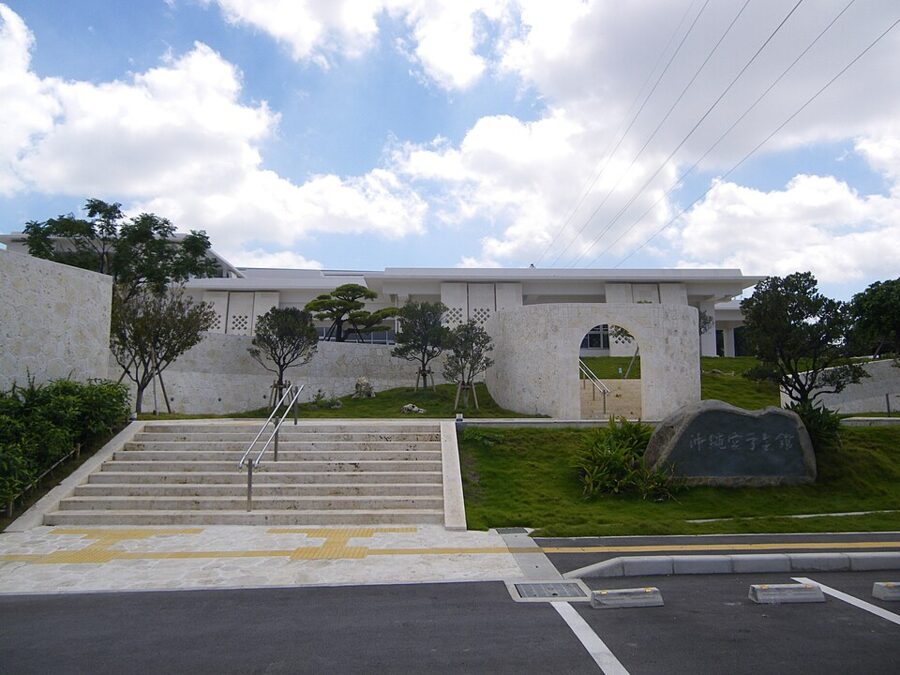
The Okinawa Karate Kaikan opened on 4 March 2017 on the site of Tomigusuku Castle, just south of Naha. Besides training halls it has a paid reference room with an exhibition on karate’s history, a hands-on corner and a film theatre, open 09:00–18:00 (last entry 17:30); it closes on Wednesdays and from 30 December to 3 January.
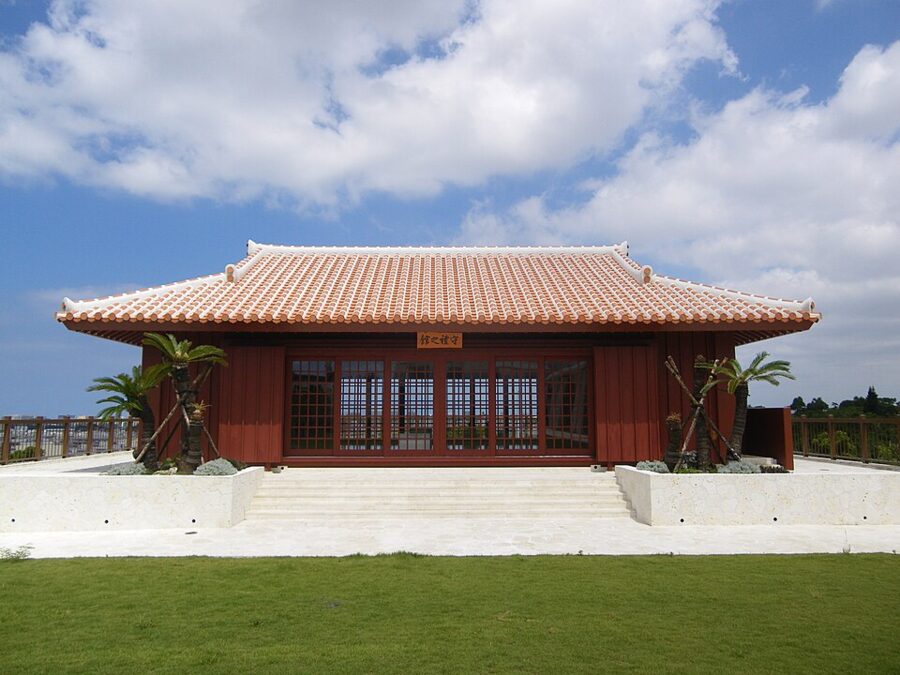

The Kaikan runs a karate experience session with a teacher, booked on its site at least a month ahead. Longer training is arranged with a dojo directly or through your own association, so know which style you want first.
Dojo manners are simple and matter: bow on entering and leaving the floor, bare feet, no photographs without asking, and follow the senior students. A small dojo is someone’s home and life’s work.
Crafts
Most Okinawan crafts were made for the court or for tribute and then had to find new customers when the kingdom ended. Their histories follow the same line: royal workshops, decline after 1879, near-destruction in 1945, and revival by a few families afterwards. Here they are as living trades, with the places to watch and buy.
Yachimun: Tsuboya and Yomitan
Pottery in Okinawan is yachimun. In 1682 the royal government gathered potters from three kiln sites into Tsuboya (壺屋), outside Naha, and it has been the pottery quarter ever since; its jars carried awamori to Edo with the embassies.
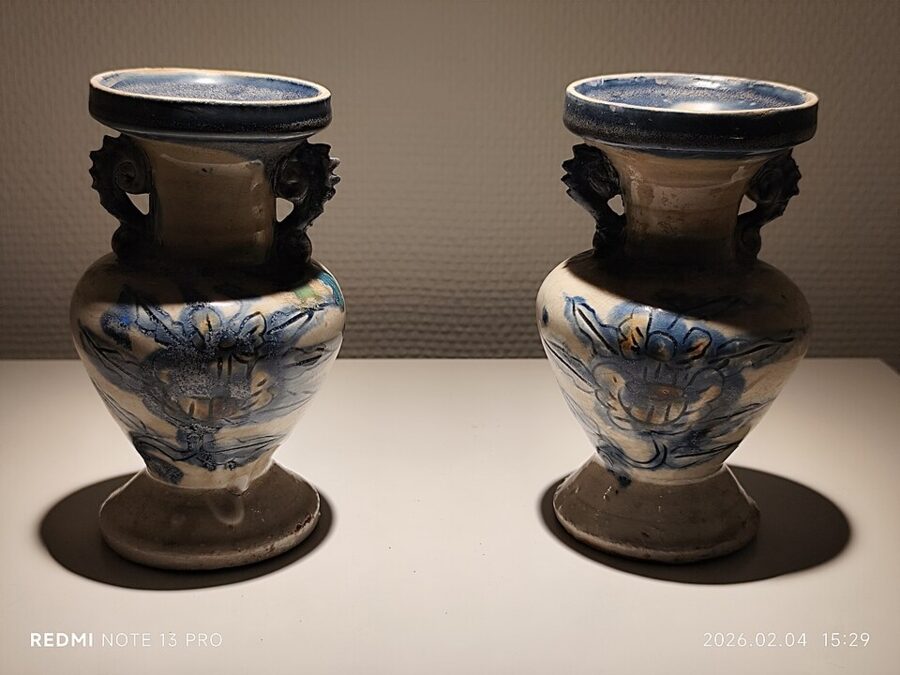
It nearly died when cheap porcelain from Arita flooded in after 1879. The folk-craft movement saved it: Soetsu Yanagi came four times between 1938 and 1940 with the potter Shoji Hamada, praised Tsuboya’s everyday ware and sold it in Tokyo and Osaka.
After the battle the Americans kept residents out of ruined Naha, but the potters argued their kilns could be working within a month and were among the first let back; the city’s rebuilding started around them. One of them, Jiro Kinjo (1912–2004), became Okinawa’s first Living National Treasure in 1985.

By the 1970s kiln smoke had become a nuisance in a dense city, and in 1972 Kinjo moved to Yomitan, north of Kadena. Other potters followed, and Yomitan’s Yachimun no Sato is now a hillside of workshops and long climbing kilns. Tsuboya kept the museum and the shops; Yomitan has the wood smoke, and buying from the potter there is half the point of going.
Ryukyu glass
Ryukyu glass is the youngest Okinawan craft. After the war there was no raw material, so glassblowers melted down the cola and beer bottles thrown out by the bases. The result was thick, bubbled and tinted by whatever had gone in, and as refrigerators spread, Okinawans drank awamori on ice from it.
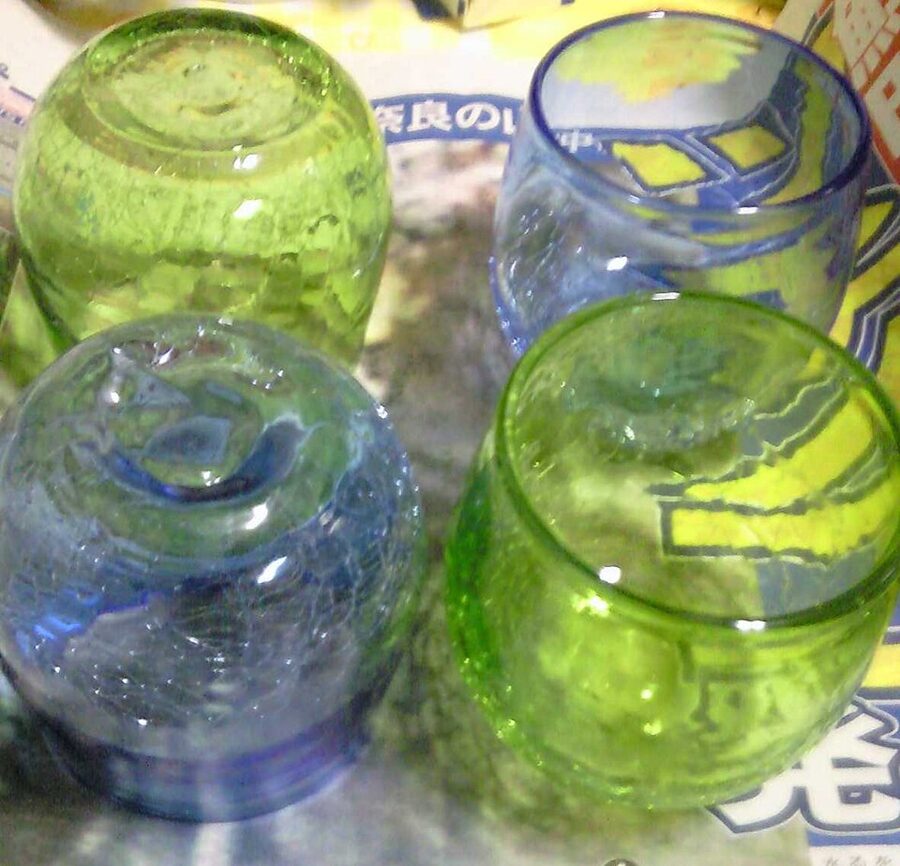

Imports are sold to look local, so buy where you can see the furnace. The largest workshop is the Ryukyu Glass Village in Itoman, open daily 09:30–17:30 with free entry, where you can watch the blowers or book a session at the furnace yourself.
Bingata
Bingata (紅型) is Okinawa’s stencil-dyed cloth, bright yellows, reds, blues and purples on cotton, silk or ramie. The court wore it, and its revival after the war by two dyeing families is one of the islands’ better stories. The name itself is modern: the scholar Yoshitaro Kamakura first used it in 1924, bin for colour in general and kata for pattern.
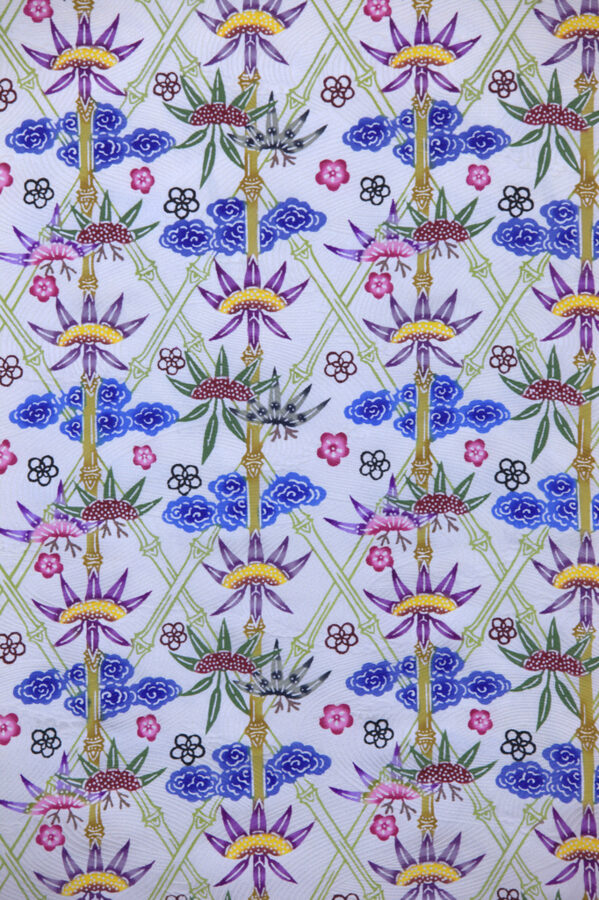

A design is cut into a stencil of persimmon-tanned paper, rice paste is pushed through it to resist the dye, and the colours are brushed on by hand, darker shading last. The old colours came from fukugi bark for yellow, Ryukyu indigo and cochineal; the all-indigo aigata was worn by older people.
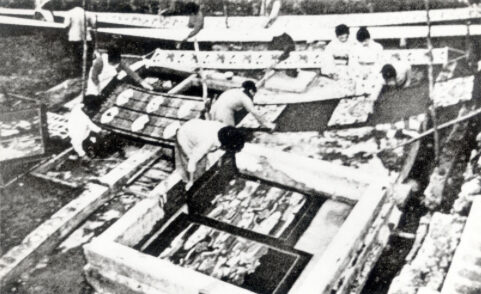
Bingata became a national traditional craft in 1984, and some dyers run short sessions brushing colour through a ready-cut stencil.
Bashofu and Kijoka
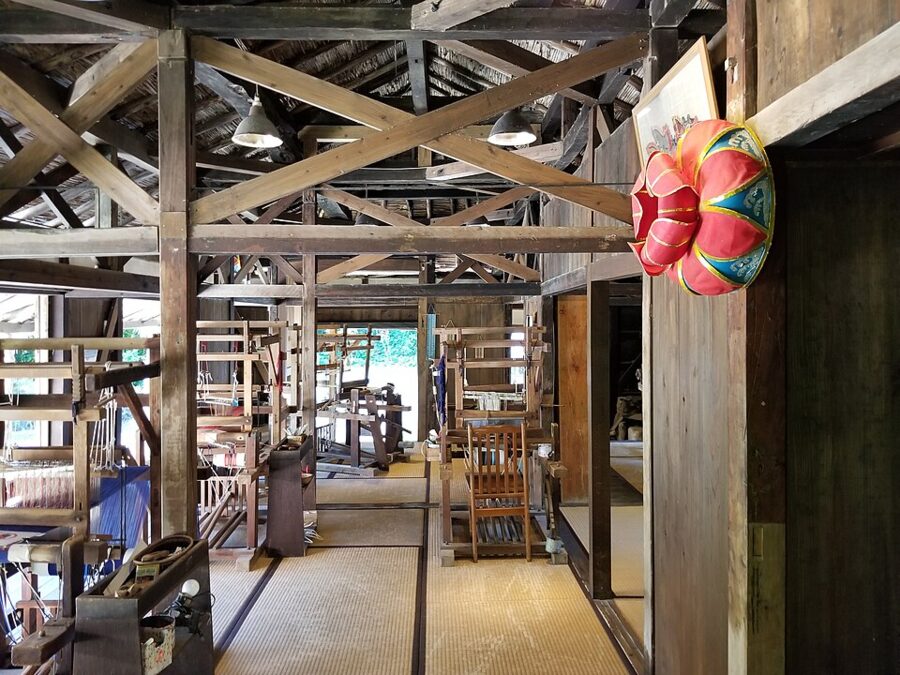
Bashofu (芭蕉布) is woven from the fibre of the thread banana, a plant grown for its stem, not its fruit. The cloth is light, stiff and cool against the skin, which made it the summer fabric of everyone from kings to farmers. Families grew their own plants by the house, and the kingdom kept plantations for tribute cloth.
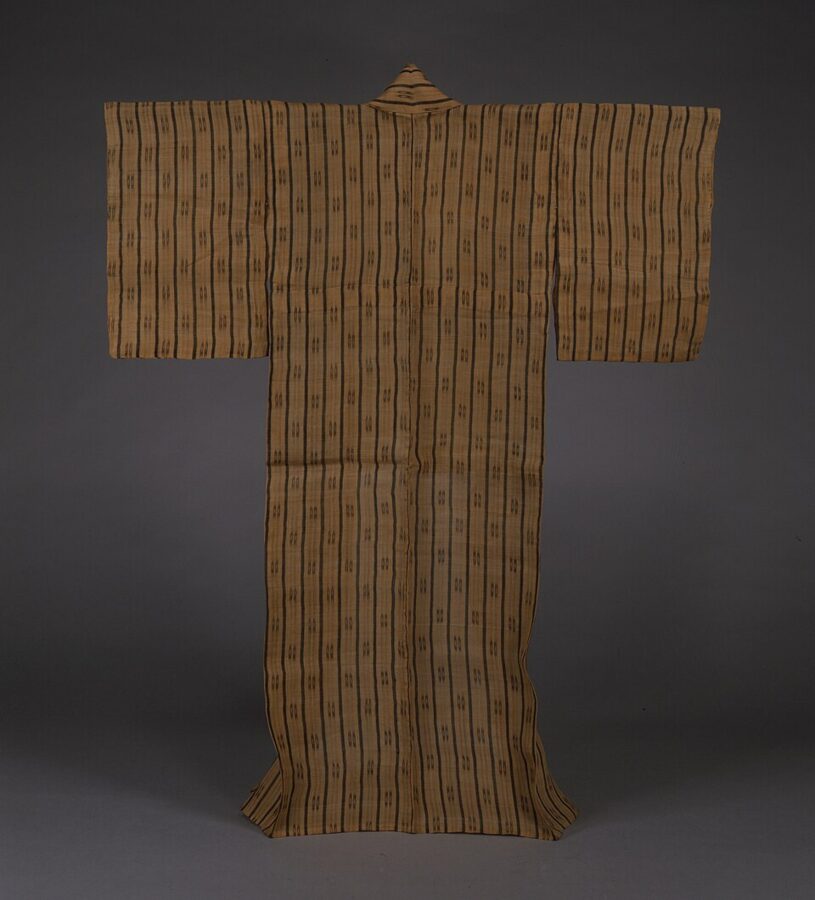

The occupation nearly ended it: the US military cut down banana groves to stop mosquitoes breeding. The cloth came back through Toshiko Taira (1921–2022) of Kijoka, in Ogimi village in the north, who learned weaving in Kurashiki after the war with the backing of the textile magnate Soichiro Ohara and rebuilt bashofu at home from the field up.
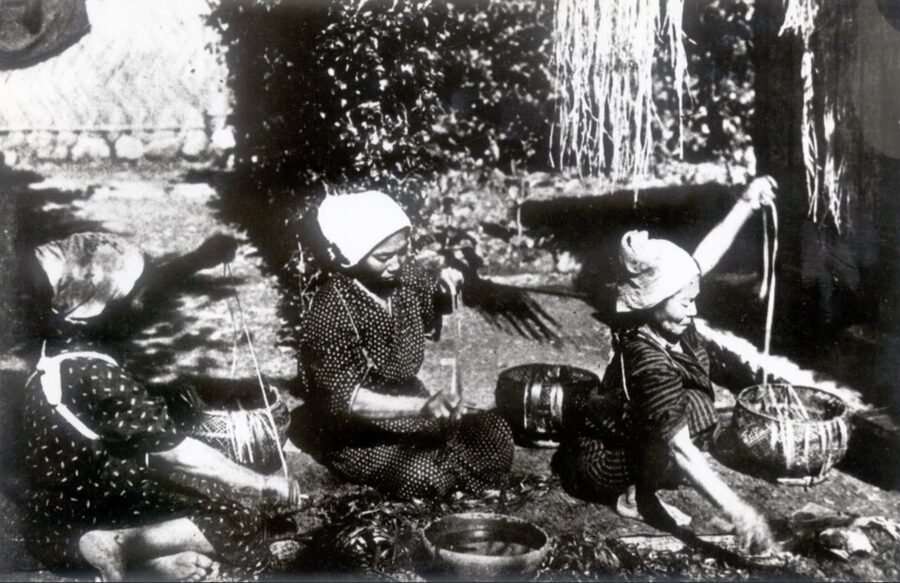
Three-year-old stems are stripped, the fibres sorted from coarse outer layers to fine inner ones, boiled in wood-ash lye, cleaned, knotted end to end into thread by hand, dyed and woven. A kimono length takes months.
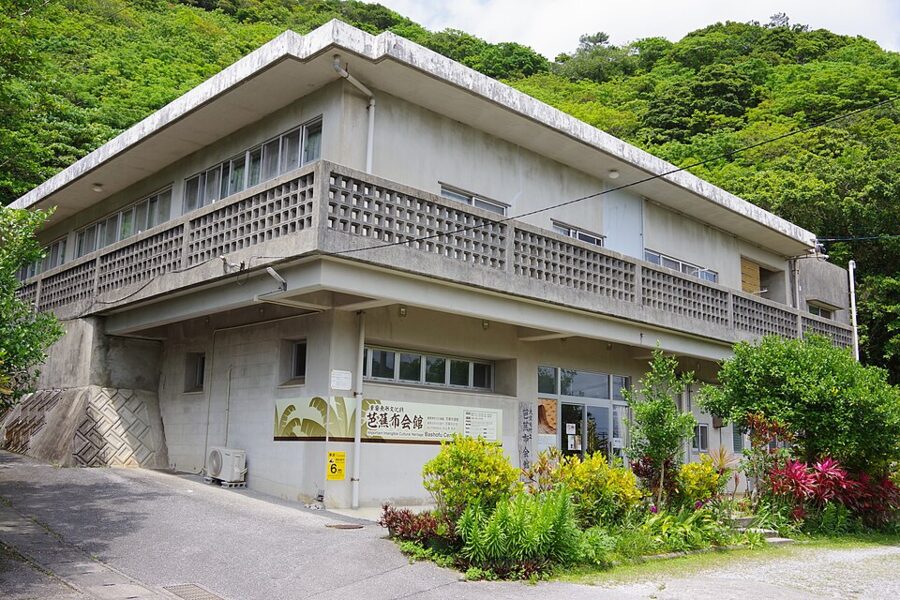
Kijoka’s bashofu became an Important Intangible Cultural Property in 1974, held by the village’s preservation society, and the banana fields behind the old houses explain the cloth better than any display.

Island textiles: Kumejima, Miyako, Yaeyama
Every island group wove for the kingdom, and paid for it. On Kumejima women aged 15 to 45 owed cloth as tax until 1903. Kumejima tsumugi is a silk dyed with island plants and mud, one weaver often doing design, dyeing and weaving herself; it became an Important Intangible Cultural Property in 2004.
Miyako jofu, from Miyakojima, is ramie spun so fine that a bolt takes more than two months to weave; an old saying paired it with Echigo cloth as Japan’s two best linens. It was in the first group of national traditional crafts, in 1975.
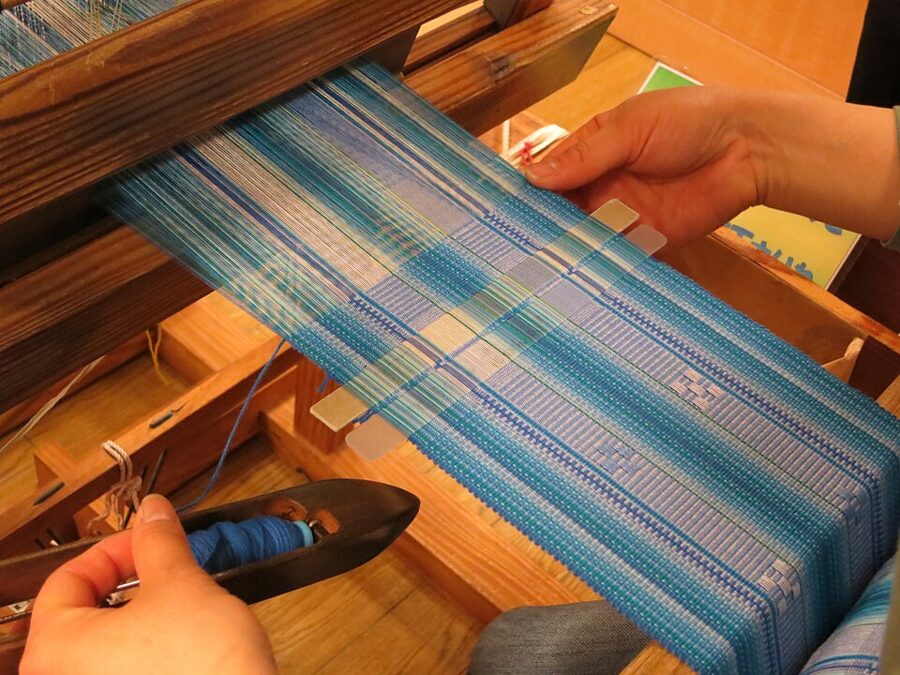

Yaeyama minsa, from Taketomi and Ishigaki, began as a narrow cotton belt a woman wove for a man as her answer to a proposal. Its indigo pattern of five and four squares carried the message, and when the Ishigaki singer Rimi Natsukawa wore a minsa-patterned costume on the 2003 New Year’s Eve song show, the whole country saw it.
Lacquer
Ryukyu lacquer began as a diplomatic gift. Its hallmark today is tsuikin, invented in the eighteenth century by Higa Josho: lacquer mixed with pigment, pressed thin, cut into shapes and laid on in relief, now about four-fifths of all Okinawan lacquer decoration.
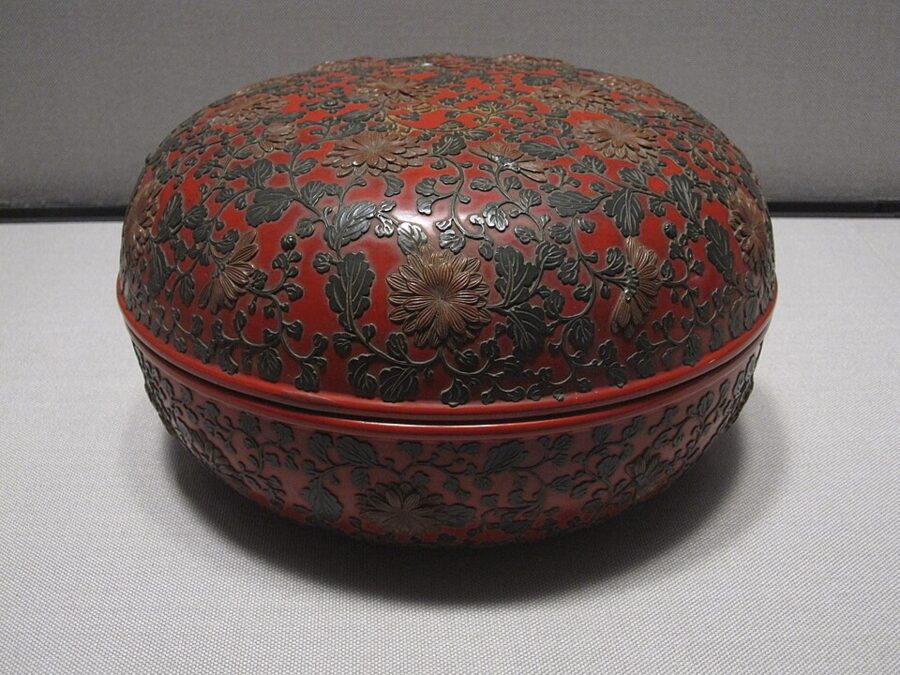

Modern pieces are turned from local woods such as deigo, the coral tree, and workshops in Naha still make trays and bowls meant to be used.
Gods, ancestors and guardians
Okinawan religion has no scripture and few buildings, and most families would not call themselves religious. Look at what they actually do, though, and the islands are among the most observant places in Japan: offerings at the household altar on the first and fifteenth of each lunar month, prayers at the sacred grove, picnics at the family tomb.
Utaki: the sacred groves
An utaki (御嶽) is a sacred place, usually a patch of forest, a spring, a rock or a whole island, where the gods come down or the founding ancestors are honoured. The name was given by the kingdom; Miyako calls them suku, and Yaeyama on or wan. There is usually no building, at most a low stone or an incense burner marking the point where the god descends.
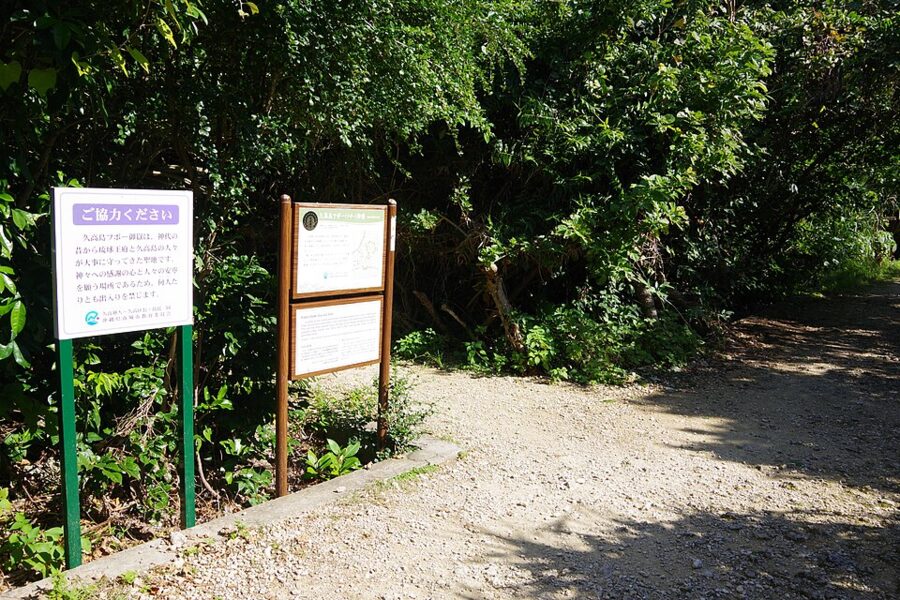

Rites at the utaki are led by women. Many groves still keep men out of their inner parts, and some keep everyone out. The torii gates in front of some groves are not part of the old religion: they were added after 1879, when the state turned groves and castle sites into Shinto shrines.
The rules are simple: stay out of anywhere roped or signed, take nothing, touch no incense burners or offerings, and if people are praying, wait at a distance. Sefa-utaki, the kingdom’s great grove, is open to the public; most village utaki are simply part of the neighbourhood.

Noro and yuta
Two kinds of women look after Okinawan religion. The noro were priestesses appointed by the kingdom to lead each village’s public rites, an office whose history belongs with the court. The yuta are something else: private shamans, consulted by a family when something goes wrong.
A yuta reads an illness or a run of bad luck in the family’s dealings with its ancestors: a misplaced tablet, a neglected tomb, a missed rite. The folklorist Tokutaro Sakurai called noro and yuta the two wheels of one cart. Educated men have long scoffed, yet clients include civil servants and teachers, and an old saying splits a cure half to the doctor, half to the yuta.
Turtleback tombs and Shimi
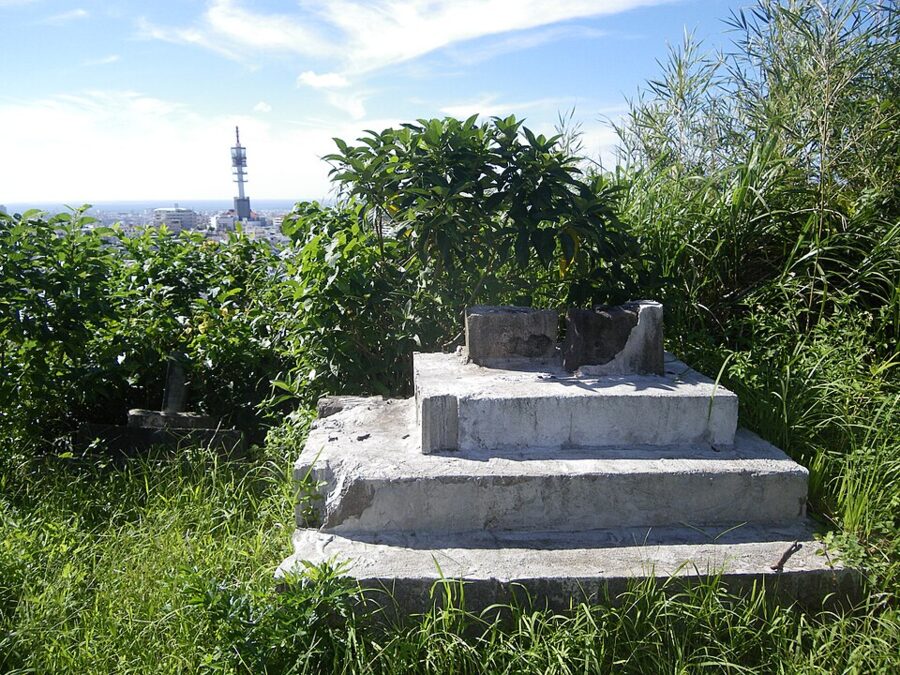
Okinawan tombs are houses for the family dead, and the grandest are kamekobaka (亀甲墓), turtleback tombs: a chamber dug into a slope under a curved roof like a turtle’s shell, with a walled forecourt. The form came from Fujian; only the gentry could build them until 1879, when they spread to everyone.
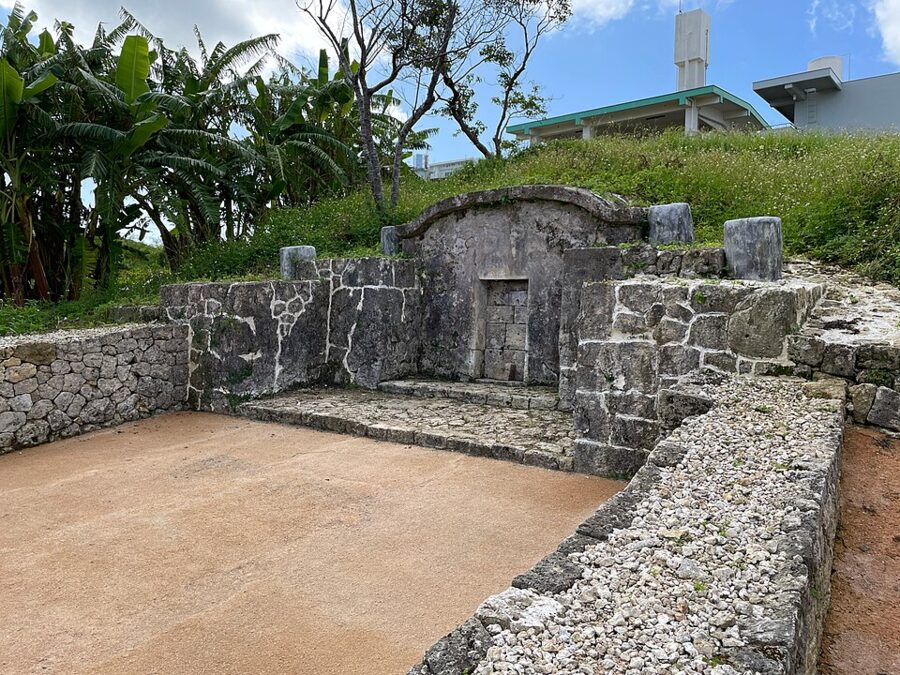

Inside, generations of bones rest in pottery urns. Until cremation took over after the war, the body was left to decay and the bones were later washed, usually by the women of the family. New tombs are smaller but still for the family, rarely for one person.
The forecourt explains Shimi (清明祭), the tomb festival from the Chinese Qingming. In April families in the centre and south of the main island gather at the tomb, sweep it, offer food, awamori and paper money, then eat the food in front of the grave. It looks like a picnic because it is one.
The butsudan and the totome
Every traditional household has a butsudan, an altar holding the totome (トートーメー), the ancestral tablets, which the eldest son inherits with the house. The rules are strict, especially in the south: no tablets passed through a daughter, no two brothers’ tablets on one altar. In 1980 the Ryukyu Shimpo newspaper published a book whose title asks, roughly, what is wrong with a woman inheriting, and families now settle it more freely than the rules allow.
Shisa and ishiganto
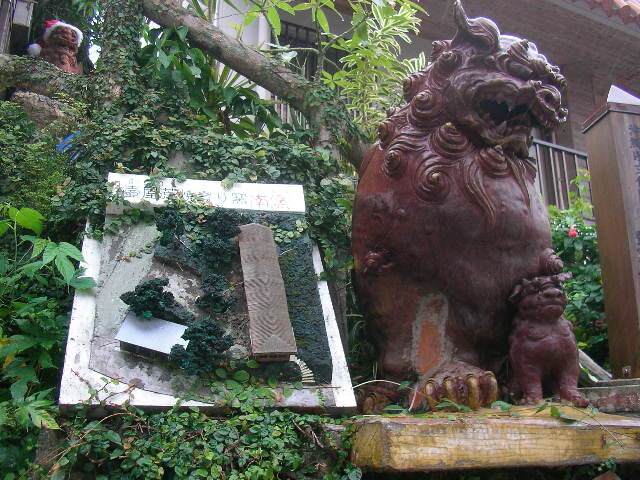
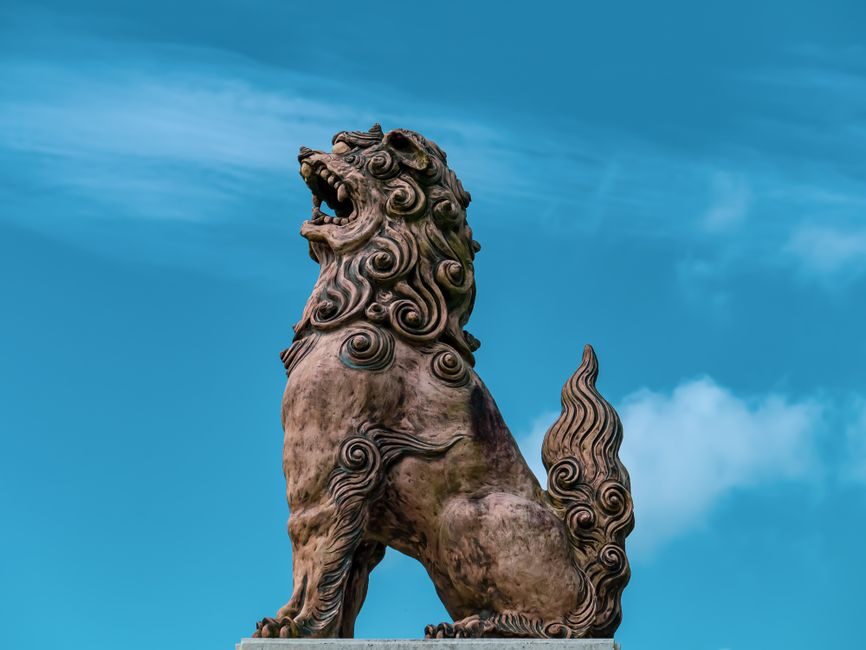
The lion-dog on the roof or gate is a shisa (シーサー), Okinawan for shishi, lion. The first were royal, on tombs at Urasoe and Tamaudun. Village shisa began in 1689, when, the kingdom’s chronicle says, a village plagued by fires was told by a geomancer to set a stone lion facing Yaese-dake, the hill blamed for them; it still sits at Tomimori, in Yaese.
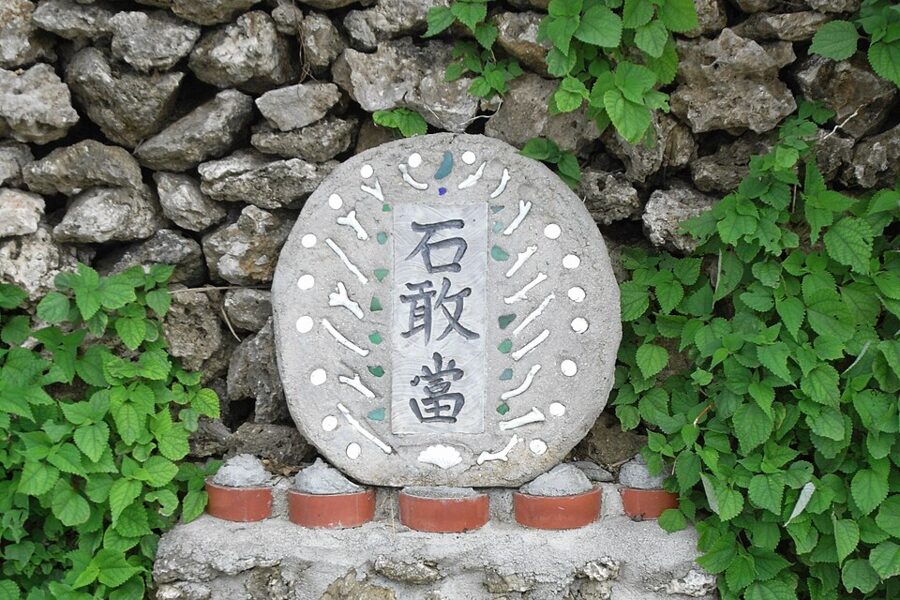
At the end of a T-junction, set into a wall, there is often a small stone carved 石敢當, ishiganto. Evil spirits are believed to travel in straight lines, so a road that runs straight at a house needs a stone to stop them. The custom came from Fujian, and one estimate puts the number on the islands at around 10,000.

Food, long life and awamori
Okinawan cooking is pork, island vegetables, tofu, kelp and seaweed, with more China and Southeast Asia in it than mainland cooking, and since 1945 more America. Older Okinawans call good food nuchi gusui, “medicine for life”.
The everyday table
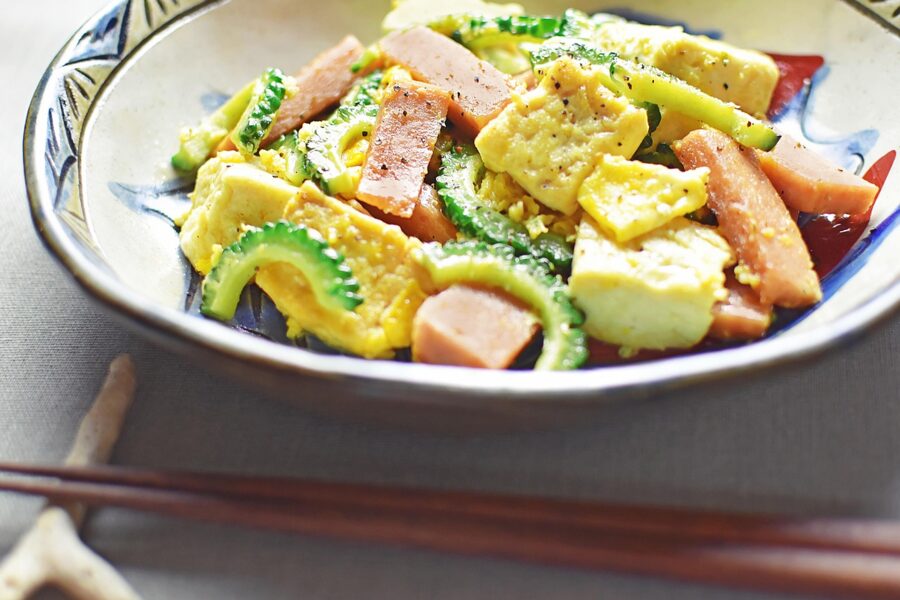
Champuru means a mixture, and the stir-fries of that name combine firm island tofu, egg and pork or canned luncheon meat with one main vegetable: goya, bitter melon, in the best known, but also wheat gluten, bean sprouts or thin somen noodles. Umibudo, “sea grapes”, a seaweed farmed in tanks along the coast, is eaten raw with a vinegar dip and pops in the mouth. Okinawa soba, which contains no buckwheat, and rafute, pork belly braised in awamori, are the other two dishes everyone orders.
Almost every part of the pig is used: mimigaa, sliced ear with peanut dressing, and tebichi, trotters stewed until soft. In the kingdom’s time pork was festival food.
The long-life story, and what happened to it
For decades Okinawa was where people lived longest. Okinawan women topped every prefectural life table from 1975 to 2005, and the prefecture led for centenarians per head from 1973 to 2009. The diet got the credit: sweet potato, vegetables and seaweed, little salt, and hara hachi bu, stopping when eight-tenths full.
Then the numbers turned. In the 2000 tables Okinawan men dropped from fourth to 26th, the “26 shock”, and in the 2020 tables they were 43rd of 47 at 80.73 years; women had fallen to 16th at 87.88. Doctors point at drinking, smoking, obesity and diabetes in middle age, and a diet that changed faster under American rule than anywhere else in Japan.
The twist is in the same tables: an Okinawan woman of 75 can still expect to outlive women of that age anywhere else in Japan. The generation raised on the old diet still leads; the ones after it do not.
Awamori and kusu
Awamori (泡盛) is the islands’ spirit, distilled once from long-grain rice with a black koji mould, a method that came from Siam in the fifteenth century. Aged three years or more it becomes kusu, old spirit, and families used to keep jars of it for decades, topping up the oldest from the next oldest.
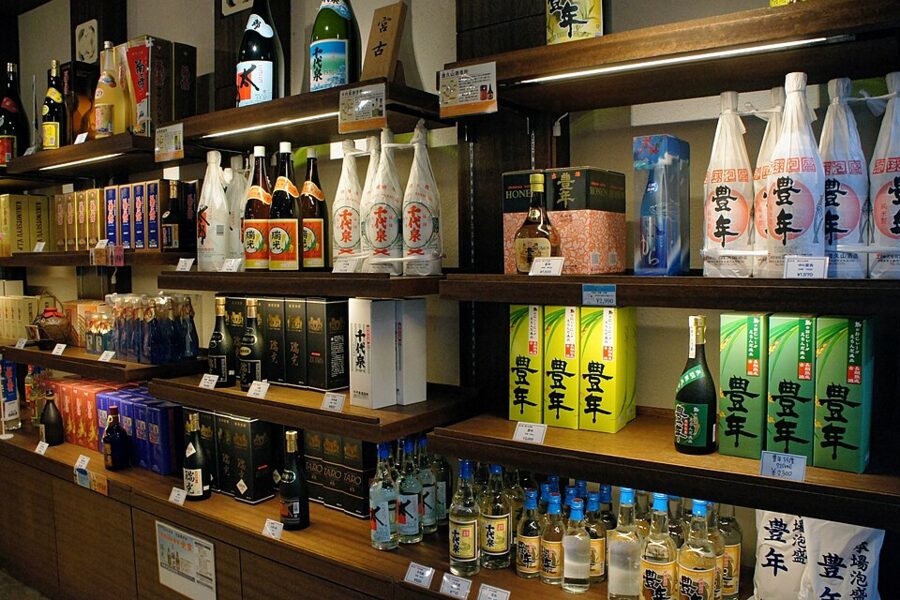

The war destroyed most old kusu and most koji strains, which makes one bottle worth knowing. Zuisen, a Shuri distillery, makes Usaki from a pre-war black koji kept at the University of Tokyo and revived decades later, the nearest thing to the old Shuri spirit.
Where to eat
The best Okinawan food is in the plainest places: a shokudo, a neighbourhood diner with a long menu on the wall, of which the arcades around Naha’s First Makishi Public Market are full. Roadside farmers’ markets sell island vegetables, sea grapes and sata andagi doughnuts, and show what Okinawans actually buy.
Where to see it
Most of this can be seen around Naha in two or three days, with one long day north for Yomitan, Onna and Kijoka. The castles and sacred sites of the kingdom are a separate trip, and one of Japan’s UNESCO World Heritage sites. With one day, I’d spend the morning at the Okinawa Prefectural Museum and Art Museum in Omoromachi, which has the best craft collection and a frank account of the islands’ history, walk Tsuboya in the afternoon and end at a folk-song bar.

- Okinawa Prefectural Museum and Art Museum, Naha: the kingdom, the crafts, the war and the occupation under one roof; closed on Mondays.
- Tsuboya, Naha: the Tsuboya Pottery Museum and Yachimun-dori, a short walk from Makishi monorail station.
- Ryukyu Mura, Onna: an open-air museum opened in 1982 with old houses moved from around the island, daily eisa shows, a street parade, music and craft sessions. It opens every day; adults pay ¥2,000, high-school students ¥1,500 and children aged 6–15 ¥800. Okinawa Bus and Ryukyu Bus routes to Nago stop at Ryukyu Mura-mae, about an hour from Naha.
- National Theatre Okinawa, Urasoe: the home of kumiodori, the court dance-drama inscribed by UNESCO in 2010, and of classical Ryukyuan dance.
- Okinawa Karate Kaikan, Tomigusuku: the exhibition and the experience programme, closed on Wednesdays.
- Yachimun no Sato, Yomitan: climbing kilns and potters’ workshops on a hillside.
- Ryukyu Glass Village, Itoman: glassblowing to watch and to try.
- Kijoka, Ogimi: bashofu and the banana fields, a two-hour drive north of Naha.
Ryukyu Mura is a theme park as well as a museum, and I’d not choose it over a real village festival. Out of season, though, it is the one place sure to give you eisa, a sanshin and the old village houses before lunch.
Festivals through the year
Many festivals follow the lunar calendar, so their dates move every year; check the current year’s dates with the town or the organiser.

| When | What | Where |
|---|---|---|
| 4 March | Sanshin Day: players across the islands strike up the same classical piece on the hour from noon | Everywhere, led by RBC radio |
| April | Shimi, the family tomb festival | Central and southern main island |
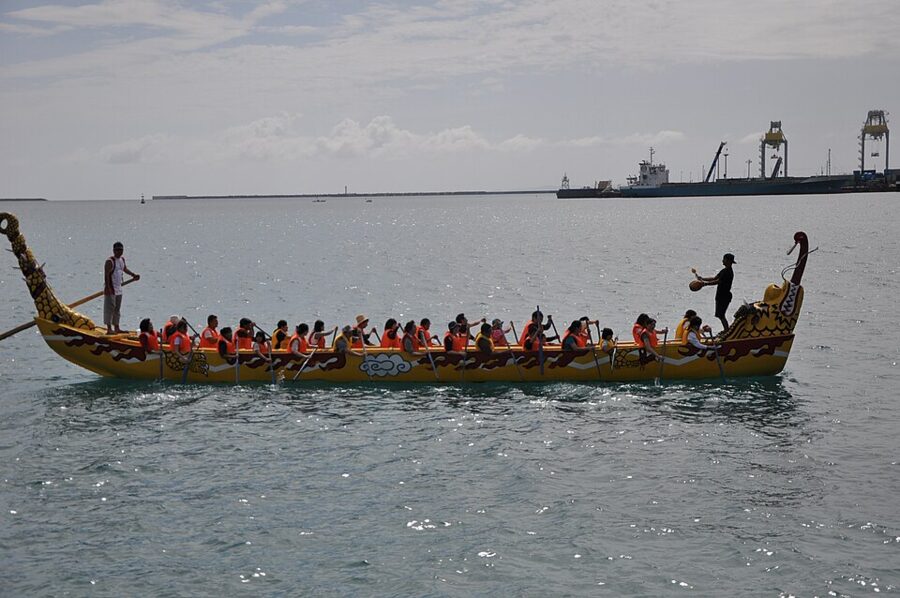
| Early May | Naha Hari dragon boat races | Naha port |
| 5th lunar month | Itoman Haare and other village boat races | Fishing towns |
| 23 June | Irei no Hi, the memorial day for the Battle of Okinawa | Mabuni, Itoman, and everywhere |
| Obon (August or early September) | Eisa in every district | Main island |
| First weekend after Obon | All-Island Eisa Festival | Okinawa City |
| 9th lunar month | Paantu, the mud-covered visiting gods | Shimajiri, Miyakojima |
| October | Naha Great Tug-of-War; Karate Day on 25 October | Naha |
| Autumn | Tanadui, the seed-sowing festival | Taketomi |
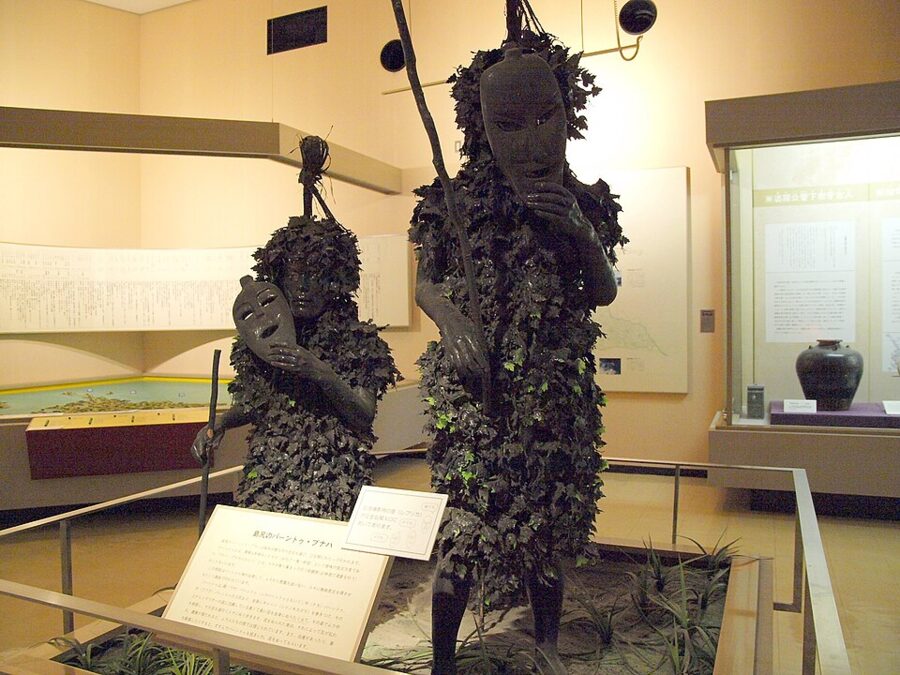
Two are worth planning a trip around. The All-Island Eisa Festival needs a hotel booked months ahead. Paantu is the opposite of a show: in Shimajiri, on Miyakojima, masked men covered in mud and vines come out of a sacred well and smear mud on houses, people and new cars to drive out bad luck. UNESCO inscribed it in 2018; wear clothes you will not want back.

Then go back to the bar in Naha on your last night. When the fast song starts and the room gets up, you will know the shout about the ship from China, the snake on the sanshin and the stirring in the word kachashi. Put your hands up and turn your wrists, fists if you like, open fingers if you prefer. Nobody minds which.