
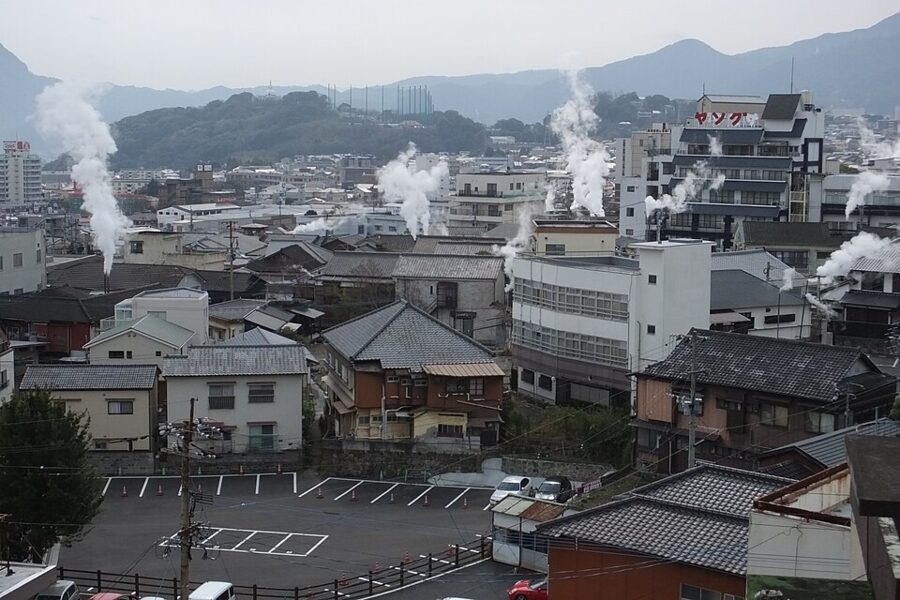

Come into Beppu by sea in the early morning and the first thing you see of the city is steam. It stands up in white columns all over the slope behind the port, dozens of them, leaning with the wind off the bay, some thin as a thread, a few thick enough to hide the house they come from. The mountain behind them is a volcano, and the steam is the reason anyone built a city here at all.
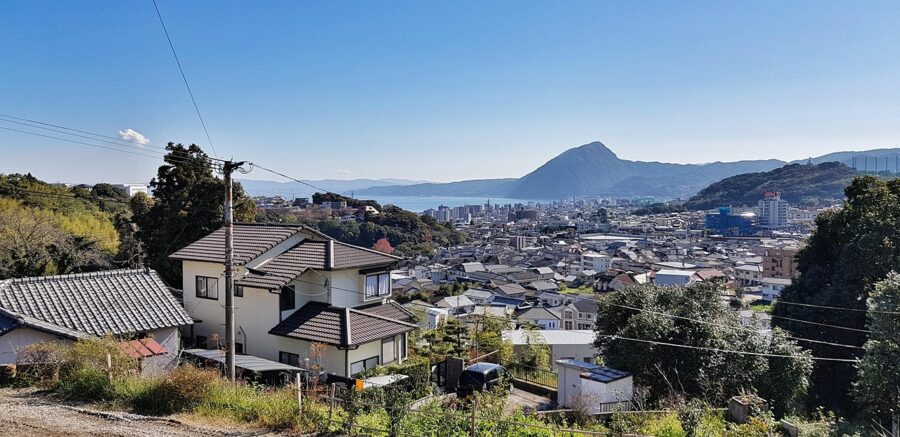
Beppu (別府) sits on the east coast of Oita Prefecture (大分県), in the north-east corner of Kyushu. Its hot water is not an amenity laid on for guests. It comes out of the ground in back gardens and car parks, runs in channels beside the road, heats houses, cooks supper and fills the neighbourhood baths that residents use the way people elsewhere use a corner shop.
Most people give it one afternoon: the hells, a photograph of the blue pond, the bus back to the station. I think that is the wrong way round. The hells are for looking at; the rest of the city is for getting into, and it rewards a night or two, a pocket of coins and a willingness to sit in very hot water with strangers.


In this guide
Why the water comes up here
Look inland from the seafront and the city climbs a broad fan of volcanic gravel to a ridge of lava domes about five kilometres long. Its southern end is Tsurumi-dake (鶴見岳), 1,375 metres; its northern end is Garan-dake (伽藍岳), 1,045 metres, also called Io-yama, sulphur mountain. The Japan Meteorological Agency watches the two as a single active volcano.
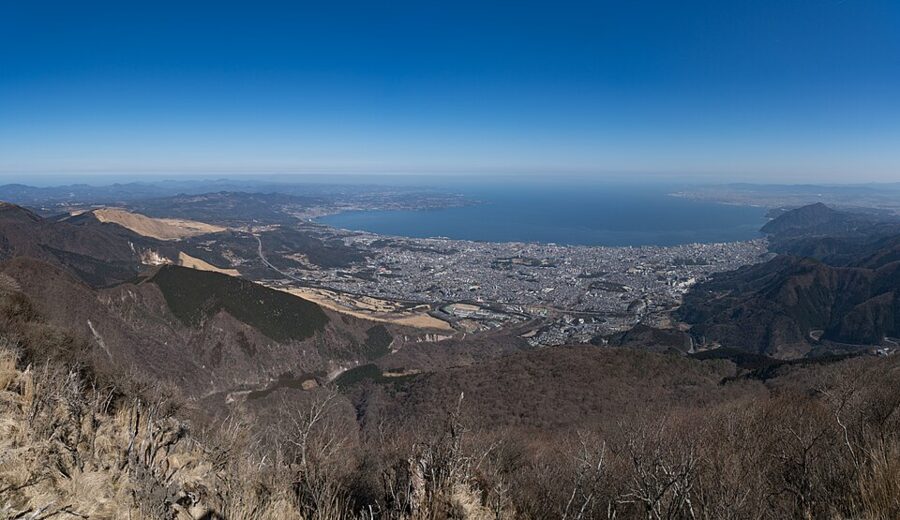
Rain falls on the mountains, soaks down through fractured rock and meets heat rising from magma several kilometres below. It comes back up along two large faults that cut the fan, gathering minerals on the way, and emerges anywhere from the hillside at 400 metres to the beach. The whole strip from Beppu Bay through Kuju and Aso to the Shimabara peninsula is a sinking rift, and its volcanoes have been heating water under this coast for tens of thousands of years.
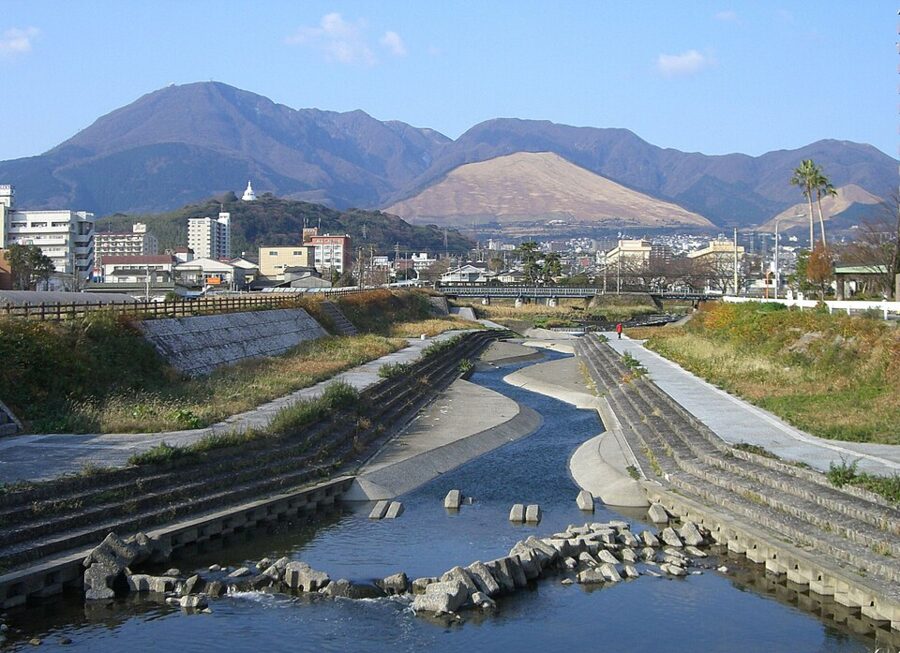

The numbers are hard to take in. At the end of March 2025 the city counted 2,831 hot-spring sources with a combined flow of 101,856 litres a minute, enough to fill an Olympic pool about every 25 minutes. Only Oita Prefecture as a whole counts more sources than this one city; Kagoshima, second in the national table, recorded 2,735. Of the ten classes of spring water posted on Japanese bathhouse walls, seven come out of the ground somewhere in Beppu.
It was not always so many. In 1876 every source in Beppu flowed of its own accord. Around 1880 well-diggers brought in kazusa-bori, a bamboo-rod drilling method from the Chiba peninsula, and by 1911 drilled wells outnumbered natural springs 76 to 17. The tools of the trade, known locally as yutsuki, “hot-water poking”, were registered as a folk cultural property in 2020.
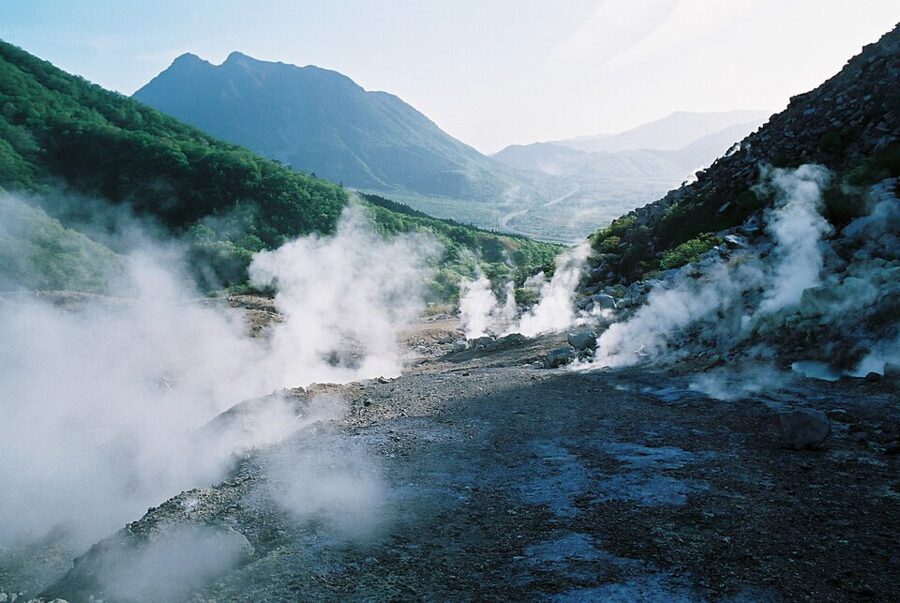

Living on an active volcano
Tsurumi-Garan sits at alert level 1 on the agency’s five-step scale, which means “remember this is an active volcano”. It is not a formality: a burst of earthquakes raised it to level 2, closing the ground near the vents, from 8 to 27 July 2022. Check the current level before you walk on the mountain.
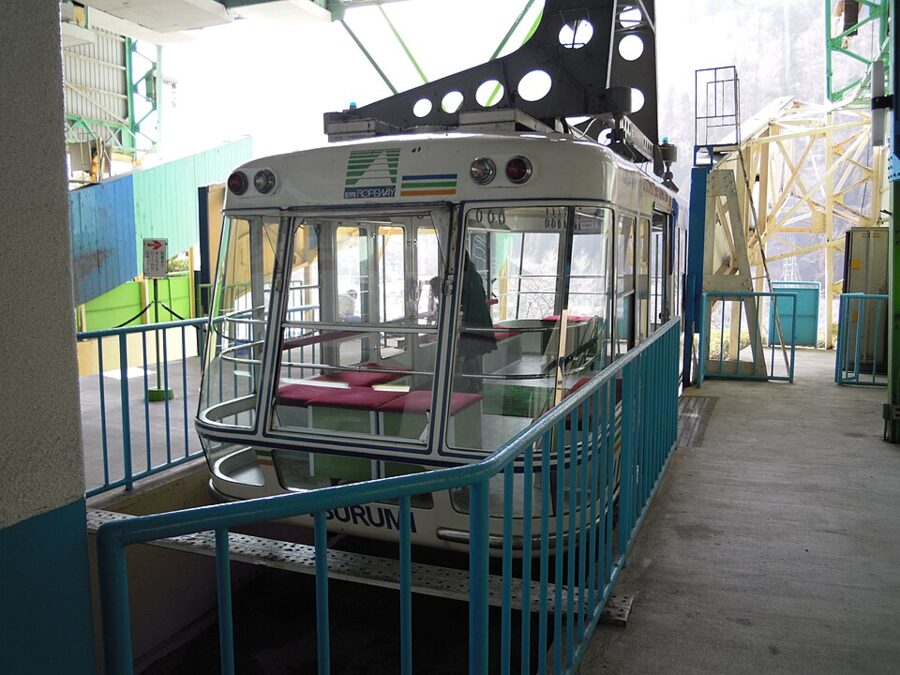
The easy way up is the Beppu Ropeway, running since 1962 from a station at 503 metres to one at about 1,300 metres in about ten minutes, with the summit a fifteen-minute walk beyond. On a clear day you can see Shikoku; in winter the trees turn white with rime ice.


Beppu Hatto: eight towns, eight waters
Beppu is a set of hot-spring villages that grew into each other. The usual count is eight, the Beppu Hatto (別府八湯), a name newer than it sounds: a local tourism study group proclaimed the “independence” of the eight at 8:08 and 8 seconds on 8 August 1996, and the stunt stuck. Until the Taisho era people spoke of ten, counting Yufuin and Tsukahara over the mountains.
Each district has its own water and character, and moving between them is the real pleasure of the place. Roughly from south to north:
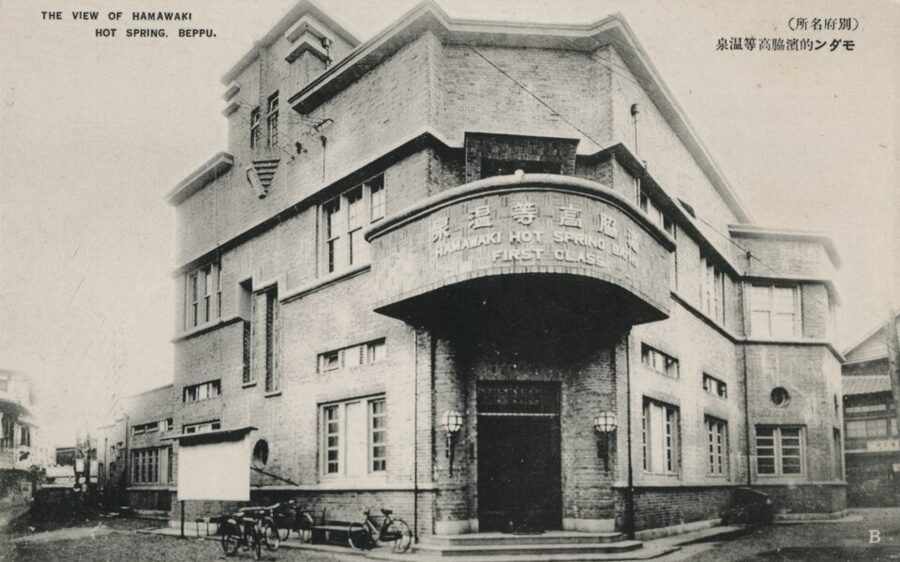
- Hamawaki, at the mouth of the Asami River, prospered early, and an 1817 ranking of the nation’s spas placed it above Beppu itself. Today it is quiet streets around municipal baths.
- Beppu, the old harbour district around the station and Kitahama, has the most varied water and the nightlife; Takegawara is here.
- Kankaiji, on the slope above, has no municipal bath and is given over to big hotels with bay views.
- Horita, higher up near the expressway, is an old mountain spa of sulphur water that also supplies baths elsewhere in the city.
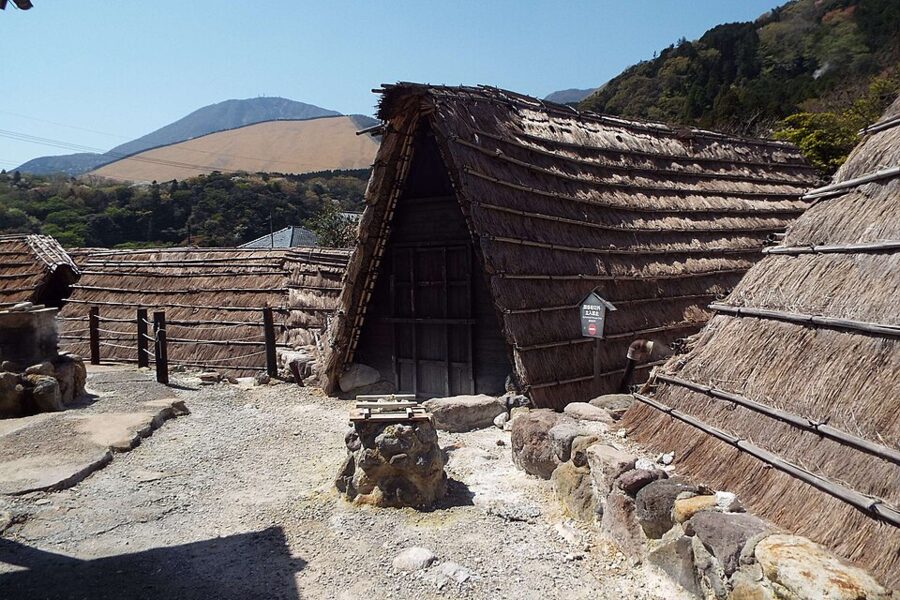
- Myoban, at about 400 metres on the flank of Garan, smells of sulphur and is dotted with thatched huts.
- Kannawa has the most steam, five of the seven hells and the old long-stay inns.
- Shibaseki, in a valley to the north, claims visits by emperors in 895 and 1044 and has the other two hells.
- Kamegawa, on the northern coast, grew around a navy hospital opened in the 1920s and has a sand bath on the beach.
The water changes as you climb. By the sea it is mostly clear and salty or soda-rich; around Kannawa salty and very hot; at Myoban and Horita milky with sulphur and sharp with acid. Myoban’s vents also leave alum, myoban in Japanese, which gave the district its name.
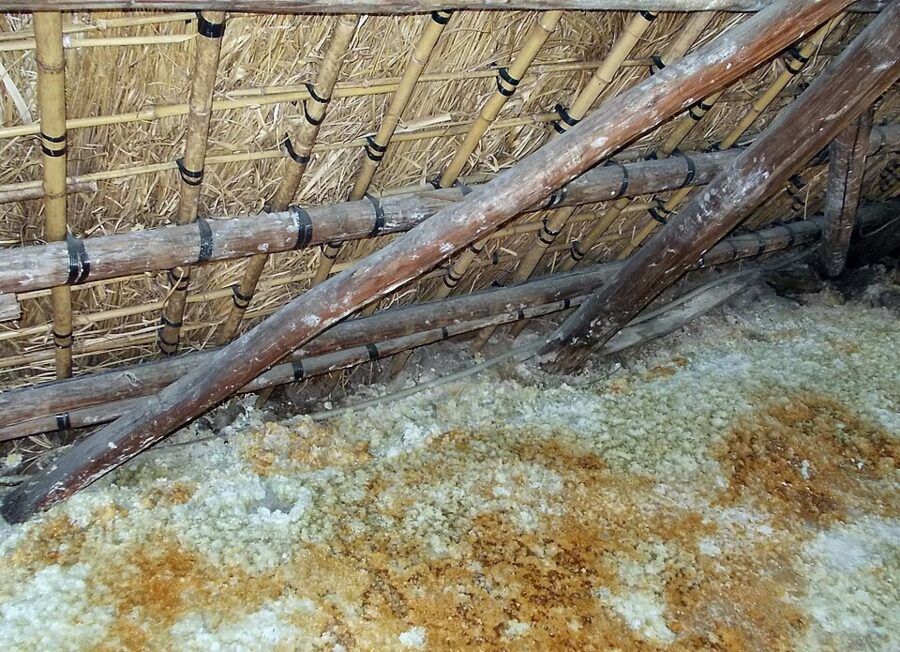
From 1725 the Wakiya family made alum here on a scale that, with the neighbouring village, supplied about 70 per cent of Japan’s needs under a shogunate monopoly. The method survives as yunohana, “hot-water flowers”: blue clay is spread on the floor of a straw hut over a fumarole, and the acid steam draws iron and aluminium out of it as needle crystals. It became an Important Intangible Folk Cultural Property in 2006.

The hells
The word jigoku (地獄), hell, was already in use for Beppu’s boiling pools when the scholar Kaibara Ekiken passed through in 1694 and wrote it down. In 1910 Umi Jigoku put up a fence and started charging admission, and over the next two decades a dozen or more hells opened, some drilled on purpose to make a show. So many wells went down so close together that older springs began to fail, and new development was stopped by the end of the 1920s.
Seven survive as members of the Beppu Jigoku association, five in Kannawa and two in Shibaseki, and together they make the jigoku meguri, the hell tour. Umi, Shiraike, Chinoike and Tatsumaki were designated a national Place of Scenic Beauty in 2009. None of them is for bathing.
The five in Kannawa
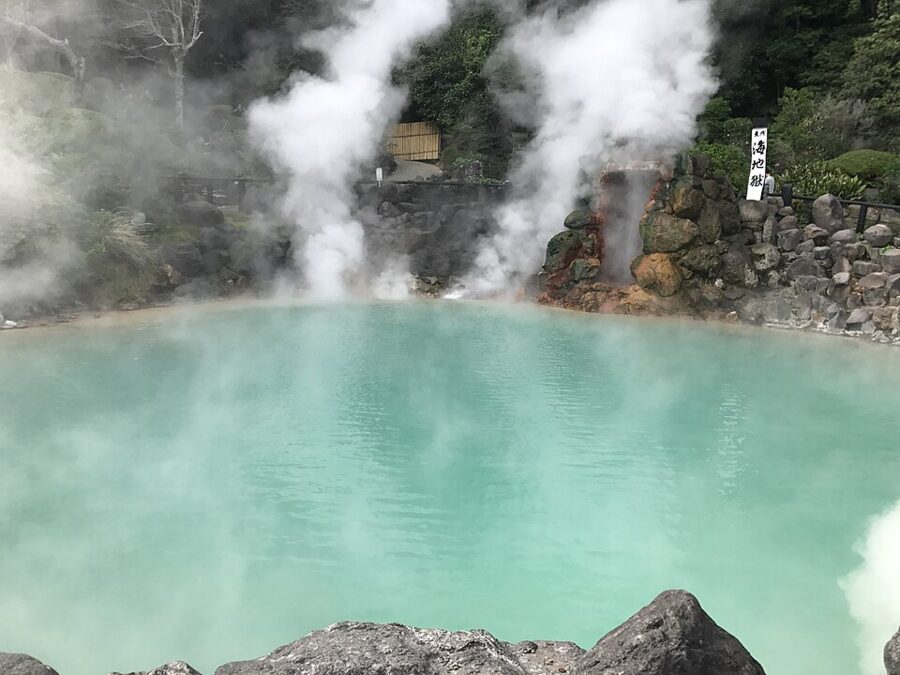
Umi Jigoku (海地獄), the Sea Hell, is the big one, cobalt-blue water at about 98°C said to have formed in an eruption of Tsurumi about 1,200 years ago; the colour comes from dissolved iron sulphate. Eggs boiled in bamboo baskets in the pond are the house speciality, and a greenhouse beside it grows giant Amazon water lilies on spring-warmed water.
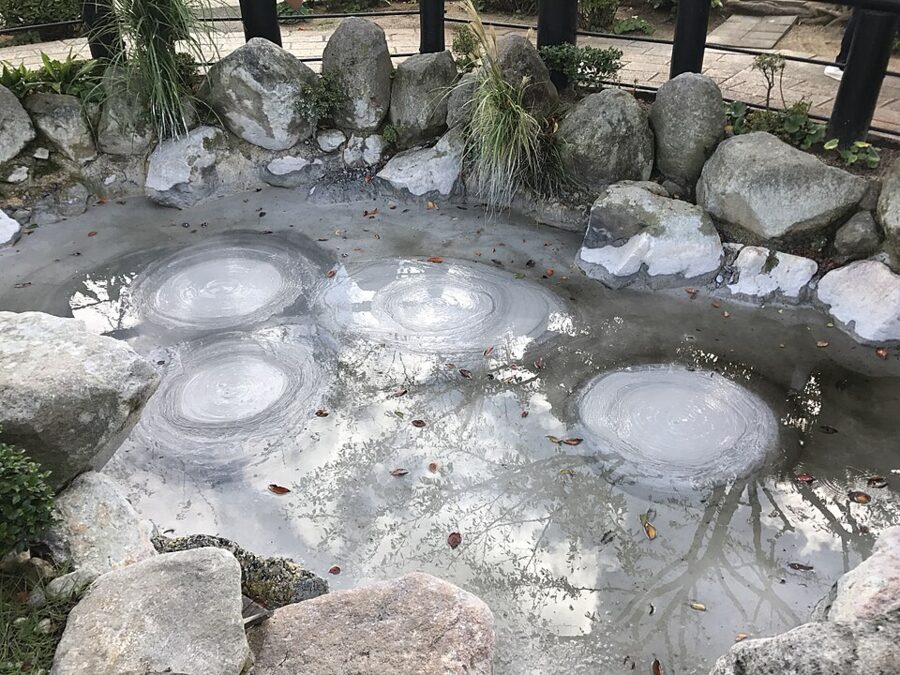
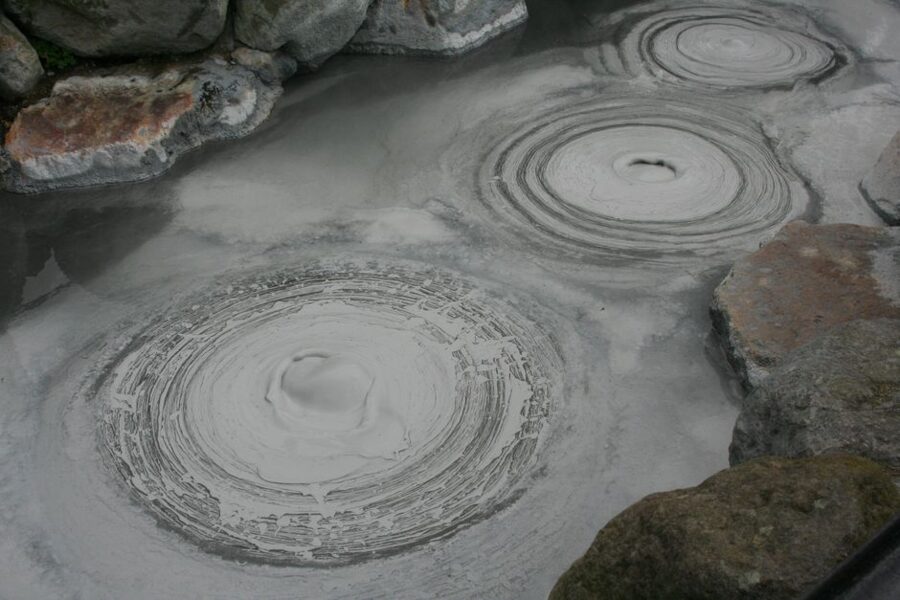
Oniishibozu Jigoku (鬼石坊主地獄), a few steps up the road, is grey mud that swells into smooth domes and pops, which someone decided looked like the shaved heads of monks, bozu. It reopened in 2002 after about 40 years closed and has a good foot bath at the back.

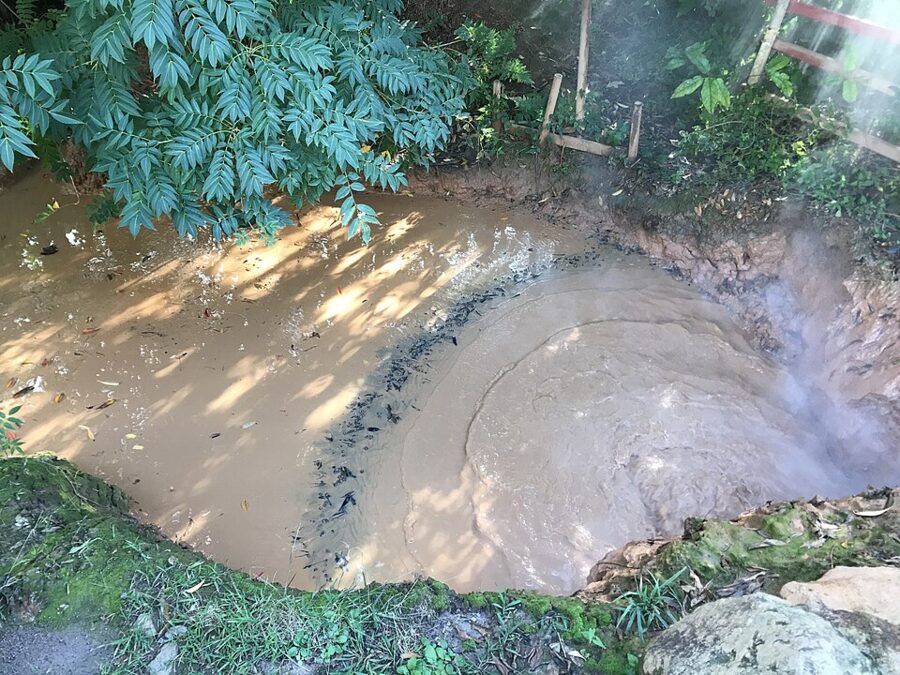
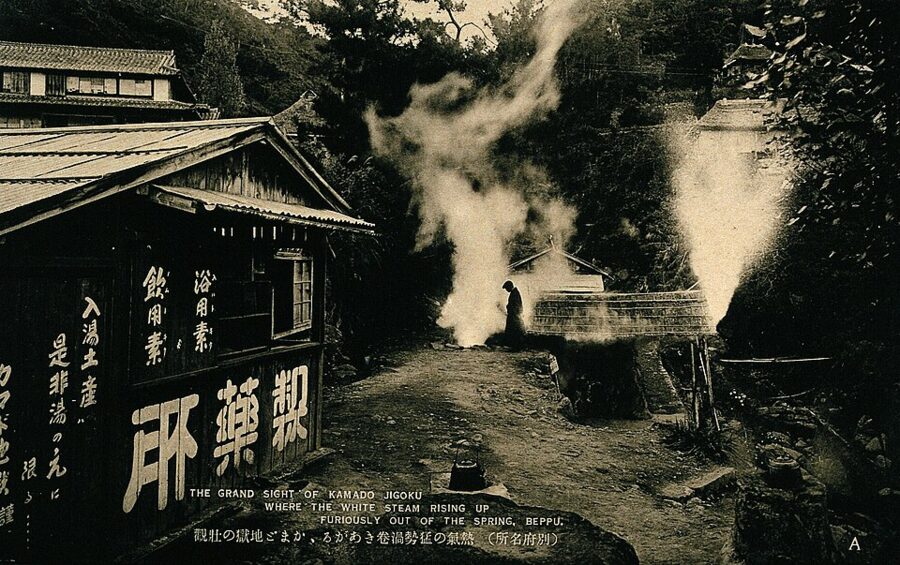
Kamado Jigoku (かまど地獄), the Cauldron Hell, is a digest of the others: six pools numbered like city blocks, from blue water to boiling red mud. Its name comes from rice once steamed over its vents for the festival of the Hachiman Kamado shrine. It has moved: the original near Shibaseki dried up and the name came to the present site in Kannawa, in 1936 by one account and about 1947 by another.


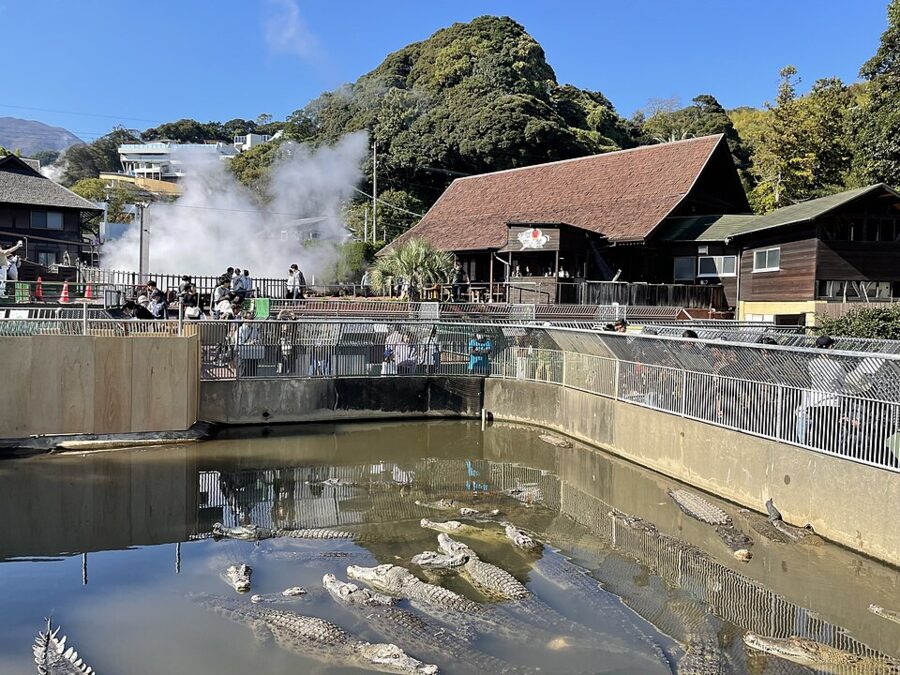
Oniyama Jigoku (鬼山地獄) is better known as the crocodile hell. It began raising crocodiles on the heat of its spring in 1923 and keeps about a hundred in concrete pens; a stuffed crocodile called Ichiro, which lived here from 1925 to 1996, is on show. If animals kept in concrete trouble you, this is the stop to skip.

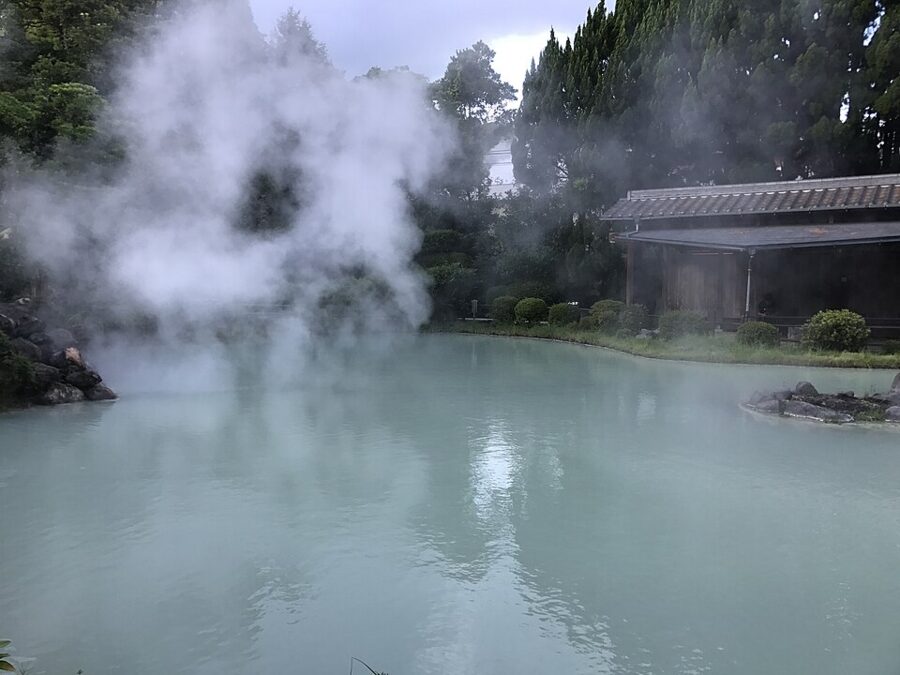
Shiraike Jigoku (白池地獄), the White Pond Hell, comes out of the ground clear and turns milky as it cools and loses pressure. It burst out in 1931 and is the calmest of the seven, a Japanese garden with a stone pagoda in the Kunisaki style and a small tropical-fish house heated by the spring.

The two in Shibaseki
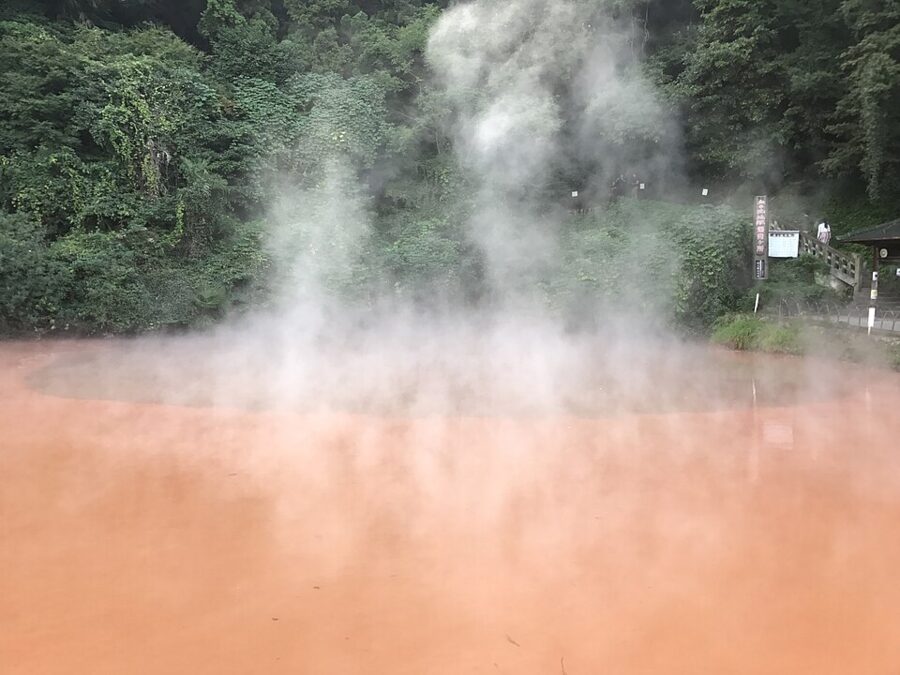
Chinoike Jigoku (血の池地獄), the Blood Pond Hell, is the oldest on record: the eighth-century gazetteer of Bungo Province and the poetry anthology Man’yoshu both mention a red hot spring here. Iron oxide colours the water orange-red, and it puts out about 1,800 kilolitres a day. In 1927 it exploded, throwing mud, by one account, some 220 metres into the air.

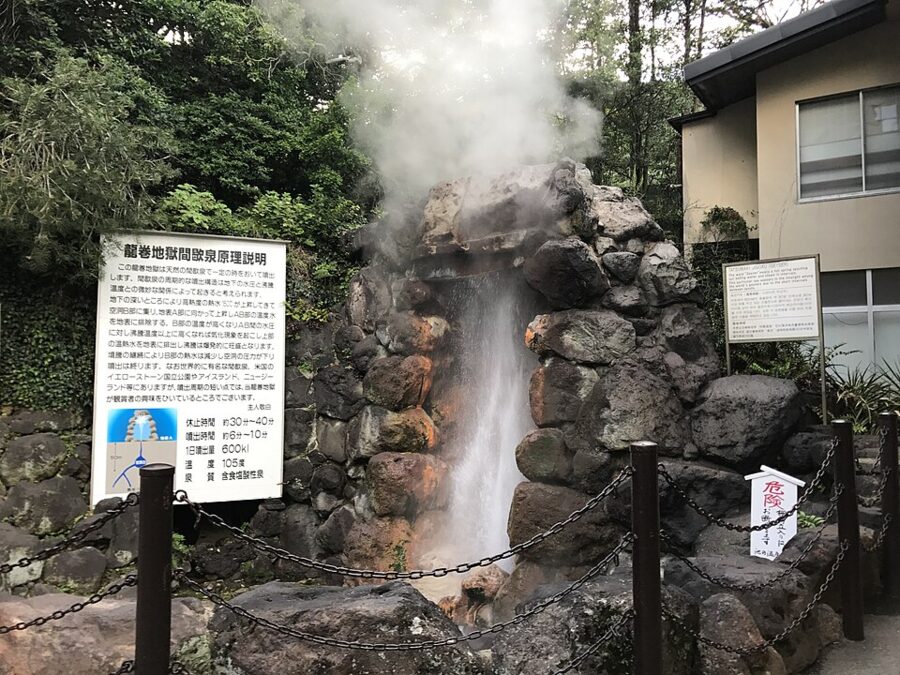
Tatsumaki Jigoku (龍巻地獄), next door, is a geyser. Water heated to about 150°C underground flashes to steam as it rises and erupts every 30 to 40 minutes; a stone roof stops it at a few metres, though the operators say it has the force to reach about 30. A red lamp above the entrance lights when an eruption is near. Recent seasons have brought longer waits and shorter eruptions, so if it has just finished, buy a drink and sit down.

Tickets, time and the old tour bus
Every hell sells the combined ticket, ¥2,400 for adults and ¥1,200 for children in late 2026, valid on the day of purchase and the next, one entry per hell. All seven open 08:00–17:00 every day. Allow half a day at an easy pace; Shibaseki is a short bus ride north of the Kannawa five.
My advice: be at Umi Jigoku at 08:00, before the coaches, see Oniishibozu, Kamado and Shiraike, take the bus to Chinoike and Tatsumaki, and be done by lunch. If you want to cut, drop Oniyama, then Kamado. Umi, Chinoike and Tatsumaki are the three that justify the trip.
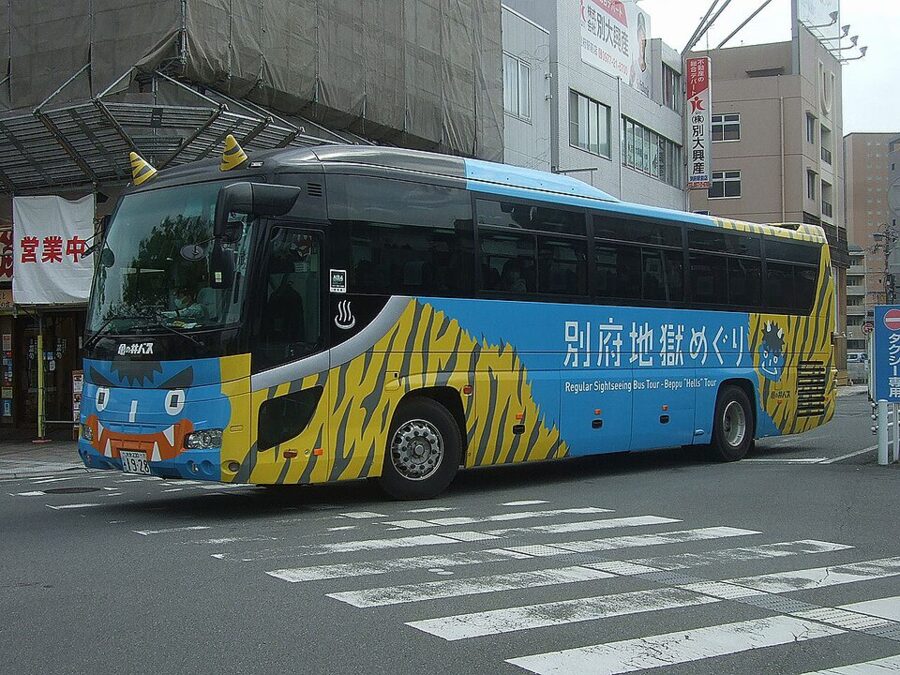
There is another way round. In January 1928 the hotelier Aburaya Kumahachi started a sightseeing bus on the circuit with young women as guides reciting the commentary in seven-and-five-syllable verse, the first women bus guides in Japan. His company, Kamenoi Bus, still runs it: about three hours, morning and early-afternoon departures from Kitahama and Beppu Station, ¥4,500 for adults with admission included. One surviving line goes roughly “Next, with a name both rare and strange, the sea hell in the mountains.”

How to bathe in Beppu
This is the part the day-trippers miss. Beppu has hundreds of baths, from grand public bathhouses to a tiled room under a block of flats, and most cost less than a coffee.
Takegawara and the sand bath
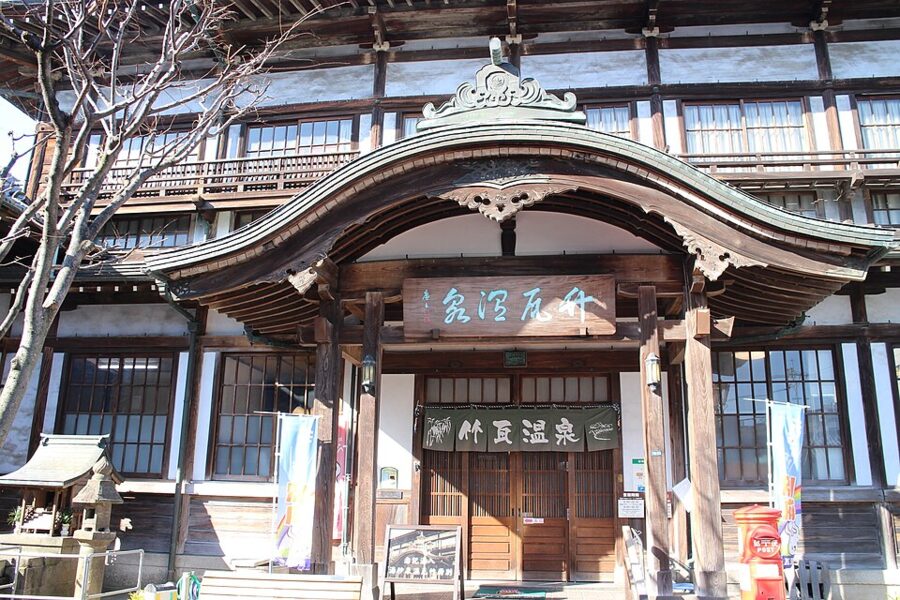
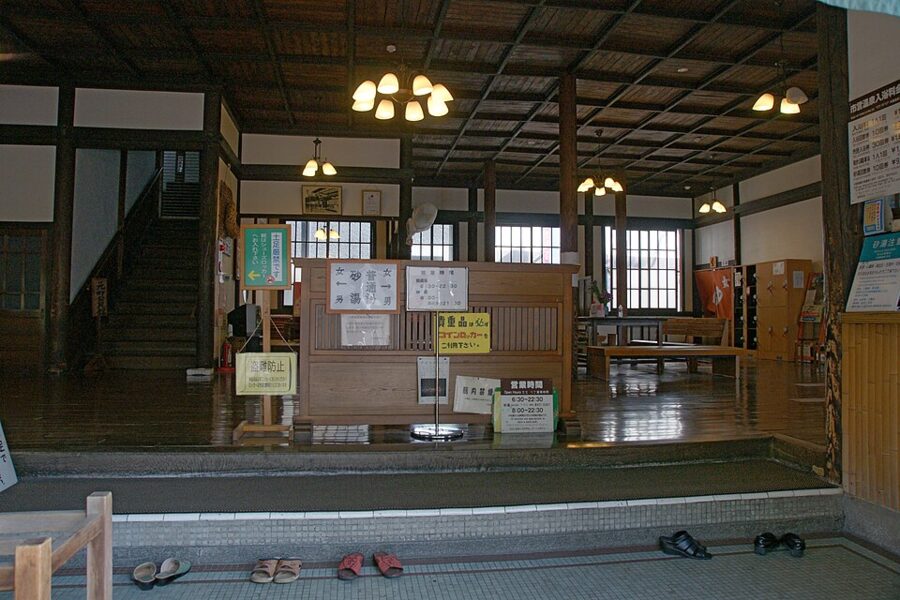
Start at Takegawara Onsen (竹瓦温泉), the city-run bath in the old harbour quarter, its 1938 building a registered tangible cultural property. Inside, changing area and bath share one room: you undress at the lockers and walk down a few steps to a tub sunk into the floor. There are no washing taps, so you scoop water from the tub with a basin; the cold tap is only for cooling a bath that is often very hot.

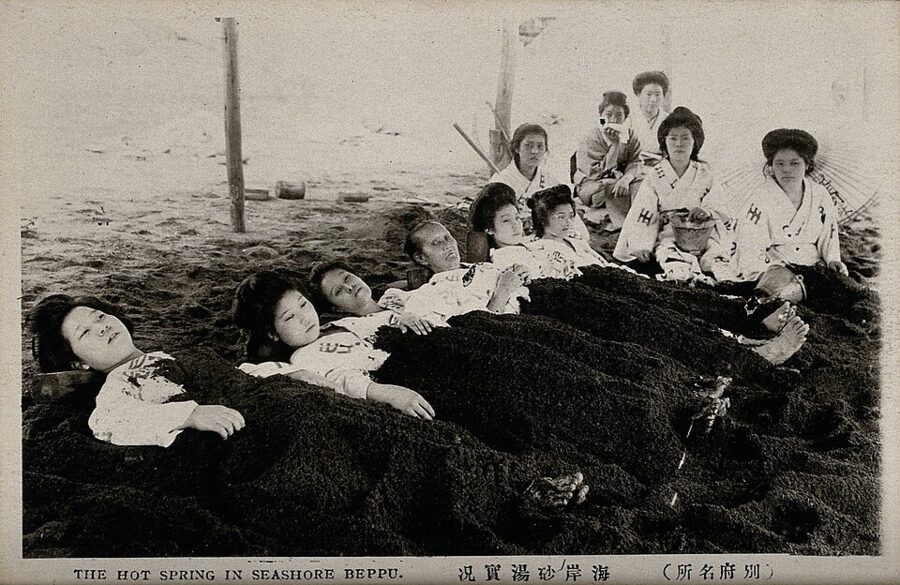
The famous part is the sunayu, the sand bath. You change into a cotton yukata, lie down on sand warmed from below by spring water, and an attendant, the sunakake-san, shovels warm sand over you to the neck. After about ten minutes you are dug out, rinse and go into the ordinary bath.
In late 2026 the ordinary bath costs ¥300 and the sand bath ¥1,500. The ordinary bath opens 06:30–22:30 and the sand bath 08:00–22:30, last entry 21:30; both close on the third Wednesday of the month. Up to eight people can be buried at once, nothing can be booked, and at busy times you take a numbered ticket and wait.


The jimotoyu: neighbourhood baths
Beppu has several hundred kyodo onsen, community baths built by street associations and kept up by their members, which locals call jimotoyu, “the local water”. Many are a single room with a tub and a few taps. Some are strictly for members behind a locked door; others let outsiders in for a coin in a box or a small fee to a caretaker. Where a sign says members only, believe it.
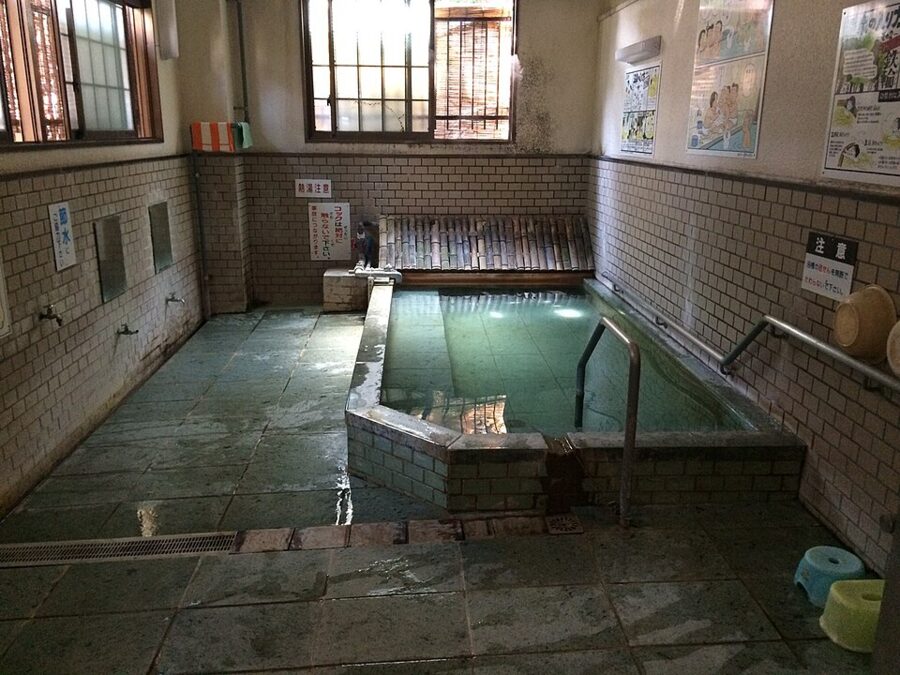

The city’s own baths are the easy entry point. Takegawara’s ordinary bath, Horita and Shibaseki all charge ¥300 for adults in late 2026. The city advises keeping a first soak in water this hot to three to ten minutes and resting afterwards. The municipal seafront bath at Kitahama has closed, so ignore older guides that send you there.
Hyotan Onsen
For everything under one roof, go to Hyotan Onsen (ひょうたん温泉) in Kannawa. Kono Junsaku opened it in 1922 after moving here for his wife’s rheumatism, naming it after the gourd, hyotan, on the battle standard of his hero Toyotomi Hideyoshi; his seven-storey wooden lookout tower was pulled down on army orders in May 1945 as a possible bombing target. Today there are indoor baths, waterfall baths that pound your shoulders, steam, sand and private family baths, all on unmixed spring water, for ¥1,160.
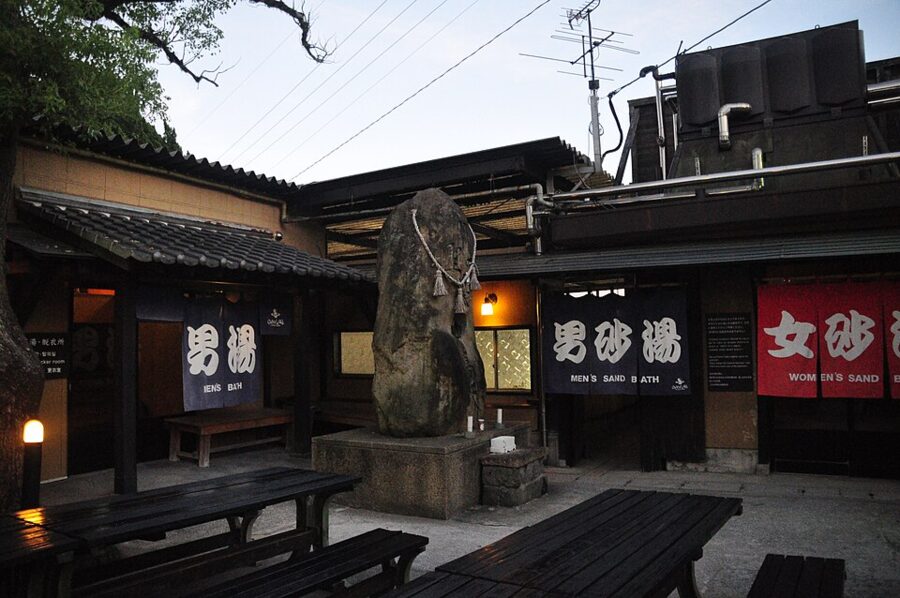

Sand on the beach and mud in the hills
For sand with a sea view, the beach sand bath at Shoningahama in Kamegawa, renovated and reopened as Sand SPA, buries you on the shore of Beppu Bay for a set fifteen minutes, for about ¥2,500 with the ordinary bath included; hours change with the season. The beach is named after the monk Ippen, said to have landed there. Japan’s other famous sand baths are at Ibusuki, south of Kagoshima.
Mud is a Myoban speciality. At Beppu Onsen Hoyoland (別府温泉保養ランド), on the site of the old Konya Jigoku, you lower yourself into pools of warm grey mud fed by the hell’s vents, then rinse off in milky sulphur water. Postcards from the 1930s show an indoor mud bath here that has hardly changed. It opens 09:00–20:00 and costs ¥1,500 for adults.
Etiquette and tattoos
The rules are those of any Japanese bath, and they matter more in a small one. Wash thoroughly on the stool before you get in, wear nothing, and keep your small towel out of the water. If the water is too hot, ask before running the cold tap, because the regulars may like it that way. If you have bathed in Hakone, the drill is the same, only hotter and cheaper.
Tattoo rules are set bath by bath, with no city-wide policy. Beppu has a reputation as one of the easier onsen towns for tattooed bathers, but some hotels and resort spas still turn them away or ask for covering. Ask at the counter, carry large plasters, or book a private family bath.
The Onsen Dojo stamp book
The surest way into the life of the baths is the Beppu Hatto Onsen Dojo (別府八湯温泉道), “the Way of the Hot Spring”, running since 2001. About 150 baths take part. You buy a stamp book called the Spaport, sold at the tourist office by the station’s east exit and at the city tourism association, or use a GPS app called Onsen Hunter, and collect a stamp at each bath. Every eight baths earns a grade, as in a martial art, with a towel to prove it; at 88 you become an onsen meijin, a master, and your portrait hangs in the hall of fame at Hyotan Onsen.
Each grade costs ¥800 to register. The devoted go round again, and when somebody finished 88 circuits in 2015 the organisers created a final title and promised to stop there. Even if you only manage eight, the book sends you through doors you would never have opened.
Kannawa: steam, ovens and a wandering monk
Kannawa (鉄輪) is where to stay if you stay anywhere. Steam comes out of drains and walls along its lanes, and the old kashima ryokan, inns that let rooms by the week to long-stay bathers who cook for themselves, still line the streets around the hells. In winter the same steam heats their rooms.
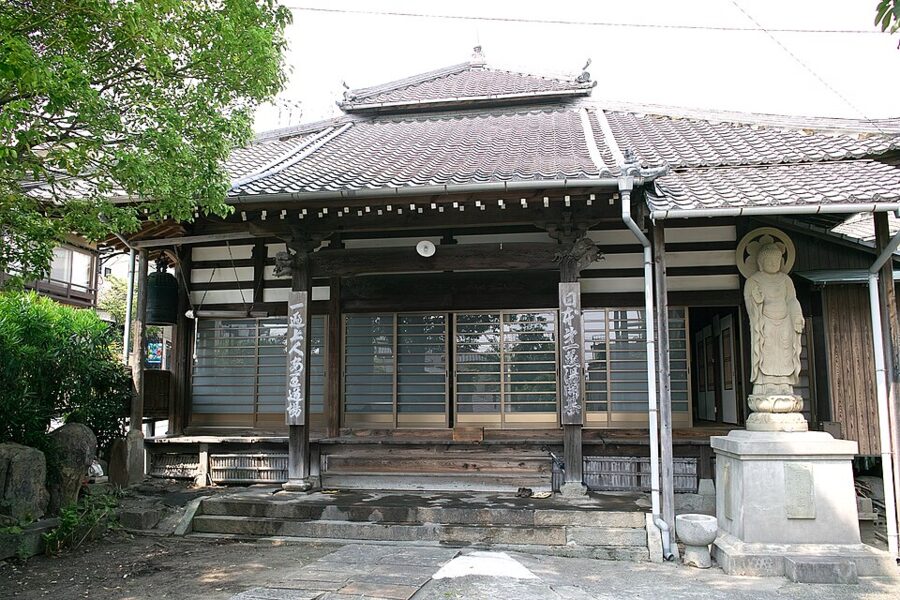
Its founding legend is about a monk. In 1276 Ippen, the wandering preacher who founded the Ji school of Pure Land Buddhism, came through what was then a waste of vents and boiling mud, calmed it and built a steam bath for the sick. The temple of Eifuku-ji keeps his statue, and every September, at the Kannawa Yuami festival, it is washed with water from the local springs.

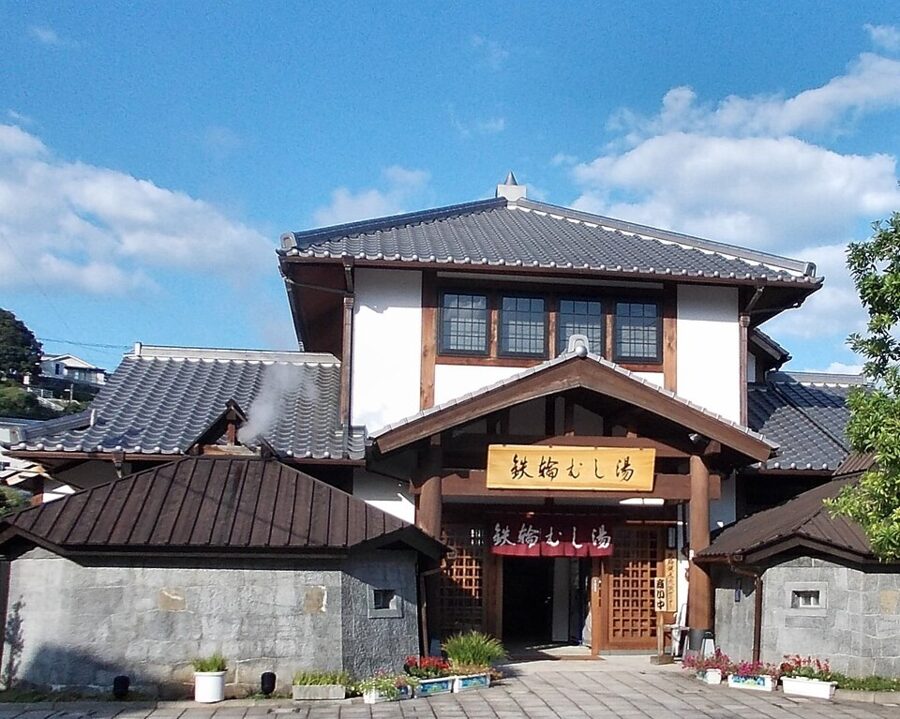
The steam bath, rebuilt and run by the city as Kannawa Mushiyu (鉄輪むし湯), is still in use. You change into a yukata, which you can rent for ¥220, crawl through a low door into a stone chamber floored with sweet-flag leaves, and lie on them in the steam for a few minutes. It costs ¥700, from middle-school age up, takes four people per side at once, opens 07:30–19:30 in late 2026 and closes on the fourth Thursday of the month. The foot steam outside is free.

Jigoku-mushi: cooking with the hell
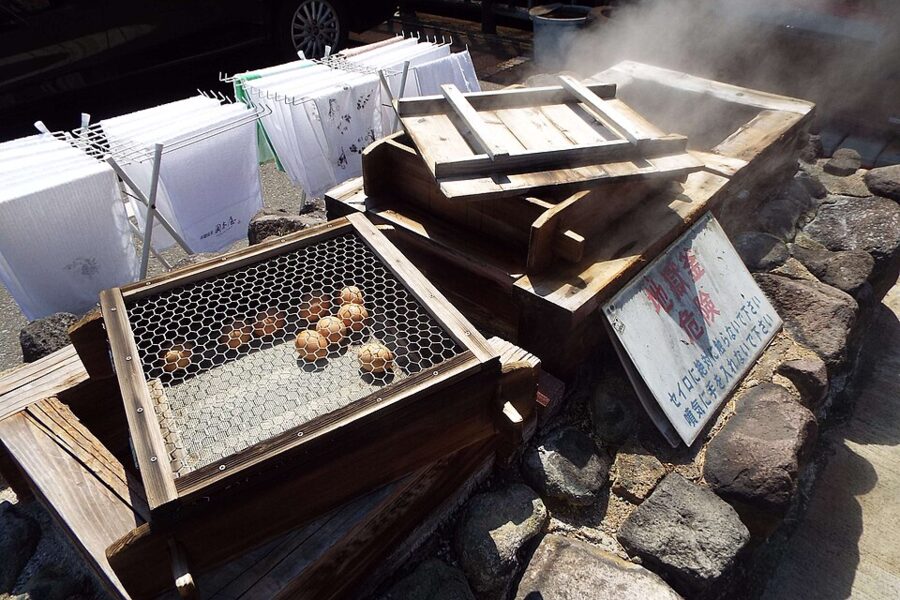
In the kashima inns, guests have long cooked on jigoku-gama, stone ovens over a steam pipe. You put rice, vegetables, fish or eggs in a basket, set it in the oven and close the lid; the salty steam, close to 100°C, cooks it in minutes and seasons it as it does. Korenaga Tsutomu’s 1964 memoir Beppu Konjaku describes Meiji-era children pushing green bamboo into the clay to open a vent and boiling soybeans taken from the neighbours’ fields. The bamboo baskets bathers cooked with are where Beppu’s basketry began; it is now a nationally designated traditional craft.
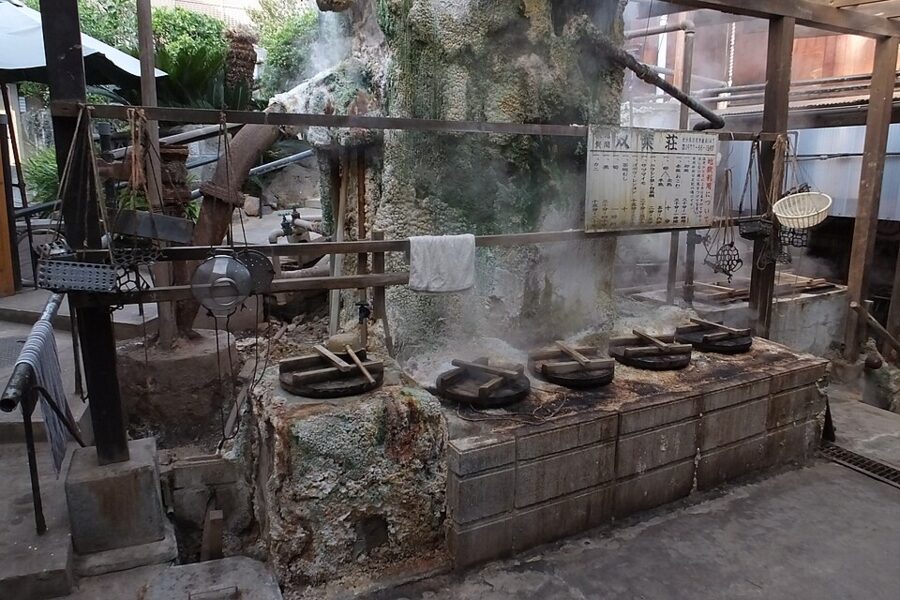

If you are not staying in one, Jigoku Mushi Kobo Kannawa (地獄蒸し工房 鉄輪) lets you do the same with ingredients chosen at the counter, and the staff show you how the baskets and lids work. It opens 10:00–19:00, last orders 18:00, closed on the third Wednesday. Queues build from late morning, so put your name down before you go round the hells.
Near the hot stream that gathers the district’s run-off stands a yumetake, a tall bamboo frame over which boiling spring water trickles and cools, so that baths need no cold water added: an invention of the 2000s on the idea of the graduation towers of German spa towns.
Yunohana at Myoban
Further up the hill, Myoban Yunosato (みょうばん湯の里), run by the family business that has kept the old alum method going, has yunohana huts you can look into, a large open-air sulphur bath and a shop selling the crystals as bath salts.

The city by the bay
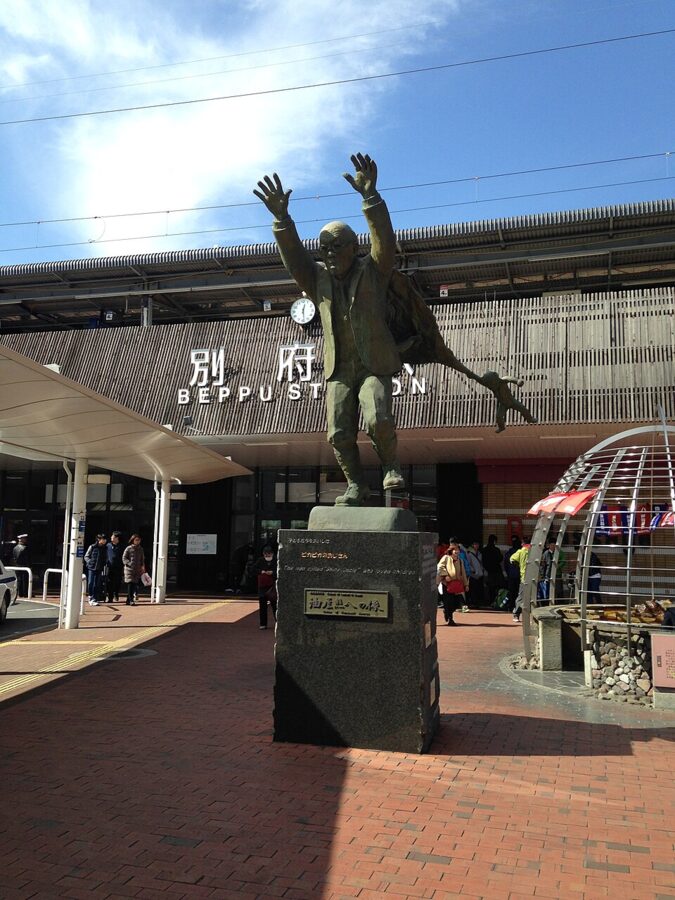
The modern resort was made by boats. A harbour finished in 1871 and a steamer to Osaka from 1873 brought visitors from the Kansai cities; a tram from 1900, the first in Kyushu, linked Beppu to Oita; the railway came in 1911. Then came the man who sold it to the nation. Aburaya Kumahachi (油屋熊八), born in Uwajima in 1863, lost a fortune speculating in rice and spent about three years in America, where he was baptised, before opening a small inn in Beppu, the Kamenoi, in 1911.
He ran it on a line from the Bible, “be hospitable to strangers”, refused to serve alcohol, and threw his money and much that he borrowed into publicity. Posts reading “Mount Fuji for mountains, the Inland Sea for the sea, Beppu for hot springs” went up around Japan, one of them in 1925 near Fuji’s summit. When a newspaper polled the nation in 1927 for its “new eight views”, he handed out postcards to the townspeople and Beppu came first. He died in 1935, and his businesses were sold to pay his debts.

The heyday ran through the 1930s, when the navy’s Combined Fleet anchored in the bay and tens of thousands of sailors came ashore, and on after a war that left the city unbombed. In 1950 Beppu became the first “international tourism hot-spring culture city” under a law of that name, honeymooners and school trips filled the inns, and visitor numbers peaked in 1976 before theme parks and cheap flights abroad drew the crowds elsewhere.
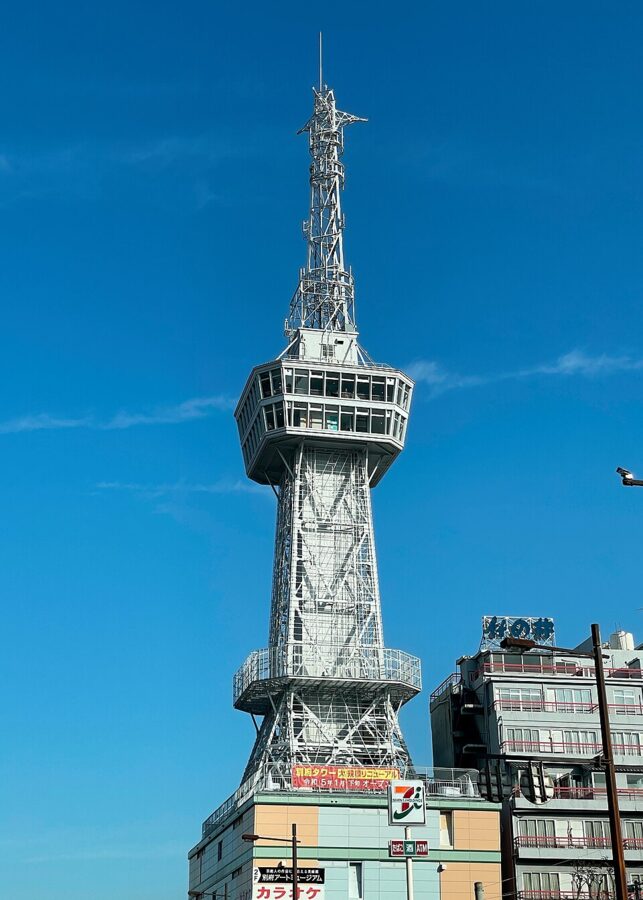
Beppu Tower (別府タワー) is the monument of the boom: 100 metres of steel lattice put up for a 1957 exposition, designed by Naito Tachu, the engineer of Tokyo Tower, and the third tall tower built in Japan. Meant to carry television signals, it never did; it came close to demolition in the 1980s, was registered as a cultural property in 2007, and reopened in January 2023 after a renovation that restored its original colours. The observation deck, 55 metres up, stays open into the evening.

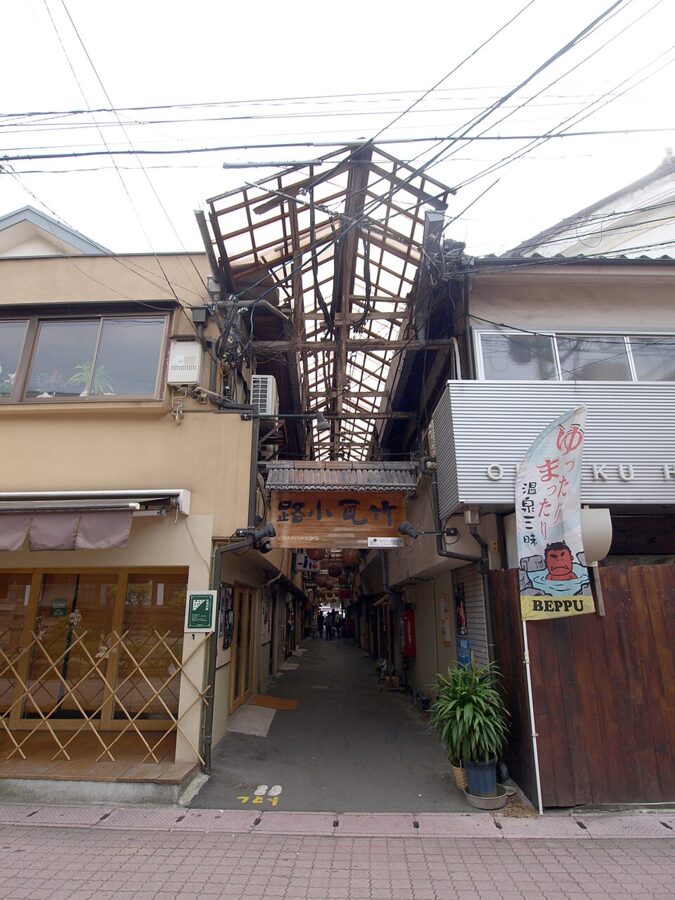
Around it, Kitahama (北浜) is the old entertainment quarter between the station and the sea: covered arcades, bars and late eating places, the Tokiha department store, and the bus centre for the airport and the hell tour. It is shabbier than the hotels up the hill and more fun.
A university town
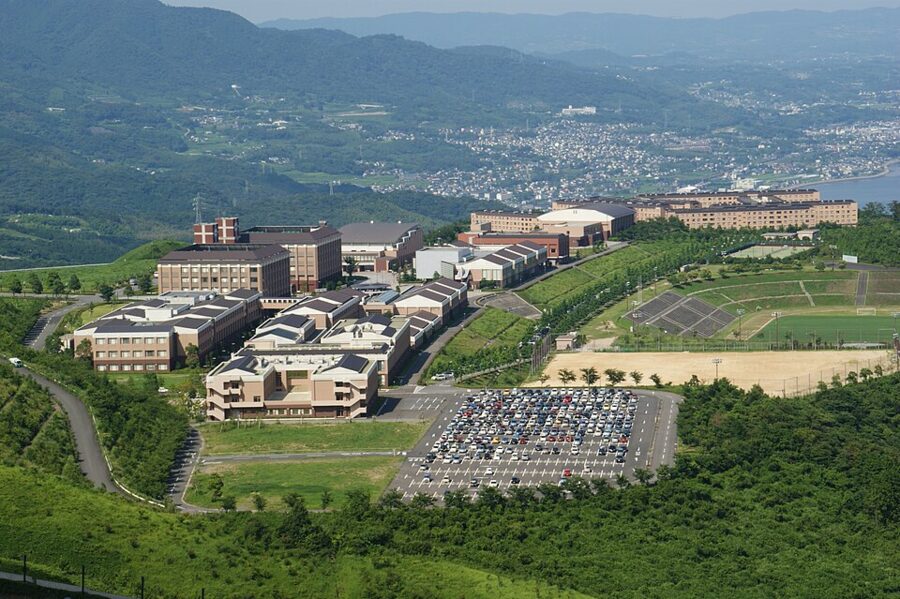
On the Jumonjibaru plateau above the city is Ritsumeikan Asia Pacific University (立命館アジア太平洋大学), APU, opened in 2000. On 1 November 2026 it had 6,650 students, of whom 3,302, about half, were international students, most in Beppu for a full degree rather than a semester. Many of them settle into neighbourhood life, community baths included. APU teaches in English and Japanese and admits students directly from abroad, a different route from most study in Japan.

What Beppu eats
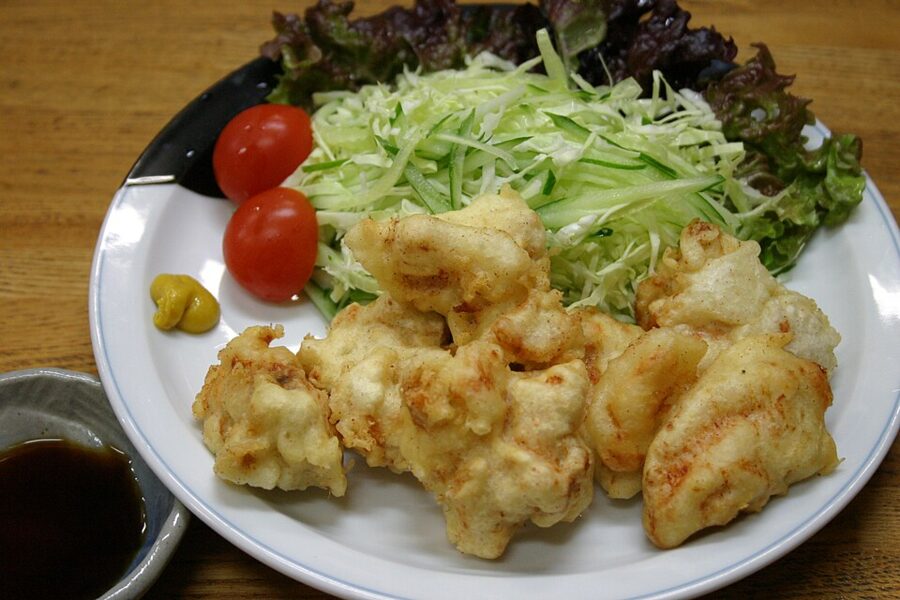
Toriten (とり天) is chicken marinated with soy and garlic, fried in tempura batter and dipped in vinegared soy with mustard. It is so ordinary in Oita that many people there assume the whole country eats it. Beppu claims it: Toyoken, opened in 1926 by Miyamoto Shiro, had “chicken tempura” on its early menus and still serves it at its main restaurant in Ishigaki-higashi and at a counter in the Tokiha department store. Oita city tells its own origin story, from a diner there in the early 1960s, and the two claims have never been settled.
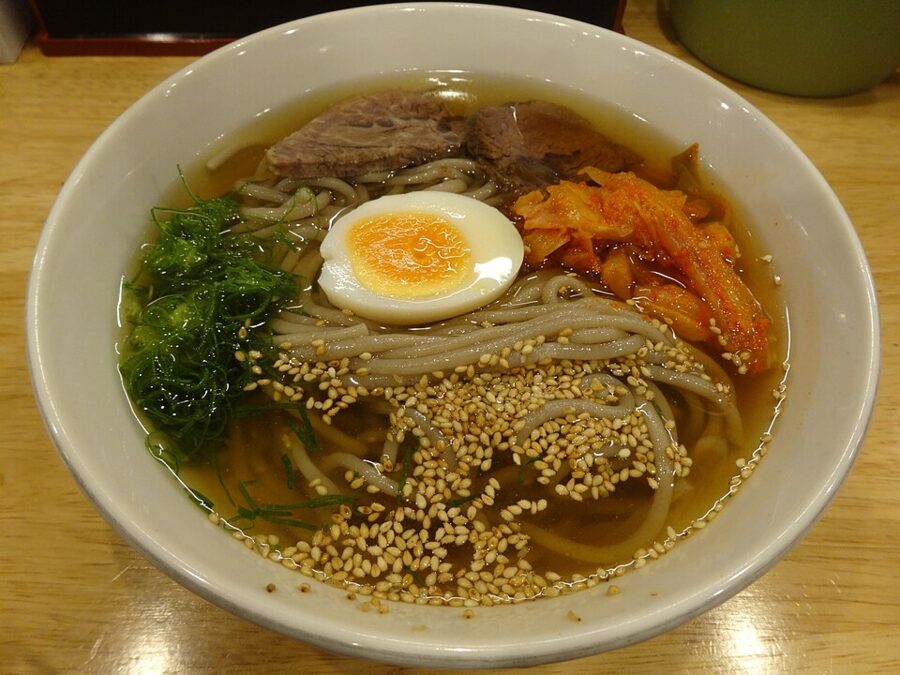
Beppu reimen (別府冷麺) are cold noodles in cold, clear broth, introduced around 1950 by a cook back from Manchuria who adapted the Korean naengmyeon he had known there. The noodles, of wheat flour, buckwheat flour and starch, are chewy enough to need teeth; the broth is Japanese in style. Specialist shops serve thick noodles with cabbage kimchi, barbecue restaurants thinner ones with napa-cabbage kimchi, and about 60 to 70 places in the city serve one or the other. Rokusei (六盛), which stretches its noodles by hand, is at Matsubara-machi, open for lunch and early evening and closed on Wednesdays.

Jigoku-mushi, steamed in the hell, is a method more than a dish: eggs, sweet potatoes, corn, pork buns, seafood, and the steamed custard pudding sold all over Kannawa and Myoban. The pudding is worth the walk.

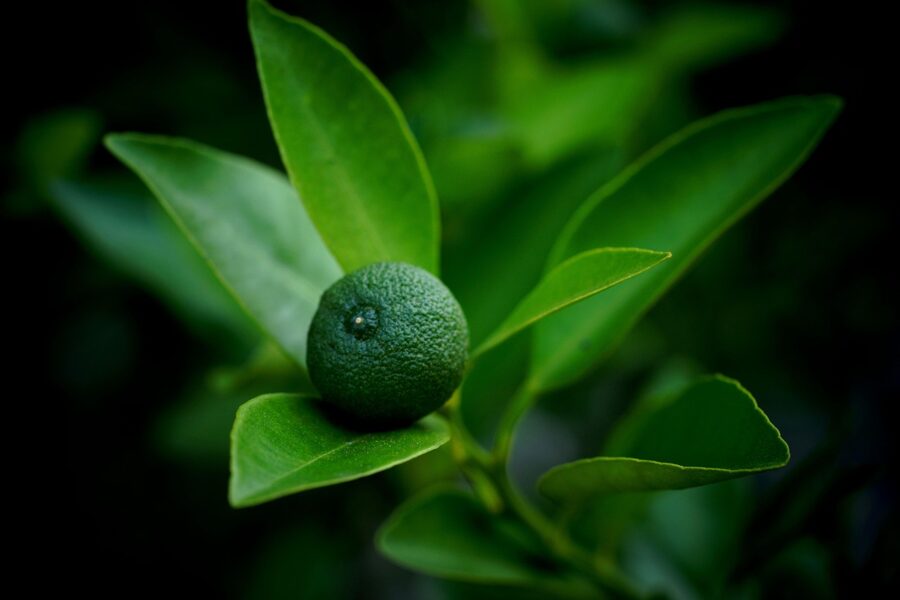
Kabosu (カボス), Oita’s green citrus, is sharper and a size larger than the sudachi of Tokushima, and goes on everything from fried chicken to miso soup and the local shochu. Tradition credits an Edo-period doctor in Usuki with bringing the first saplings from Kyoto. Offshore are Oita’s famous fish: seki-aji and seki-saba, horse mackerel and mackerel landed at Saganoseki in Oita city, and shiroshita karei, flatfish from the water below the old castle at Hiji, the next town up the coast. Ask for them by name in Kitahama.
Day trips: Yufuin, Usuki, Kunisaki and Oita
Yufuin
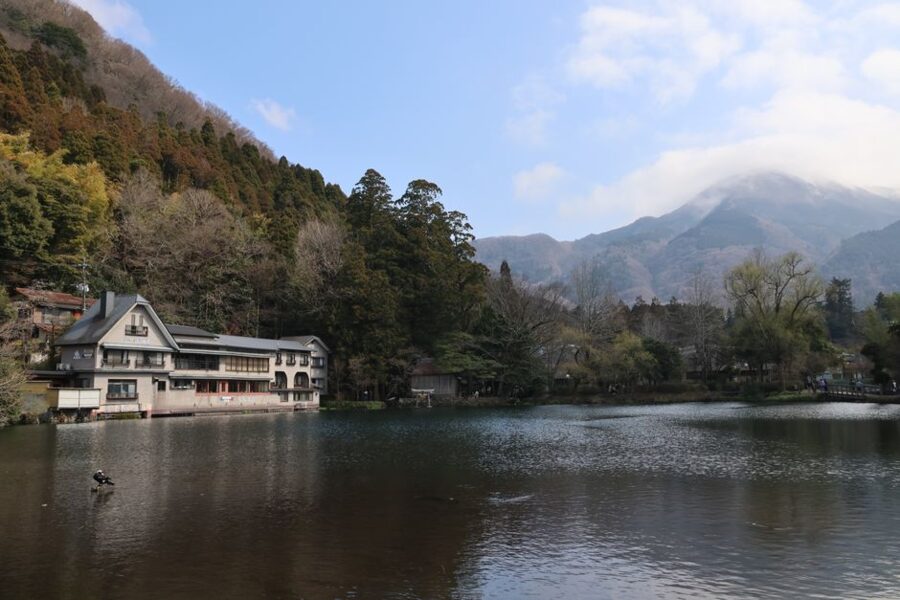
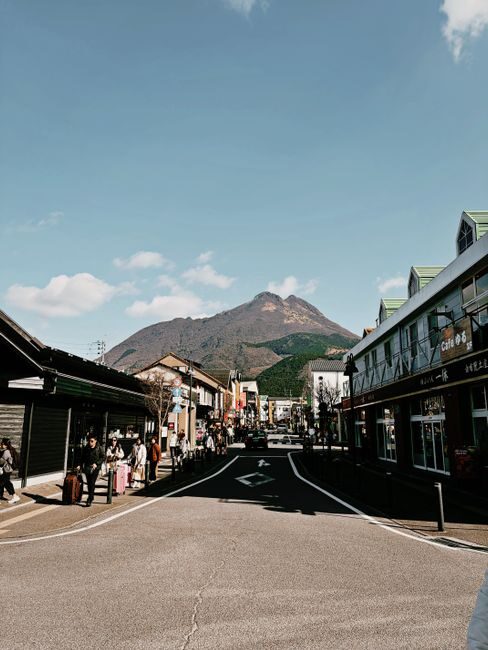
Yufuin (由布院) is Beppu’s opposite: a farming basin over the mountains under the twin peaks of Yufu-dake (由布岳), 1,584 metres. From the late 1960s it chose film and music festivals over neon, fought off a dam in 1952 and big developments in the bubble years, and kept its inns scattered among fields and woods. The main street fills with day-trippers walking from the station to Lake Kinrin, a pond fed by hot and cold springs, where mist rises on cold, clear mornings. Kamenoi Bus route 36 runs from Beppu Station in about an hour; go early and leave before the crowds peak.
The Usuki Stone Buddhas
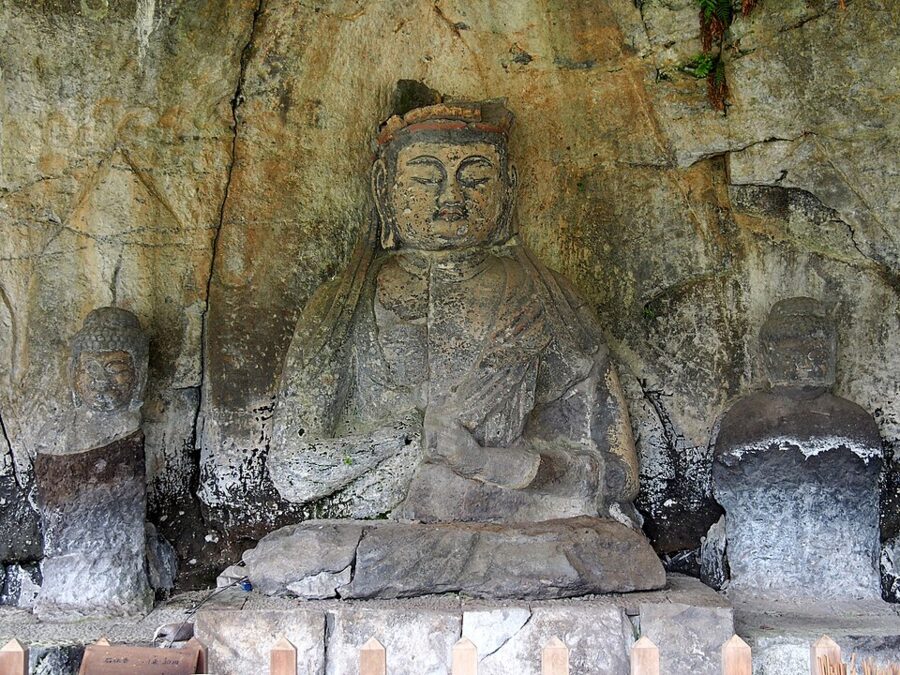
About an hour south, Usuki (臼杵) has the finest rock-cut Buddhas in Japan: 61 figures in four groups carved into cliffs of soft welded tuff laid down by an eruption of Aso. No document records who carved them or when; local legend credits a charcoal-burner turned rich man mourning his daughter. In 1995, 59 of them became the first rock carvings in Japan named National Treasures, and the last two followed in 2017.
The head of the great Dainichi of the Furuzono group fell long ago and sat on the pedestal below until restorers put it back in 1993, after a long argument about whether they should. Admission is ¥550, 09:00–17:00. The limited express reaches Usuki from Oita in about 35 minutes; then take a bus or taxi.

The Kunisaki peninsula
The round volcanic peninsula north of Beppu, Kunisaki (国東), is where Buddhism and the worship of Hachiman, the god of nearby Usa shrine, fused into a mountain faith called Rokugo Manzan. Its temples claim foundation by a holy man called Ninmon in 718, which historians doubt.
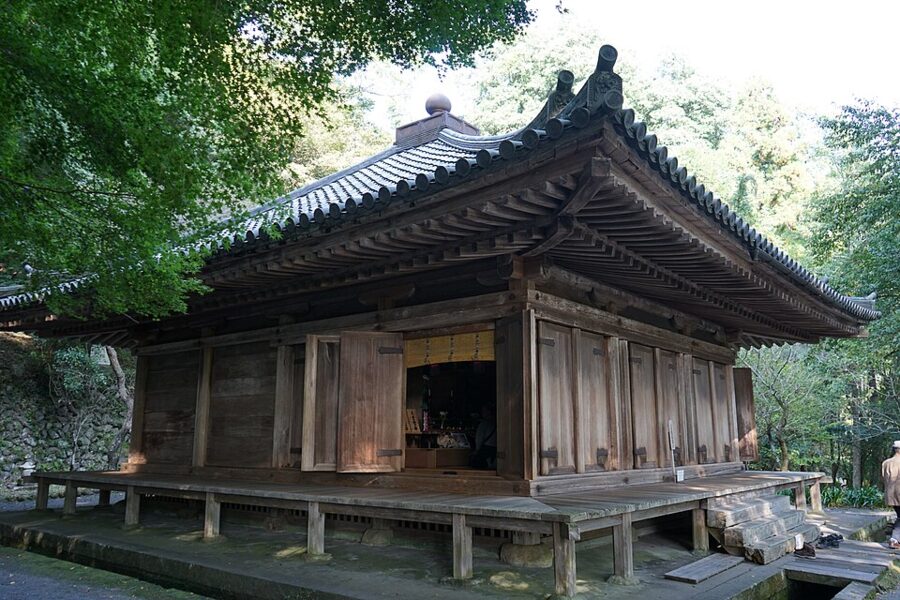
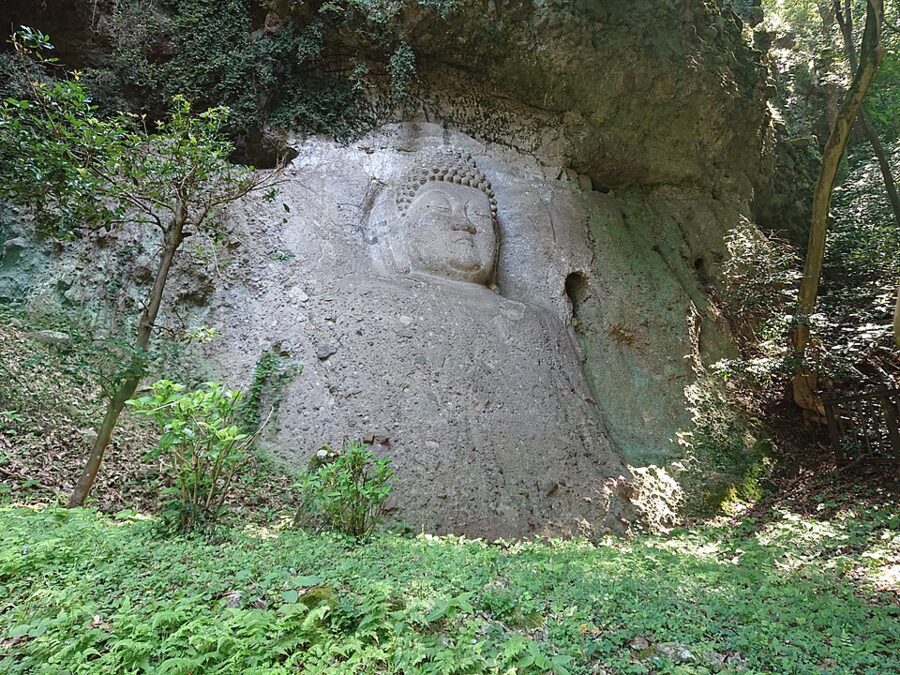
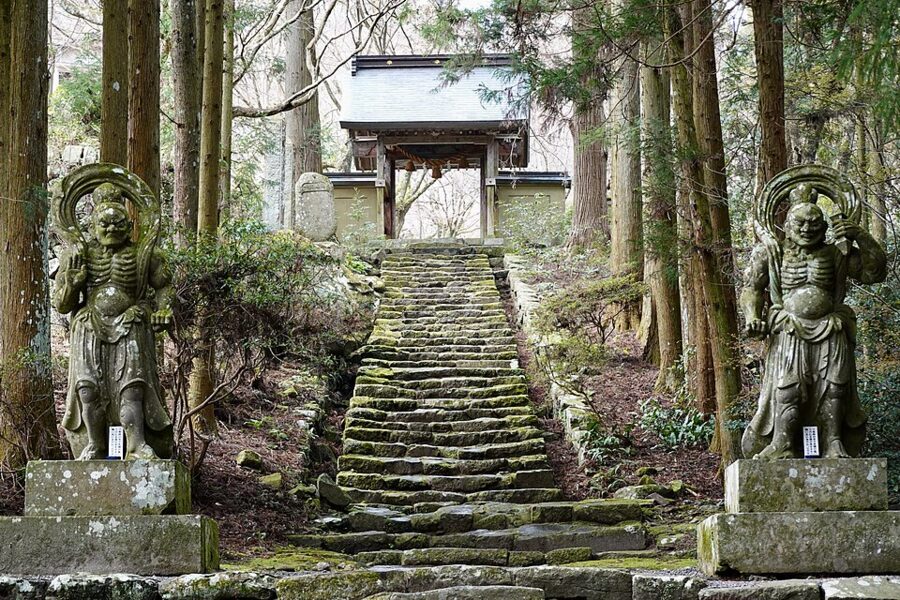
Three places make a day. Fuki-ji (富貴寺) has a small Amida hall from the Heian period, a National Treasure and one of the few buildings of that age outside the Kansai region, with faded paintings of paradise inside. Kumano Magaibutsu (熊野磨崖仏) is two huge figures cut into a cliff, a Fudo about 8 metres high and a Buddha about 6.7 metres, reached up a boulder staircase that legend says a demon built in a night. Futago-ji (両子寺) has the peninsula’s largest stone Nio guardians.
The bus to Futago-ji stopped in 2020, so Kunisaki is a day for a hire car, from Beppu or from Oita Airport on the peninsula’s coast.



Oita city
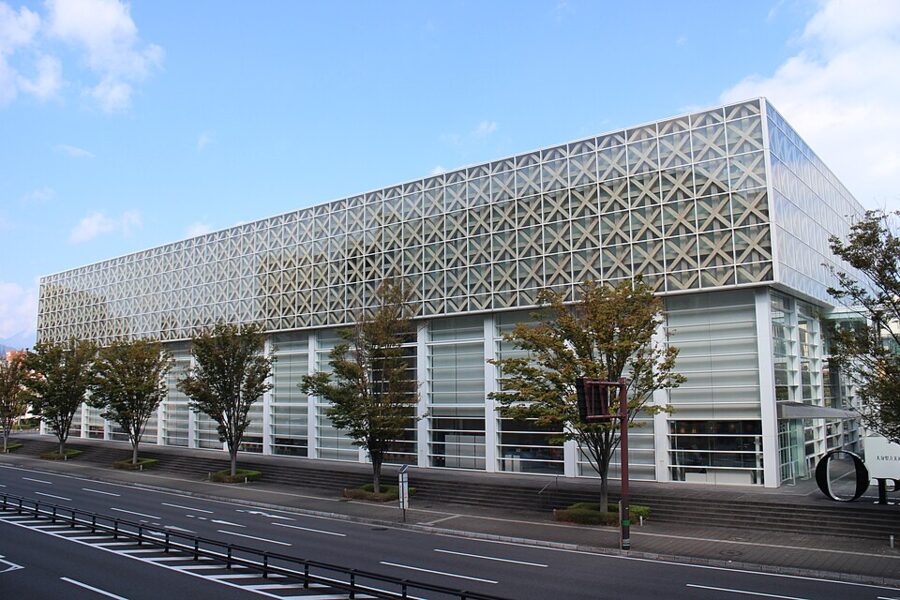
Oita (大分), the prefectural capital, is ten to fifteen minutes south by train: flat, modern and busy. Go for the Oita Prefectural Art Museum, OPAM, opened in 2015 in a building by Shigeru Ban whose glass ground floor can open to the street. On the way, Takasaki-yama has a troop of wild macaques that come down to a feeding ground, with an aquarium at its foot.

Getting there and getting around
By train
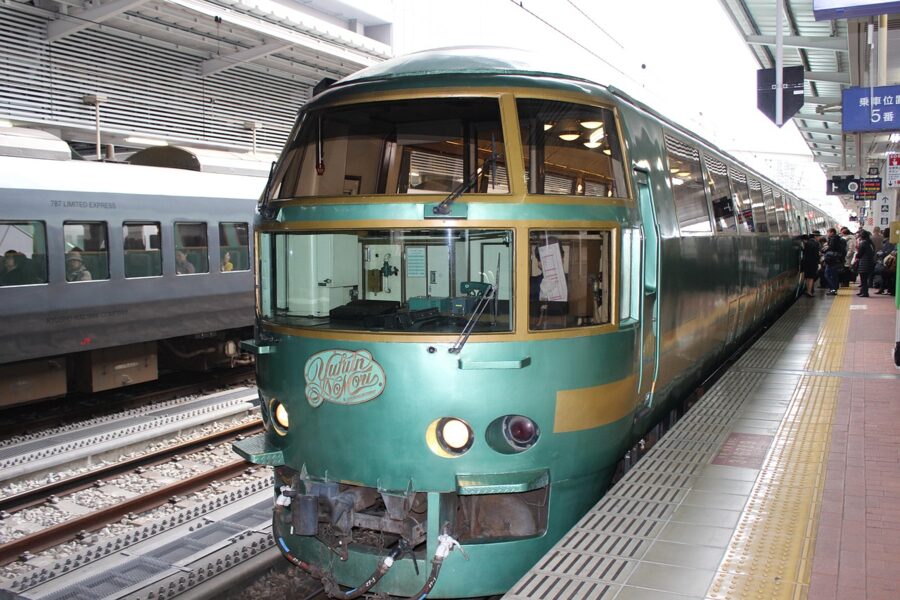
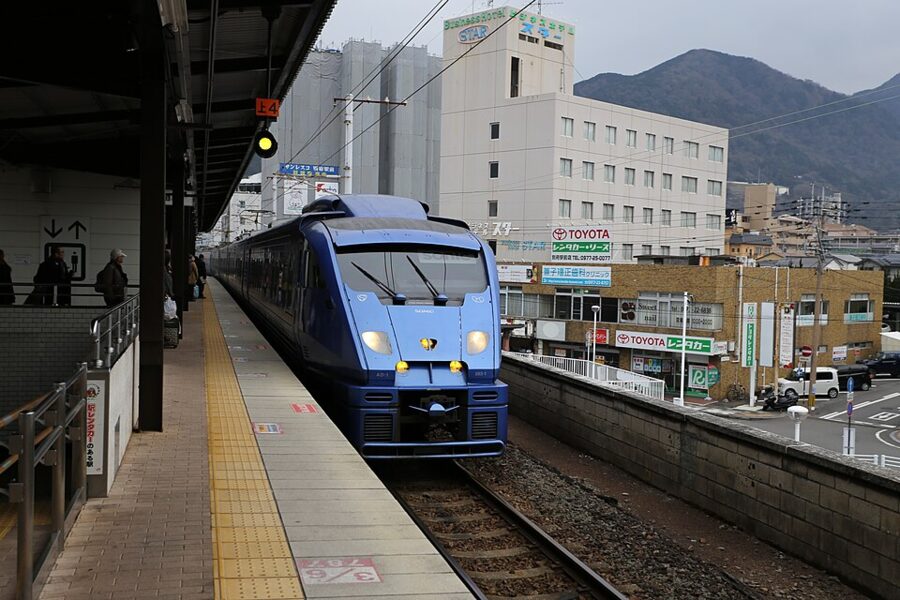
The Sonic limited express runs from Hakata to Beppu in about two hours, roughly twice an hour. A one-way ticket with an unreserved seat costs about ¥6,900; JR Kyushu’s 2-mai kippu, two unreserved one-way journeys between the Fukuoka city area and Beppu or Oita for ¥7,600, pays as soon as you return the same way or travel as a pair. From Honshu, change from the Shinkansen at Kokura. The national Japan Rail Pass and JR Kyushu’s Northern Kyushu pass both cover it.

By sea from Osaka
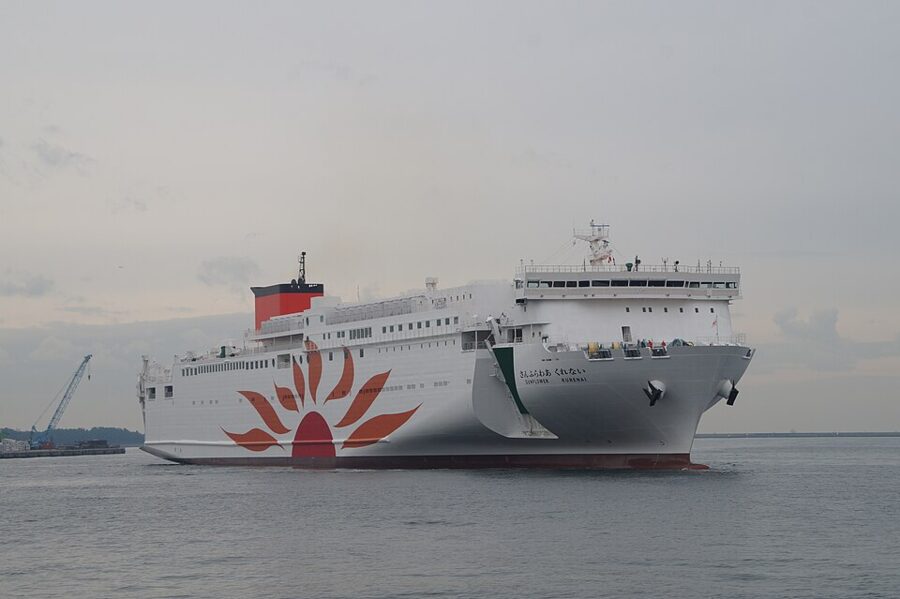
The overnight ferry is how I would arrive. The Osaka run, begun by a steamer in 1873, is the oldest domestic passenger route still operating in Japan, and today’s ships, the Sunflower Kurenai and Sunflower Murasaki, entered service in 2023.
Sunday to Thursday they leave the Sunflower terminal at Osaka Nanko at 19:05 and reach Beppu at 06:55; on Fridays and Saturdays it is 20:05 and 07:55. The base adult fare runs from about ¥15,400 to ¥22,700 one way in late 2026 depending on the date, with cabins extra. In Osaka the nearest station is Trade Center-mae on the New Tram, not Ferry Terminal.

By air and by bus
Oita Airport, with flights from Tokyo, Nagoya and Osaka, is across the bay on the Kunisaki coast; the Airliner bus reaches Beppu’s Kitahama in about 40 minutes. From Fukuoka the non-stop Toyonokuni highway bus runs to Beppu about ten times a day.
Getting around
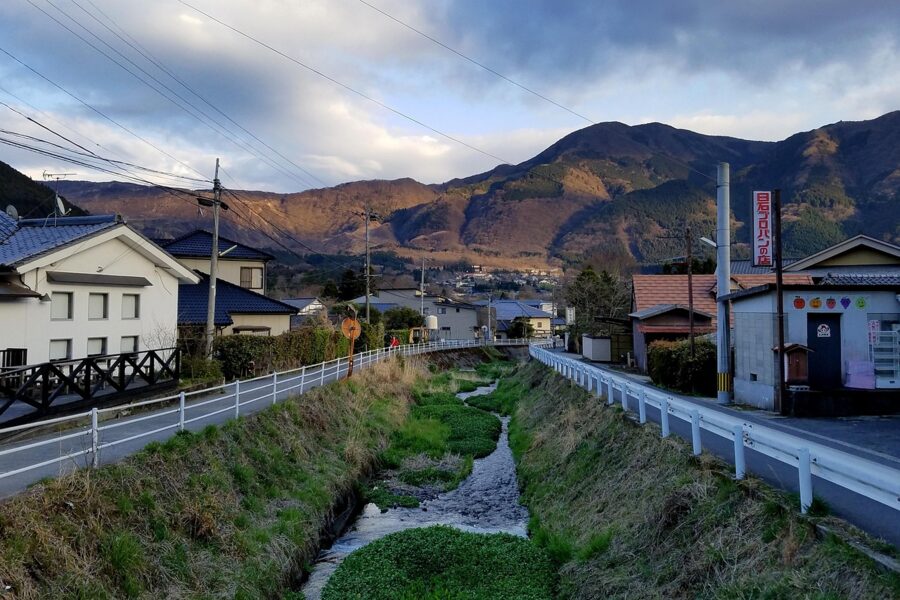
Beppu is too spread out and steep to walk between districts. Kamenoi Bus covers the city from Beppu Station and Kitahama: Kannawa is 15 to 25 minutes away depending on the route, and from the west exit route 5 or 41 reaches Myoban in about 26 minutes for ¥360. If you will ride more than three or four times, buy My Beppu Free, a one- or two-day pass on every Kamenoi route, in a city-only Mini or a Wide version that adds the parks on the plateau. Share bikes have docks at Umi, Kamado and Tatsumaki Jigoku.
Plans for one, two or three days
One day. The hells at 08:00, lunch in the Kannawa steam kitchen, the steam bath in the early afternoon, then Takegawara for the sand bath and toriten or reimen in Kitahama. You will be tired and very clean.
Two days. Stay the night in Kannawa, in a kashima inn if you like to cook or a ryokan if you do not. Next morning go up to Myoban for the yunohana huts and a mud bath, ride the ropeway if the summit is clear, and end the day in two or three neighbourhood baths with the Spaport in your pocket.
Three days. Add a day out: Yufuin early for hot springs in a quieter setting, Usuki for something few people on your bus will see, Kunisaki if you have a car. Winter is the best season for bathing, when the steam over Kannawa is at its thickest; the best time to visit Japan depends mostly on what else is on your route.
If you can, leave the way the ferry brings people in. The Sunflower sails for Osaka in the early evening, and as the ship pulls away the city turns back into what you saw on arrival: a dark slope under Tsurumi-dake, a scatter of lights, and the steam still standing up over Kannawa, except that now you know which bath each column belongs to.