

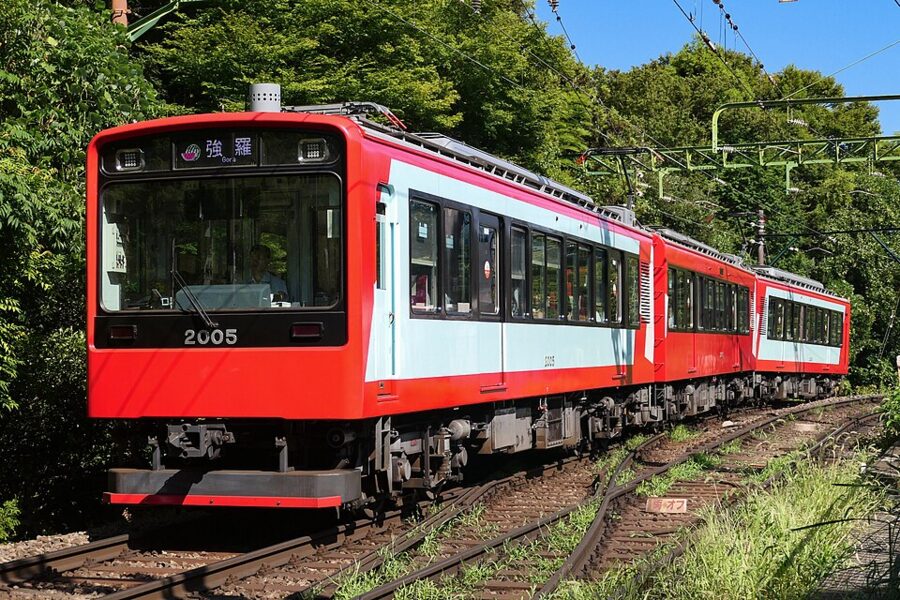
Three times on the climb out of Hakone-Yumoto the little red train runs into a dead end. It stops, the driver and the conductor change ends, and the train sets off again in the direction it came from, still climbing. By the time it reaches Gora, 445 metres higher and about 40 minutes later, it is facing backwards, and you have had the cheapest lesson in the shape of this mountain that money can buy.
The mountain is a volcano, or rather the collapsed remains of several. Hakone (箱根) is a caldera about 12 kilometres from north to south on the western edge of Kanagawa Prefecture (神奈川県), with a lake in its western half, a steaming valley near its middle and hot springs wherever the heat finds water. It sits where the old highway from Edo to Kyoto had to cross the hills, which is why it has a checkpoint, a stone road and four centuries of inns, and it is close enough to Tokyo that a limited express from Shinjuku gets you to the bottom of it in about 80 minutes.
That nearness is Hakone’s blessing and its problem. Everyone comes, most of them on the same loop on the same day, and many leave having seen a queue, a gondola and a cloud where Mount Fuji (富士山) was supposed to be. Go knowing how the place works and it is one of the best two days you can spend out of Tokyo.

In this guide
A caldera with a lake in it
Hakone began erupting about 400,000 years ago, and for most of that time it was a cluster of volcanoes rather than one. Large pumice eruptions emptied the magma beneath them, the ground fell in, and what you see now is the result: an outer rim of old peaks such as Kintoki and Myojin, a ring of younger hills inside it, and a group of central domes around Kamiyama, at 1,438 metres the highest point. One of the big eruptions in the last hundred thousand years sent pyroclastic flows as far as what are now the outer suburbs of Yokohama.
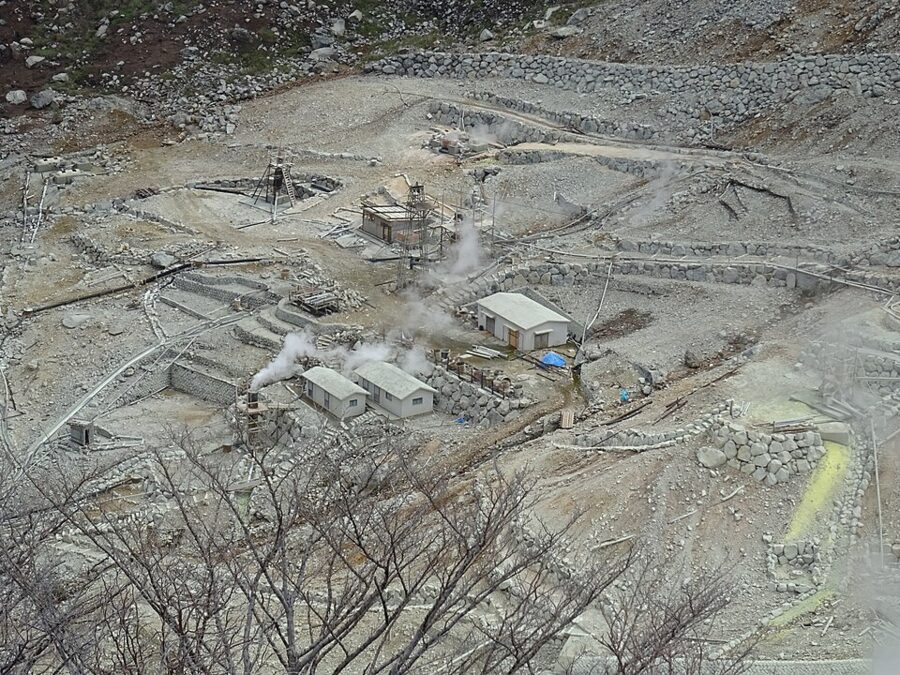
The last time Hakone erupted magma was about 3,200 years ago. A lava dome pushed up on the north side of Kamiyama, forming the knob now called Kanmuri-ga-take, and the slope beneath it collapsed. The debris avalanche ran across the caldera floor and dammed the Hayakawa river, and the water backed up into Lake Ashi (芦ノ湖) in more or less its present shape. Owakudani (大涌谷), the bare grey valley under Kanmuri, is the hollow that collapse left behind.
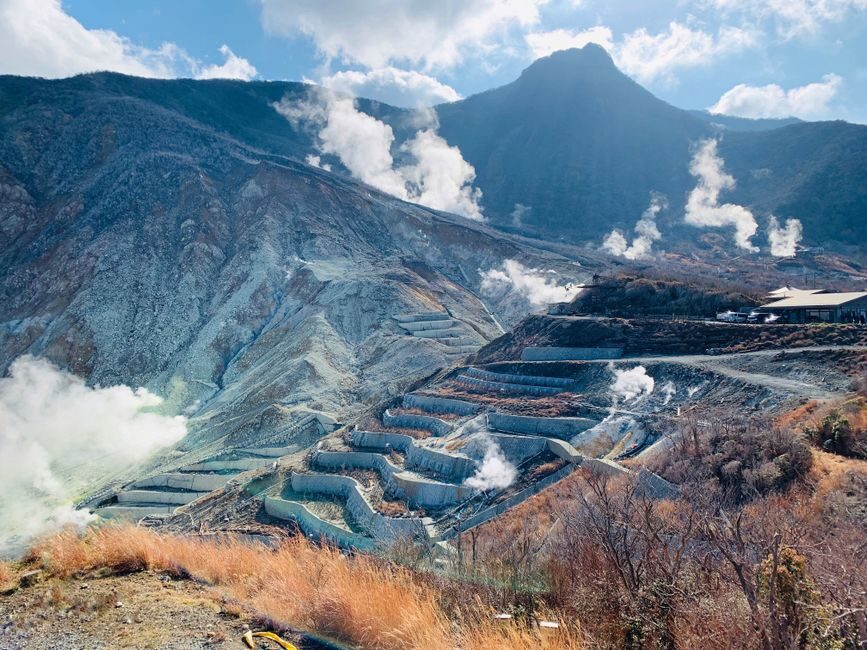
Since then there have been only steam explosions, small ones, the latest datable group in the twelfth and thirteenth centuries. The heat has not gone anywhere. Owakudani is the largest of several fumarole fields in the caldera, and by one survey it releases about a quarter of all the heat the volcano gives off.
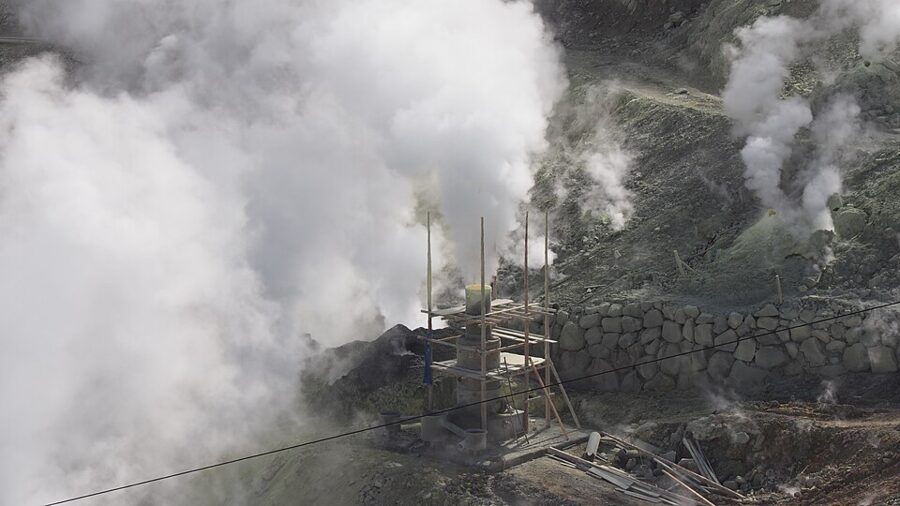

Until 1873 the valley was called Jigoku, hell, or Ojigoku, great hell. It was renamed Owakudani, “great boiling valley”, for a visit by the Emperor Meiji and the Empress, and its smaller neighbour Kojigoku became Kowakudani for the same reason. The new names stuck. The smell did not.
Alert levels, 2015 and the closures
Hakone is one of the volcanoes the Japan Meteorological Agency watches around the clock, and it has had an eruption alert level since March 2015. Level 1 means “be aware it is an active volcano”, and that is where it has stood since October 2019. Levels 2 and 3 close the area around the crater and the mountain respectively; the scale goes up to 5.
The system was tested within weeks of starting. Earthquakes under the caldera increased in late April 2015, a steam well at Owakudani blew out on 3 May, and on 6 May the level went to 2, closing the valley and stopping the whole ropeway. On 29 and 30 June a very small steam eruption opened about ten new vents in the valley and dusted ash on the slope more than a kilometre away, the level went to 3, and the town ordered people out of a one-kilometre radius. Activity died down over the summer and the level was back to 1 by 20 November, but the ropeway did not run its full length again until July 2016.
In May 2019 a fresh swarm of earthquakes sent the level back to 2 for five months, with buses replacing the gondolas. Both closures emptied inns far from the valley, whose guests had cancelled to avoid ash that never fell.
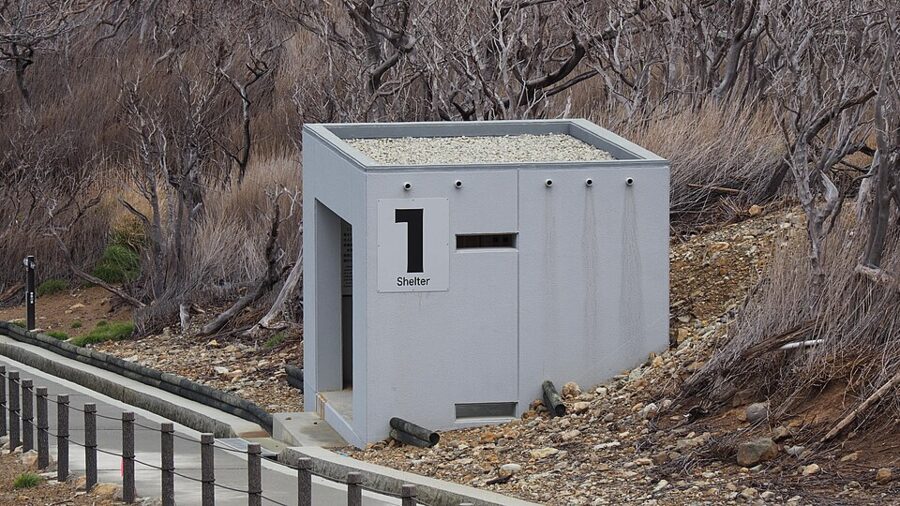

The 700-metre Owakudani Nature Trail, which takes you up among the vents to the pools where the eggs are boiled, was closed from May 2015 and has reopened under strict terms. Four guided groups a day of up to 30 people walk it in helmets, with a warden at each end, for about 40 minutes. You book online, pay ¥800 on the day towards the safety work, and must be of primary school age or older and able to run if told to; walks are cancelled for high gas readings, rain, wind or fog.
Without a booking you can still stand on the terrace by the ropeway station, which is where most people see the valley anyway.
The road over the mountain
Hakone was a barrier before it was a resort. The first highway between the capital and the east went round the north of these hills by the Ashigara pass, but an eruption of Fuji between 800 and 802 buried it, and a route over the Hakone pass to the south came into use. When Tokugawa Ieyasu settled in the east and his shogunate made the Tokaido its main road, the Hakone section became the hardest day on the whole road to Kyoto. Taki Rentaro’s song of 1901 calls it Hakone Hachiri, the eight ri, about 32 kilometres between Odawara and Mishima.
The shogunate built a post town, Hakone-juku, on the lakeshore in 1618, and the next year a checkpoint just east of it. The people of the old settlement by the shrine had refused to give up their best inn to house travelling lords, so the authorities moved residents in from Odawara and Mishima to fill a new town, and the old one became Moto-Hakone, “original Hakone”. Both names are on the bus stops today.
The checkpoint
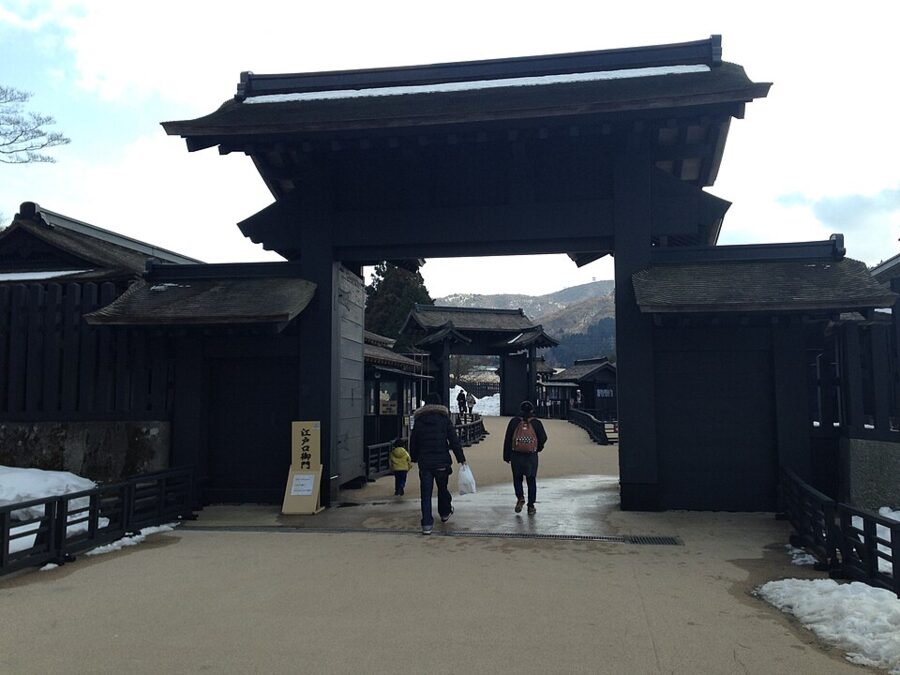
The Hakone Checkpoint (箱根関所) stood from 1619 until the new government abolished all checkpoints in 1869. It was run by the Odawara domain, with a commander, samurai guards, foot soldiers and two women, hitomi-onna, whose job was to examine female travellers. The gates opened at dawn and shut at dusk, and travel at night was forbidden.
The phrase Japanese history books use for checkpoints is iri-deppo ni de-onna, “guns coming in, women going out”. Lords’ wives and children were kept in Edo as hostages, so a woman leaving the city without papers might be one of them escaping; Hakone, on the main road west, was where they were looked for. Guns heading into Edo were mostly the business of the Arai checkpoint further down the Tokaido. Hakone’s own racks of spears, bows and muskets were largely for show: inventories suggest the muskets were not kept loaded and there were bows without arrows.
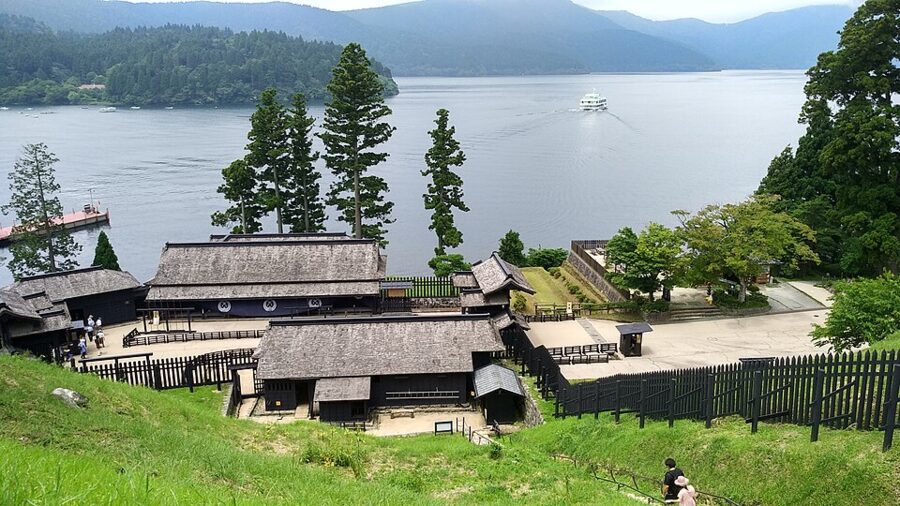
What stands there now is a reconstruction, and a careful one. In 1983 a record of repairs made to the checkpoint in 1865 turned up in the archive of the Egawa family at Nirayama, with enough detail to show how every building was put together. Excavations followed, the main guardhouse and its neighbours were rebuilt with period tools and techniques, and the whole site opened in 2007. The exhibition hall covers the permits and the people who tried to slip round through the woods, a crime punished by death.
Admission is ¥500 (¥400 with the Hakone Freepass), 09:00–17:00, closing at 16:30 from December to February. It takes about an hour, and the walk to it along the lakeshore from Moto-Hakone, 10 to 15 minutes, is part of the point.

The cedar avenue and the stone road
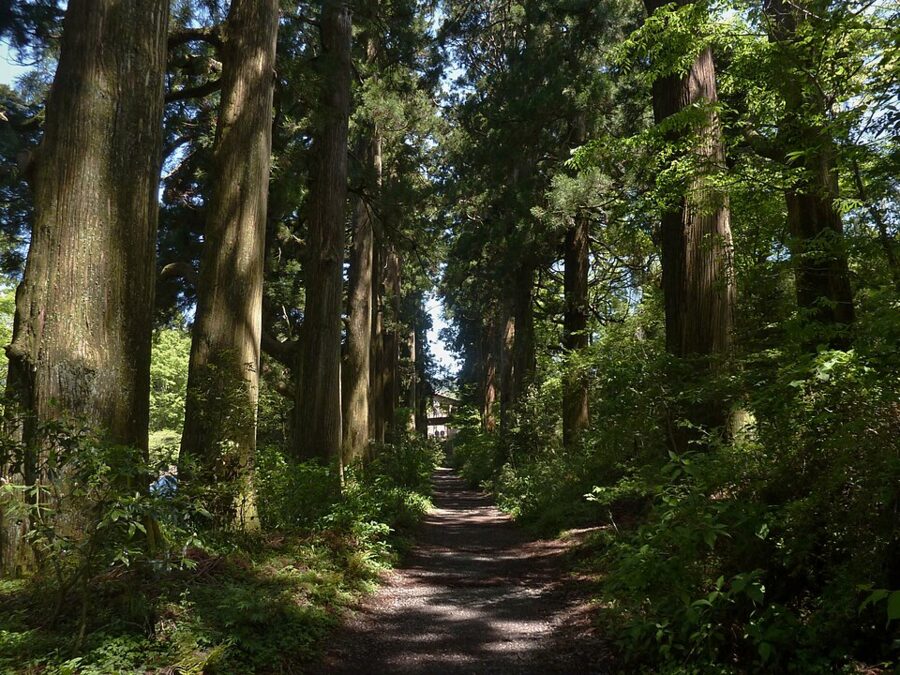
Between the checkpoint and Moto-Hakone the old Tokaido runs through an avenue of Japanese cedars, about 400 of them along roughly 500 metres, most more than 350 years old. They were planted early in the Edo period to shade travellers in summer and shelter them in winter. The modern Route 1 runs alongside, but walk the old line under the trees and the traffic noise drops away surprisingly fast.

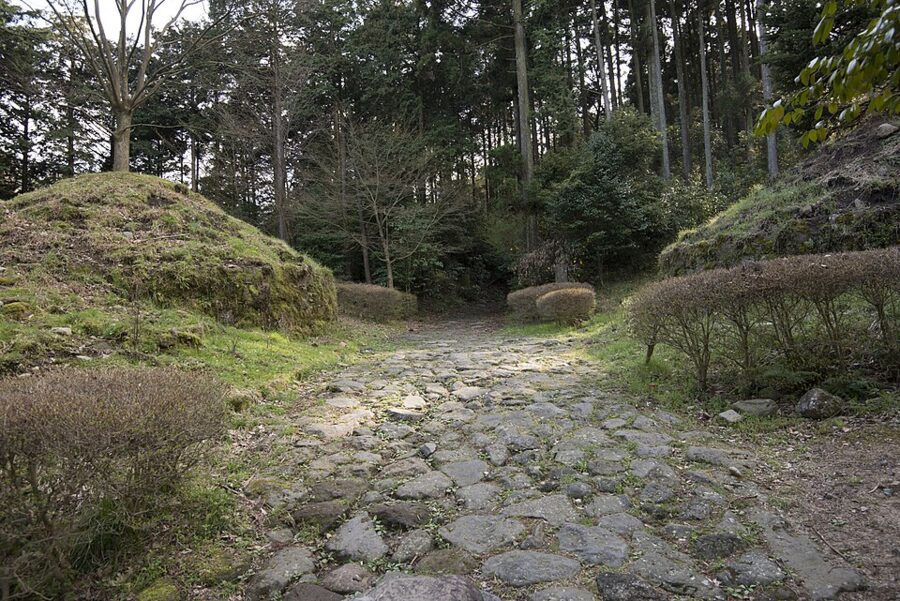
East of Moto-Hakone the old road leaves the modern one and drops through forest towards Hatajuku and Yumoto. Hakone’s clay turns to mud in the long rains, so for decades the road was laid with bamboo, which had to be replaced every year. In 1680 the shogunate paved the worst stretches with stone instead. Long sections of that paving survive, rounded and slippery, and they are a designated national historic site along with the old distance markers.

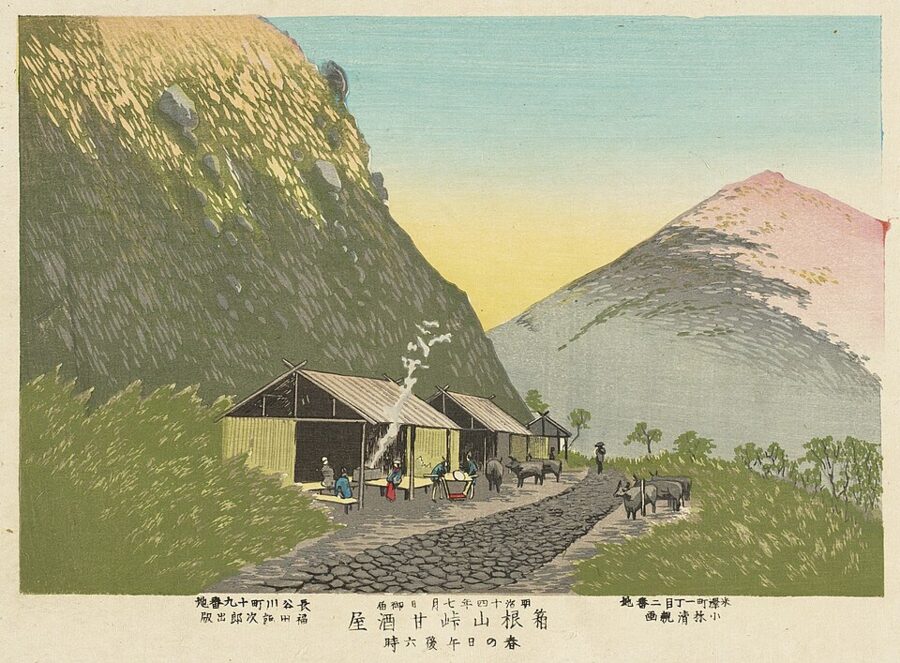
The walk from Moto-Hakone down to Hatajuku takes about two hours, and from Hatajuku to Yumoto about two more. Halfway to Hatajuku is the Amazake Chaya (甘酒茶屋), the last of four tea houses that opened at Oidaira after the checkpoint was built. It still serves amazake, a thick, sweet, non-alcoholic drink of rice and koji with no sugar added, and chikara mochi, rice cakes grilled over charcoal.
The thatched building was rebuilt in 2009 from old materials. The Hakone Tozan bus on the old road stops outside, so you can walk only the best section and ride the rest.
From post road to resort
The highway brought the first visitors to the springs, and in the Edo period the bathing villages along it were known as the Hakone Shichiyu, the seven springs: Yumoto, Tonosawa, Dogashima, Miyanoshita, Sokokura, Kiga and Ashinoyu. Toyotomi Hideyoshi’s army is said to have passed the time in them while besieging Odawara Castle in 1590, and Sokokura still has a stone bath named after him.
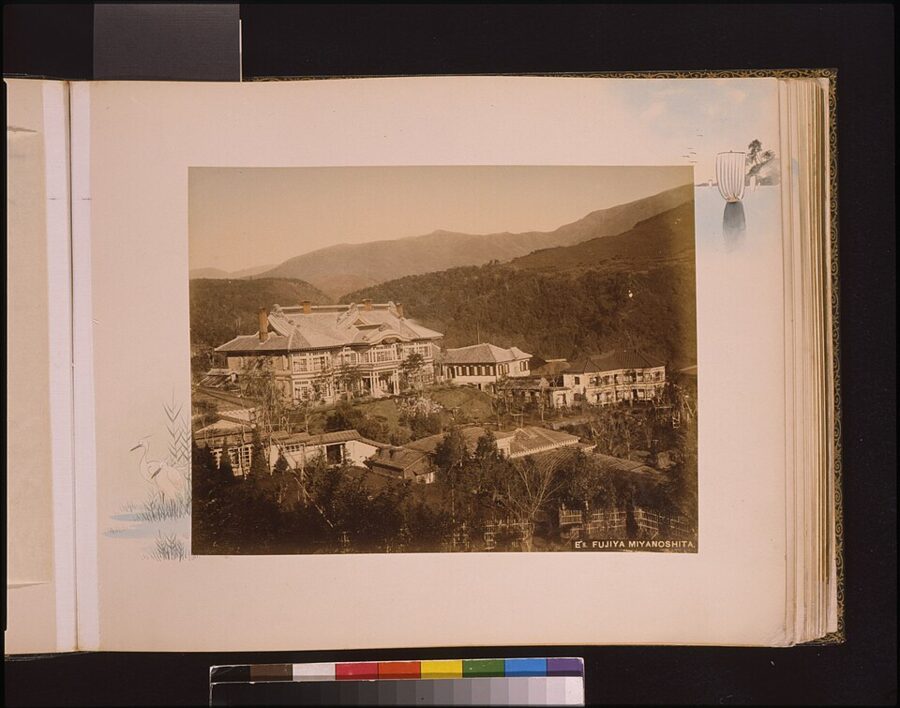
After 1868 the foreigners came. In 1878 Yamaguchi Sennosuke bought an old inn at Miyanoshita and turned it into the Fujiya Hotel, aimed openly at foreign guests’ money, and for the next half century the hills filled with the villas of politicians, businessmen and writers. Chaplin stayed at the Fujiya in 1932; John Lennon and Yoko Ono stayed in the annexe decades later. The hotel’s buildings were registered as cultural properties in 1997, and after a two-year closure for earthquake strengthening it reopened in July 2020.
The railway arrived in 1919, and after the war two railway empires, Seibu and the Odakyu and Tokyu camp, fought over Hakone’s buses, roads, boats and ropeways in what the press called the Hakone mountain war. Its legacy is the shape of the loop: almost everything on it belongs to the Odakyu group, while the rival boats on the lake and the ropeway up Komagatake belong to others and are not on the same pass.
The loop, stage by stage
The classic Hakone day goes up by mountain train and cable car, over the top by ropeway, across the lake by boat and back down by bus. Odakyu numbers every stop as one line, from OH01 at Shinjuku to the pier at Moto-Hakone, and sells one ticket for all of it.
Odawara and Hakone-Yumoto
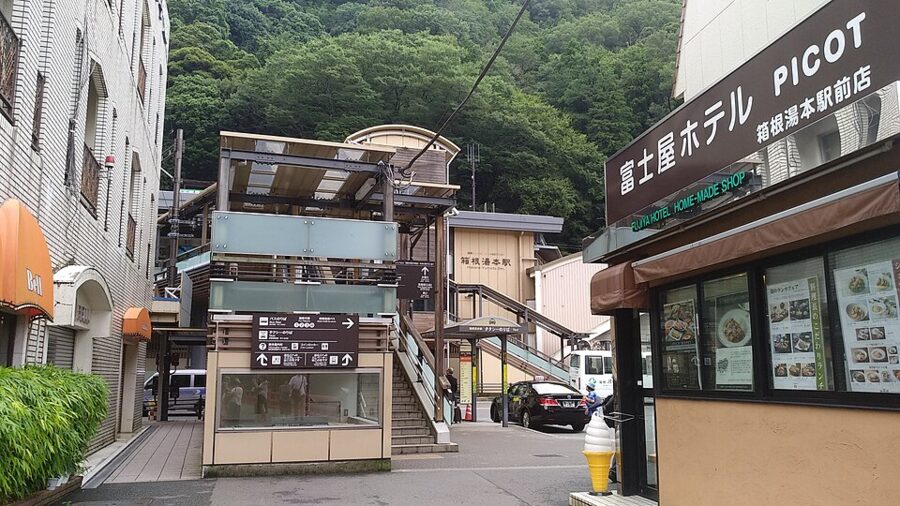
Most people arrive at Hakone-Yumoto, the town at the mouth of the Hayakawa gorge where Odakyu’s trains from Shinjuku end. Odawara, 15 minutes down the line, is where the Shinkansen and the JR lines meet the Hakone network, and the Hakone Tozan trains run between the two. Yumoto is the oldest of the hot spring towns, said to date from 738.
The Hakone Tozan Railway
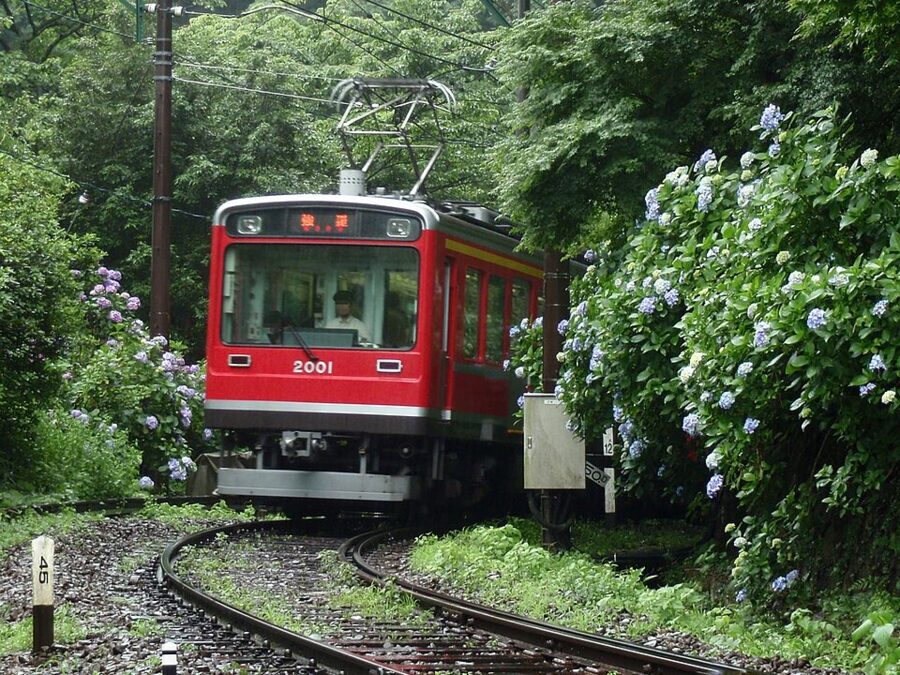
From Yumoto the Hakone Tozan Railway (箱根登山電車) climbs 8.9 kilometres to Gora. On the steepest sections it gains 80 metres for every kilometre, which makes it the steepest adhesion railway in Japan: no rack, no cable, just steel wheels on steel rail. The line was planned after Swiss mountain railways, especially the Bernina line, and opened in 1919 after seven years of work. A third of the way up, near Deyama, it crosses the Hayakawa gorge on a bridge 43 metres above the river and then reverses back over the hill above it.
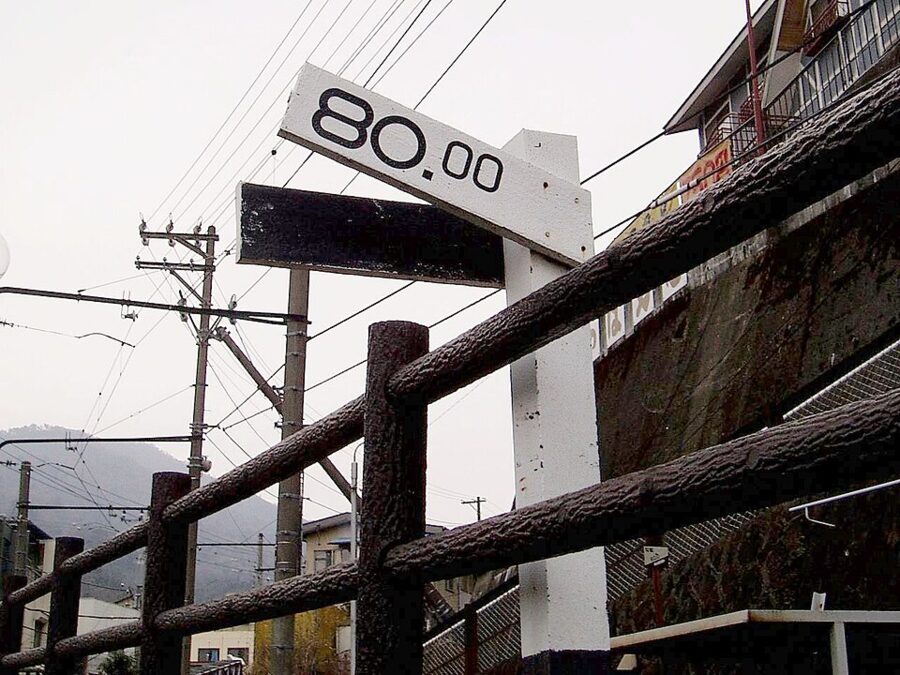

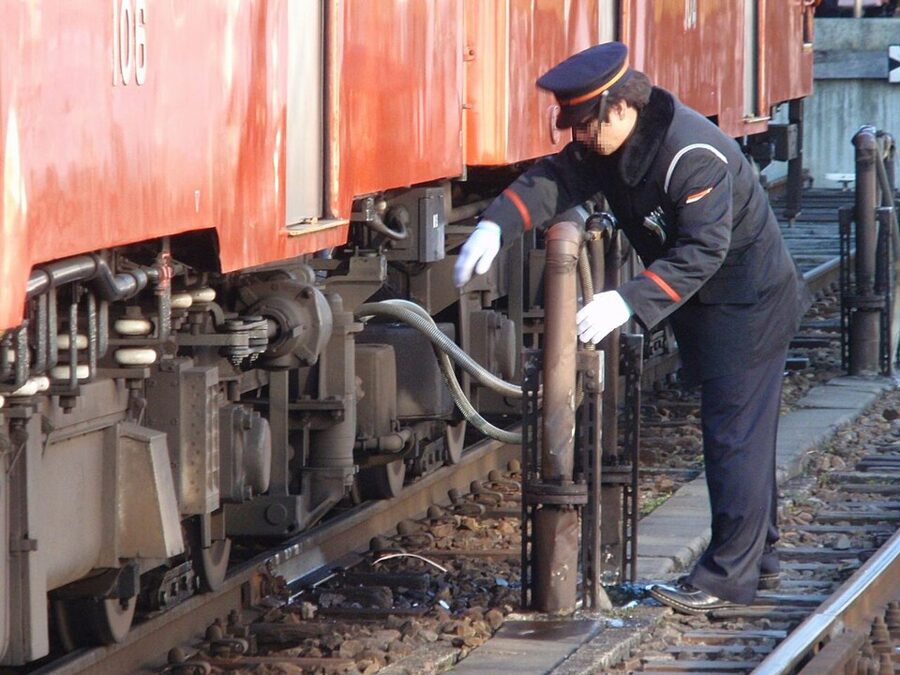
The curves are as extreme as the gradient. In places the radius is 30 metres, tight enough that the front and rear cars of a three-car train sit at almost 60 degrees to each other. Above Miyanoshita the builders were refused tunnels for fear of cutting the hot spring veins, so the line follows the contours instead. On those curves the trains spray water on the rails rather than grease, which on 80 per mille would let the wheels slip.
Typhoon Hagibis tore out bridges and buried the track in October 2019, and the section above Yumoto was closed for nine months; it reopened in July 2020. In April 2024 the operating company, Hakone Tozan Railway since 1928, merged into Odakyu Hakone, but the trains, the signs and the name you will hear are unchanged.
Gora and the cable car
Gora was empty hillside until 1911, when the railway company bought it to sell as villa plots. The steep estate needed its own transport, and in 1921 the company opened the Hakone Tozan Cable Car (箱根登山ケーブルカー), 1.2 kilometres up to Sounzan with every rail, car and winch imported from Switzerland. It climbs 209 metres in about 10 minutes and stops at four stations in between, one of them for Gora Park, a formal garden laid out in 1914.
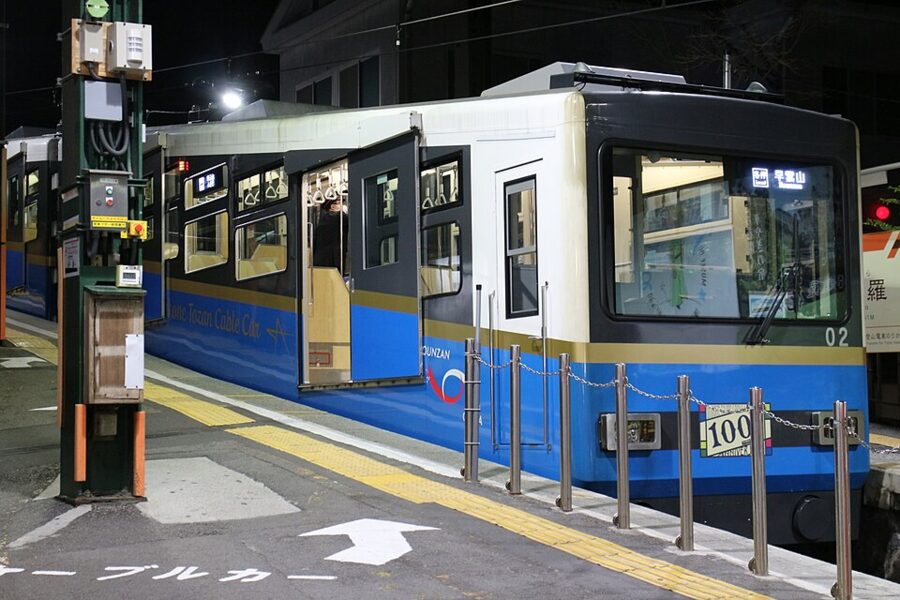

The cable car is the bottleneck of the loop. On a fine autumn weekend the queue at Gora can take longer than the ride, and on those days I would start from the other end.
The ropeway over Owakudani
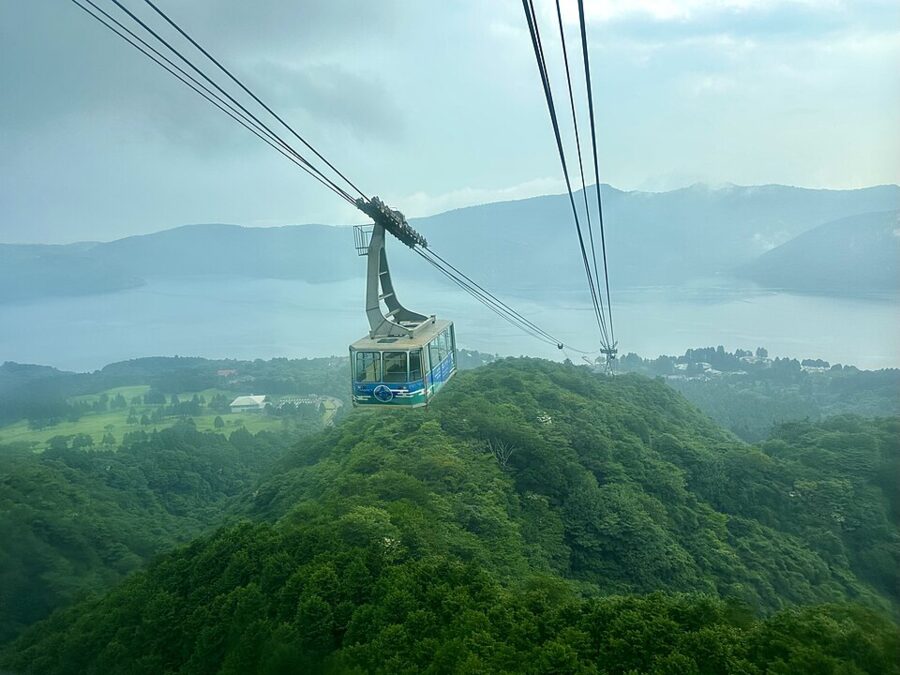
From Sounzan the Hakone Ropeway (箱根ロープウェイ) runs about 4 kilometres over the top of the caldera to Togendai on the lakeshore, changing gondolas at Owakudani. Each leg takes about 10 minutes and the 18-seat gondolas leave about once a minute. The system was rebuilt in the 2000s as a funitel, with each gondola hung from two cables, which stays open in winds that would close a single-cable line.
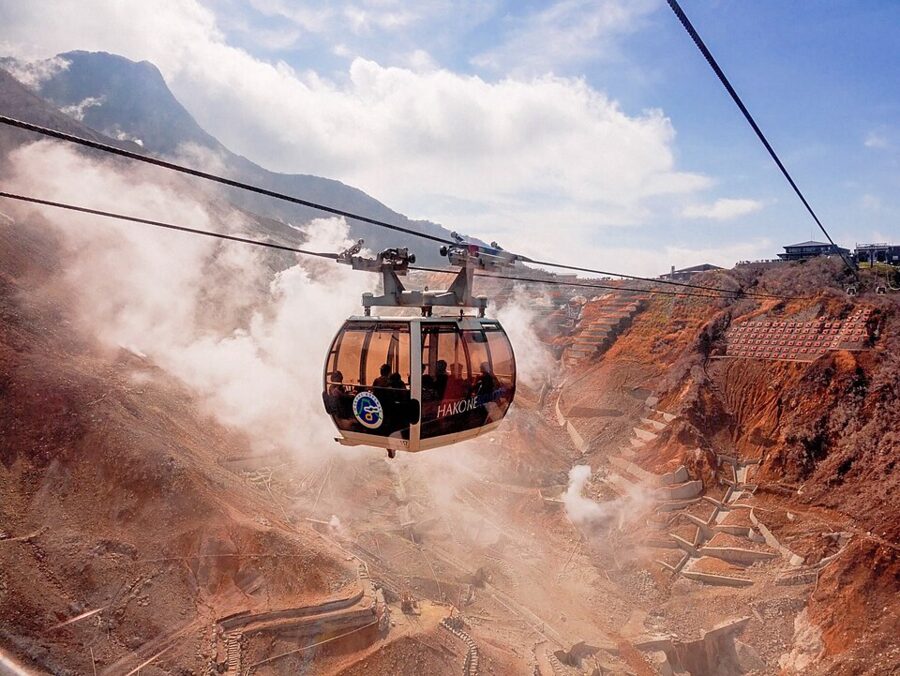

The fare is ¥2,000 one way and ¥3,000 return, and you can break the journey at any station. The ropeway runs 09:00–17:00 from February to November and 09:00–16:15 in December and January, stopping for high wind, lightning and high gas readings. It is the part of the loop most likely to close, so check before you set out, especially in typhoon season.
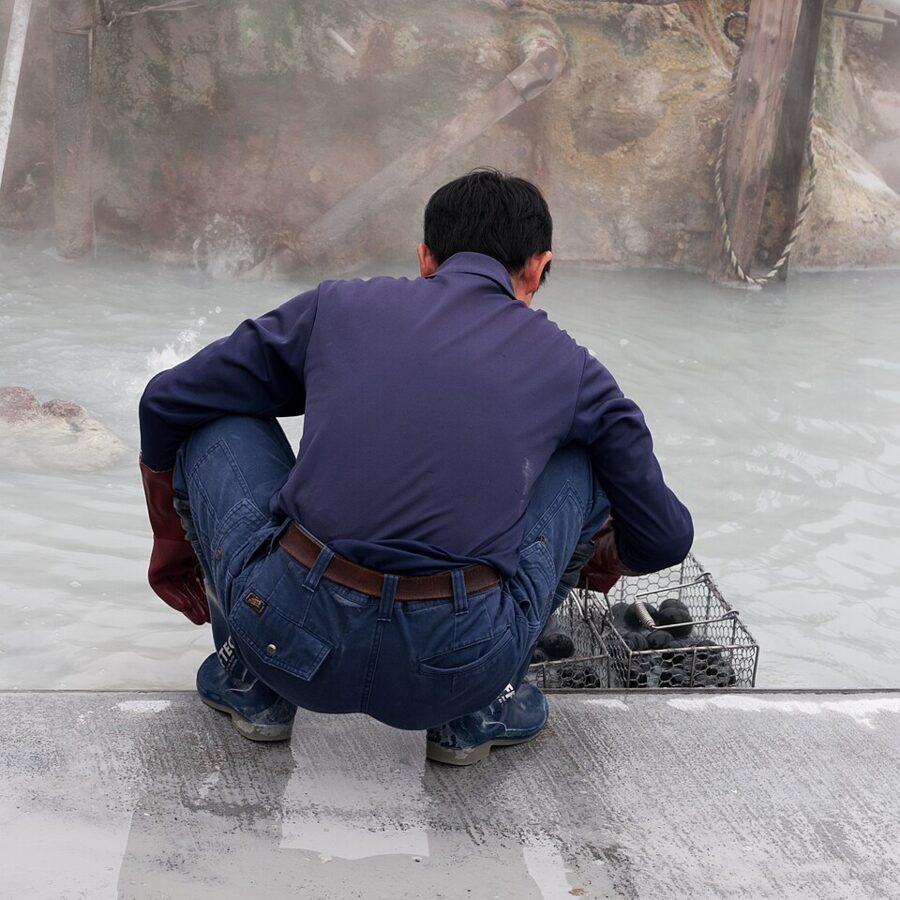
At Owakudani station you can buy black eggs, kurotamago, hen’s eggs boiled in a hot spring pool up the valley until the porous shells turn black; four cost ¥500 at the Kurotamago-kan shop. Each one is said to add seven years to your life. Why they turn black is less settled than the legend: the long-standing explanation is iron and sulphur from the water coating the shell, and a study in 2020 argued for a browning reaction instead.

Across Lake Ashi
From Togendai the Hakone Sightseeing Cruise (箱根海賊船) crosses Lake Ashi to Hakone-machi, by the checkpoint, and Moto-Hakone, by the shrine. The crossing takes about 25 to 40 minutes, and the one-way fare is ¥1,700. The ships are dressed up as seventeenth- and eighteenth-century men-of-war: the Victory is modelled on Nelson’s flagship, the Royal II on a French ship of the line, and the Queen Ashinoko, launched in 2019, was designed by Mitooka Eiji, the man behind many of Kyushu’s showpiece trains.
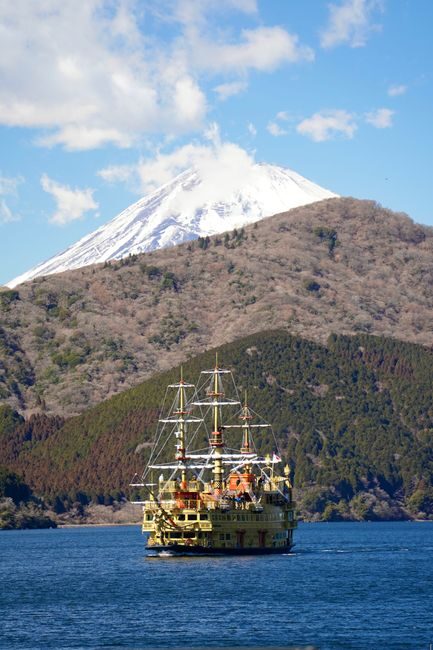
Lake Ashi is fed mostly by springs in its bed, and its water does not belong to Hakone. In 1670 the villagers of Fukara, on the Shizuoka side, cut a tunnel through the caldera rim to irrigate their fields, and the water rights went with it, so when the prefectures were drawn the lake ended up in Kanagawa and its water in Shizuoka. Black bass were first released in Japan here, in 1925.
The buses home, and which way round
From Moto-Hakone or Hakone-machi, Hakone Tozan buses run down Route 1 or the old road to Yumoto in about 35 to 50 minutes, depending on the route and the traffic, and on to Odawara. Other bus lines link Gora, Sengokuhara, Togendai and Gotemba, so you can cut corners off the loop.
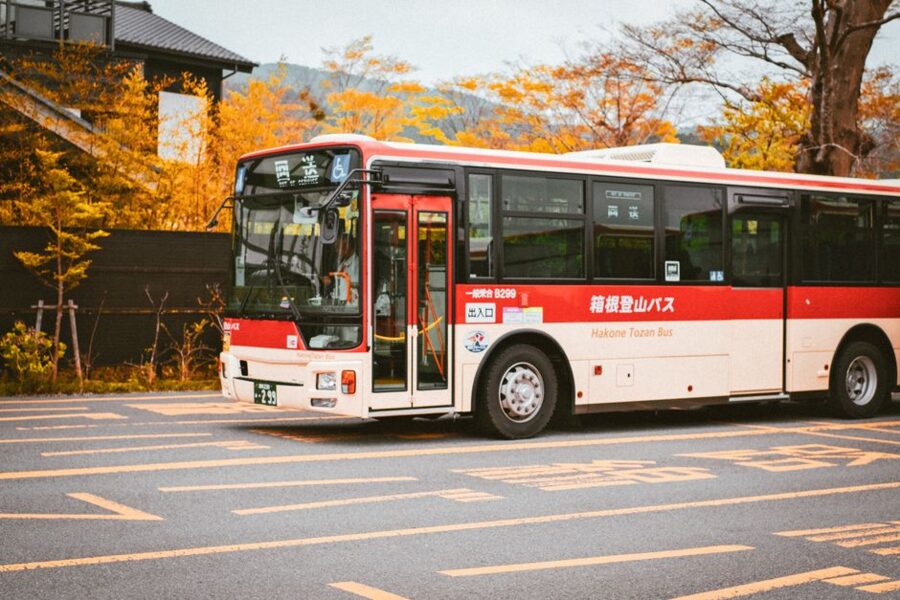
Most people go anticlockwise: train, cable car, ropeway, boat, bus. If you are staying the night, consider the opposite. Take an early bus from Yumoto to Moto-Hakone, cross the lake before the day-trippers reach Togendai, and ride the ropeway and the cable car downhill while the queues stand at the bottom waiting to go up.
The onsen
Hakone’s springs are counted by the name of the place, not by the well. The Edo period’s seven springs became eight with Ubako, an old spring left off the list because it lay away from the highway, and new resorts from the Meiji era on brought the count to seventeen and then twenty, the youngest dating from 1987. Some springs rise naturally; others, including much of Gora and Sengokuhara’s water, are made at Owakudani from steam and groundwater and piped down.
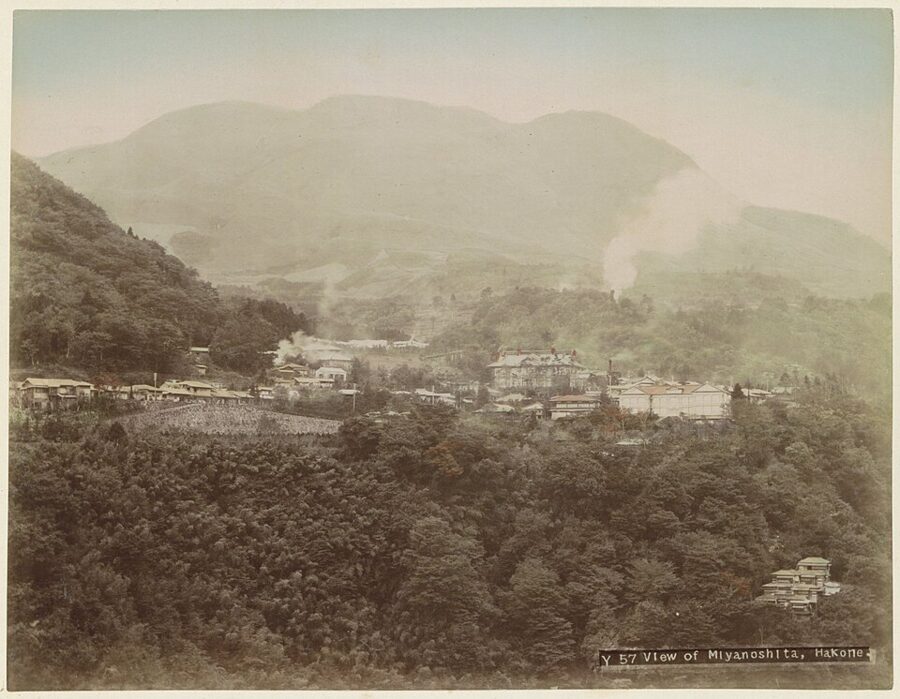
The water changes with the height. Yumoto and Tonosawa at the bottom are simple alkaline springs, clear and soft. Miyanoshita and Sokokura are salty, sodium chloride springs. Ashinoyu, the highest of the old seven, near the top of Route 1, has milky sulphur water.
How bathing works
The routine is the same in every Japanese hot spring. Shoes off at the entrance, clothes off in the changing room, and a full wash sitting on a stool at the taps before you go anywhere near the bath. The small towel goes on your head or on the side, never in the water. Swimwear is not worn except in the few places that ask for it, and the baths are separated by sex, with the curtain colour and the kanji 男 for men and 女 for women telling you which is which.
Soak, cool down, soak again, and keep your voice low: a public bath is not a pool.
Tattoos
Many Hakone baths still refuse people with tattoos, a rule that grew from tattoos’ association with organised crime and is now applied to tourists with a butterfly on the ankle as firmly as to anyone else. Rules vary from bath to bath and change, so check each one’s own site. Some day baths have dropped the restriction: Hakone Yuryo, in the woods at Tonosawa just above Yumoto, lifted it and calls itself tattoo-friendly. Otherwise the answer is a private bath, kashikiri, which many inns and day baths rent by the hour.
Day baths and ryokan
Hakone Yuryo has large indoor and outdoor baths and 19 private open-air bath rooms in three sizes. Further up the Sukumo valley at Oku-Yumoto, Tenzan Tohji-kyo is a big day bath complex of outdoor pools in a ravine; it closes for maintenance on 7–11 December 2026. Higher up, many hotels in Gora, Miyanoshita and Sengokuhara open their baths to day visitors in the early afternoon.
But the reason to stay the night is the ryokan, and in Hakone it is worth paying for. A night typically includes a kaiseki dinner of many small courses, breakfast, a yukata to wear around the inn and as many baths as you like, including the one late at night with the steam rising off the water into cold air. Many rooms have their own outdoor bath on the balcony. Prices start well above a city business hotel and rise steeply on Saturday nights and in autumn, so a Sunday or a weeknight is the better buy.
Museums and gardens
A century of rich collectors with villas in the hills has left Hakone with more art museums than most Japanese cities, most of them on the Gora side within a short bus ride of the loop.
The Hakone Open-Air Museum
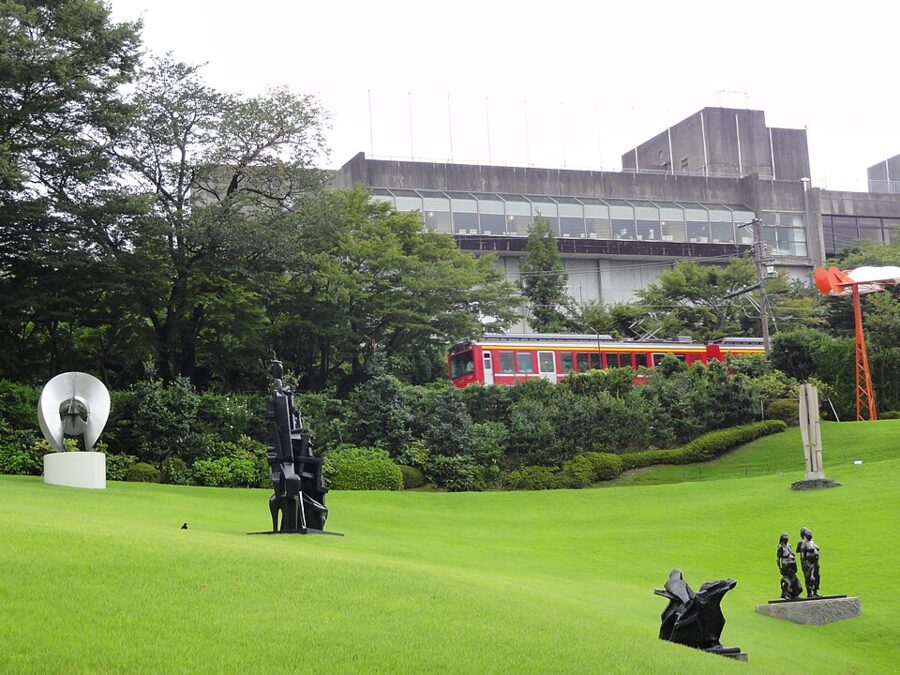
Opened in 1969 as Japan’s first open-air museum, it sets sculpture by Henry Moore and dozens of Japanese and European artists across lawns between the hills, with the Tozan railway running along its edge. Indoors, the Picasso Pavilion holds one of the larger Picasso collections in Asia, much of it ceramics. Admission is ¥2,000 at the door or ¥1,800 online, 09:00–17:00 every day; the station, Chokoku-no-Mori, is one stop below Gora.

Pola Museum of Art
In the beech woods of Sengokuhara, the Pola Museum of Art was built in 2002, mostly underground, to keep its height below the trees. The collection was built by Suzuki Tsuneshi, who ran the Pola cosmetics group, and is strongest on French Impressionism and on Japanese Western-style painting, with Monet, Renoir and Picasso, plus glass and cosmetic boxes. A forest walk runs behind it. Admission is ¥2,200, 09:00–17:00 daily, by bus from Gora or Sengokuhara.

Hakone Museum of Art
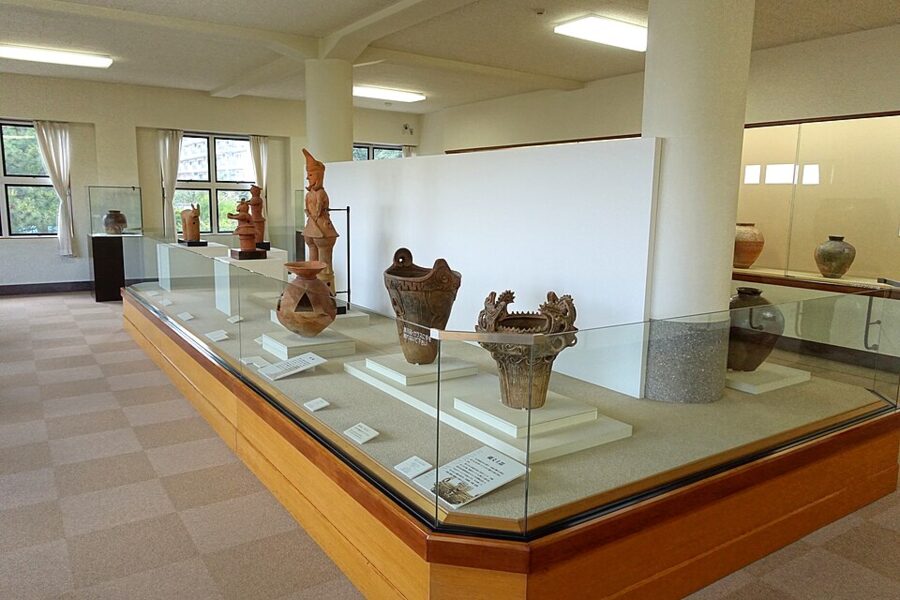
The oldest museum in Hakone, opened in Gora in 1952 by the religious leader and collector Okada Mokichi, shows mainly Japanese ceramics from the prehistoric period to the Edo era. Its garden is the draw: a moss garden of about 130 kinds of moss under 200 maples, a bamboo grove and a tea house, Shinwatei, where you can take matcha looking over the moss. It is the best autumn colour on the Gora side, usually in the first half of November.
Okada Museum of Art and Narukawa Art Museum
The Okada Museum of Art at Kowakudani, opened in 2013 on the site of a Meiji-era hotel by a businessman who made his fortune in pachislot machines, is the grandest and most expensive of them, with five floors of Japanese, Chinese and Korean ceramics and painting. Admission is ¥2,800, 09:00–17:00.
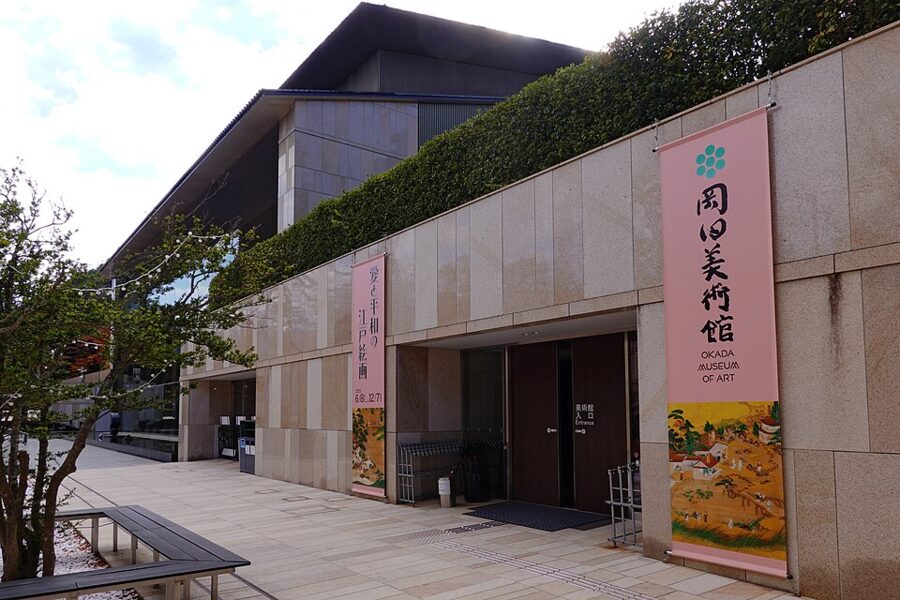

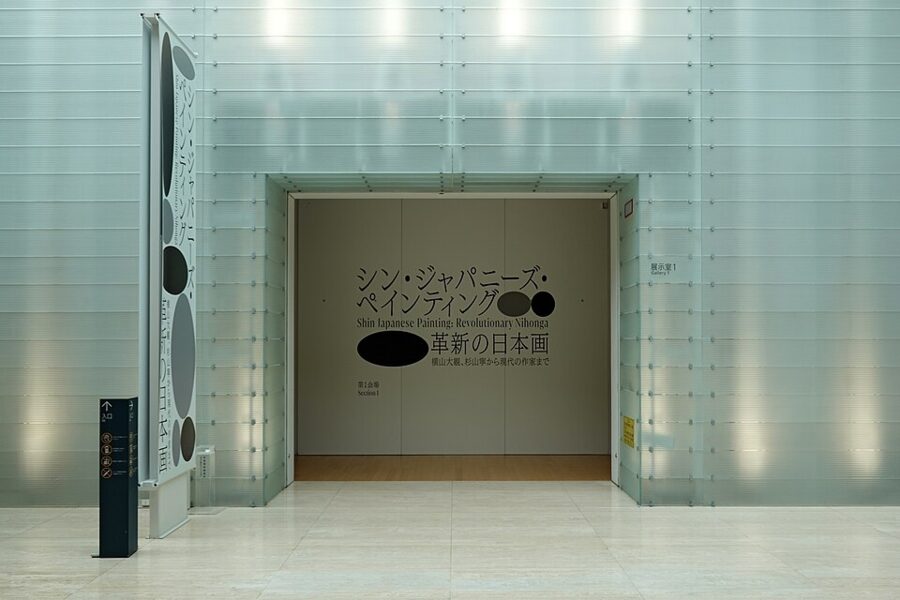
On the hill above Moto-Hakone, the Narukawa Art Museum has collected modern Nihonga, Japanese-style painting, since 1988, and its windows look down over the lake and the shrine’s red torii. It is the quiet alternative to the shrine queue and a good place to wait out a shower.
Hakone Shrine and its lake torii
Hakone Shrine (箱根神社) sits among cedars on the shore at Moto-Hakone. The mountain was a place of worship long before it had a name in the records; tradition says the monk Mangan rebuilt a shrine here in 757 and subdued a nine-headed dragon that lived in the lake, now enshrined as Kuzuryu. Minamoto no Yoritomo took refuge with the shrine’s priests after his defeat at Ishibashiyama in 1180, and for the next four centuries the warriors of the Kamakura shogunate and the Hojo of Odawara made it one of the great shrines of the east.
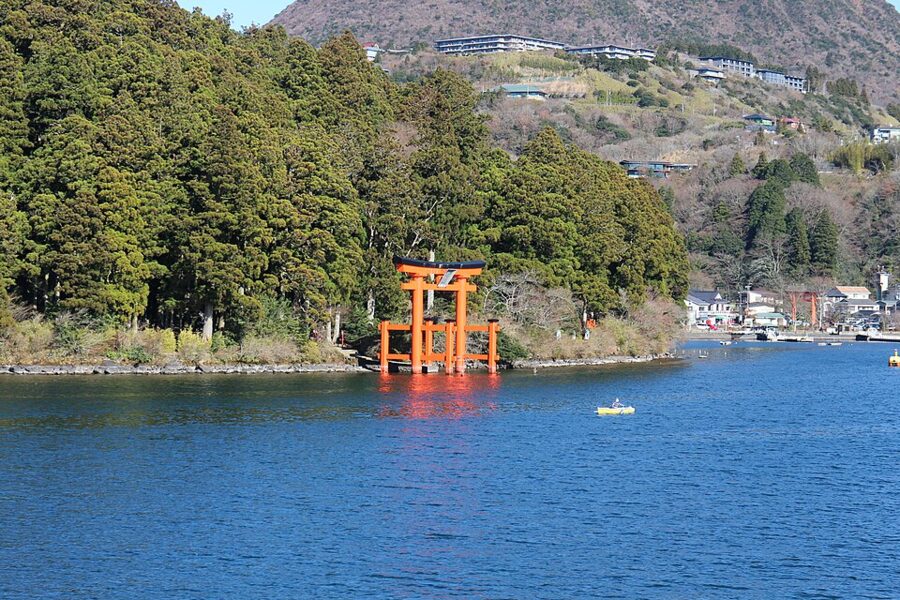

The torii standing in the water below the shrine is the photograph everyone wants, and there is usually a queue for the steps beneath it. The view from a boat or from the Narukawa museum is as good and costs no waiting.
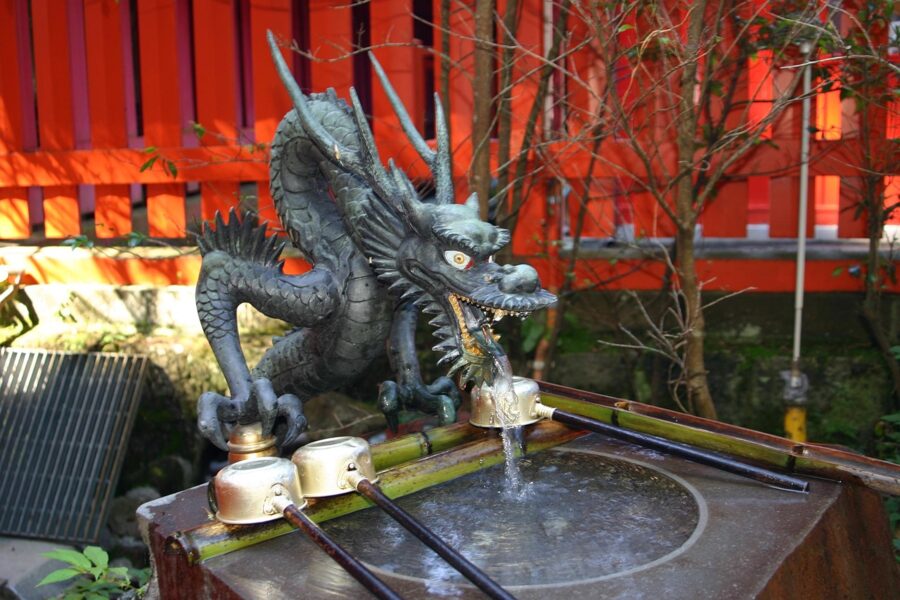
On 31 July, the day of the lake festival, the shrine closes the area around the torii for a purification rite.
Seeing Fuji
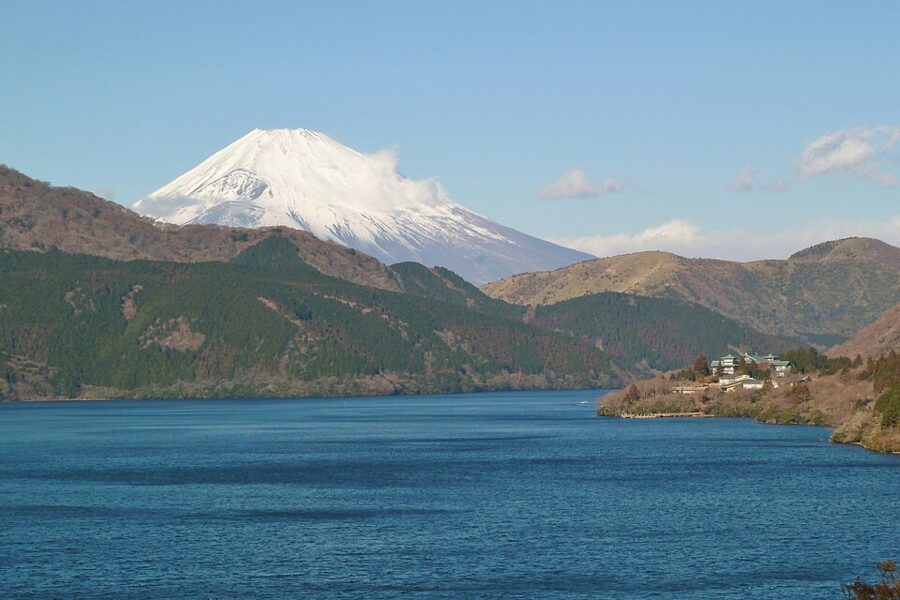
Mount Fuji is outside the caldera, about 25 kilometres west of Lake Ashi, and from inside Hakone you see it over the western rim. The volcano itself, its Five Lakes and its climbing season belong to Chubu, the region it stands in; what matters here is when it is out.
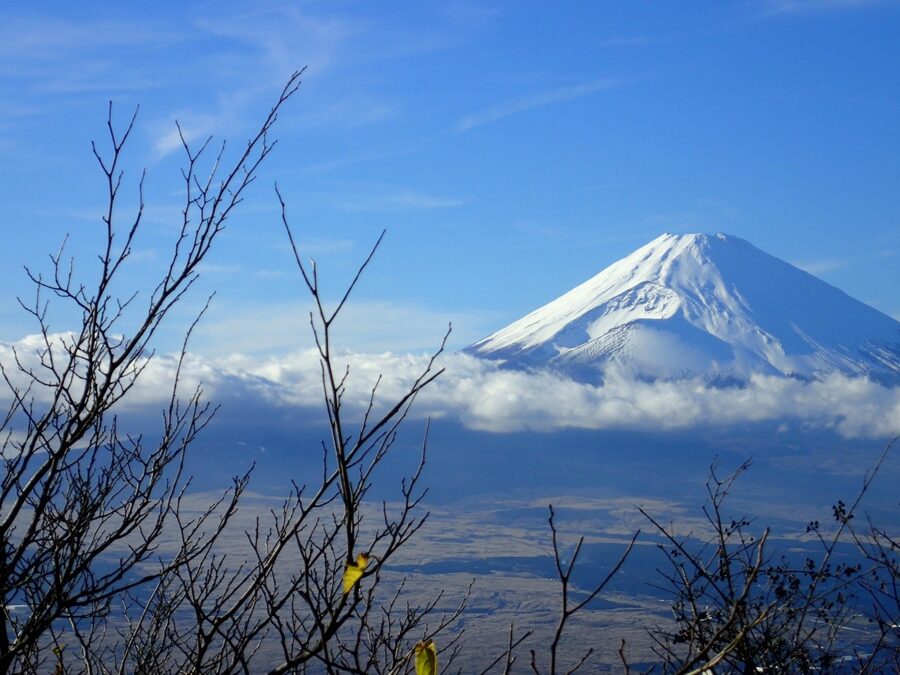
Plainly put, it is hidden more often than not. Hakone is wet and catches cloud on its ridges, fog is the rule in June and July, and on dry summer days haze usually hides Fuji by mid-morning. The best months are November to February, when dry winds from the north-west clear the air, and the best hours are the first ones of the day. If you see Fuji from your ryokan window at 07:00, go straight out, because by noon it may well be gone.
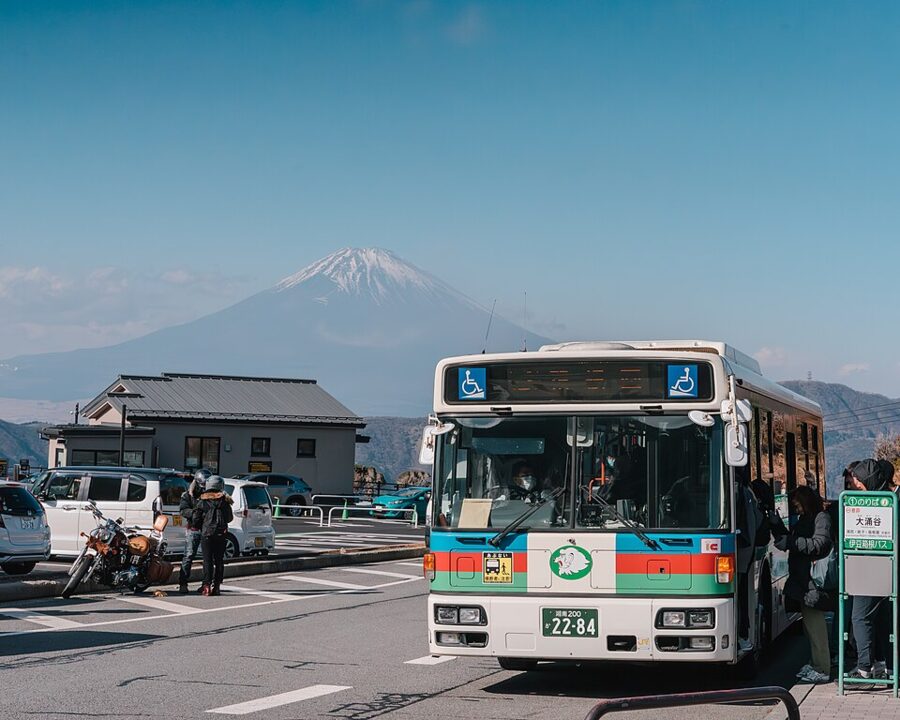

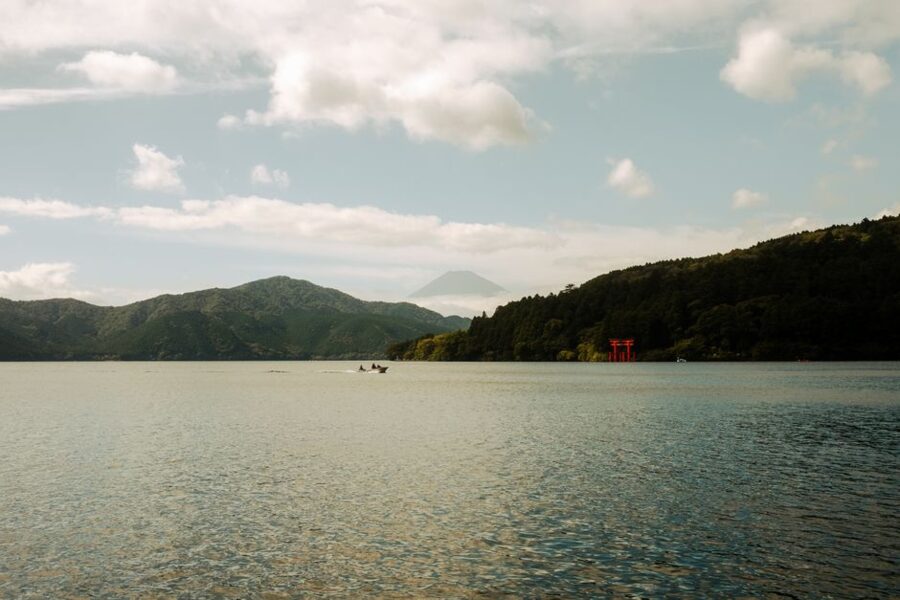
The best viewpoints, roughly in order of reliability:
- Onshi Hakone Park, on the peninsula between the checkpoint and Moto-Hakone, the grounds of an imperial villa built in 1886 and opened to the public in 1946. Free, and the lake view from the lookout is the classic one.
- The ropeway between Owakudani and Togendai, where Fuji sits over the end of the lake for much of the descent.
- Owakudani station terrace, looking west across the steam.
- Komagatake, reached by the Hakone Komagatake Ropeway from Hakone-en on the east shore, about 7 minutes up; the summit platform, renamed Ashi-no-Sora in April 2025, looks out over the lake, Fuji and Sagami Bay.
- The summit of Kintoki, on the northern rim, a steep hour or so on foot from Otome pass.

Getting there, the Freepass and the crowds
From Shinjuku, Odakyu’s Romancecar limited express runs direct to Hakone-Yumoto in about 80 minutes. All seats are reserved; the limited express ticket is ¥1,200 on top of the ordinary fare or the Freepass. Ordinary Odakyu trains, changing at Odawara, take longer and cost less. The GSE trains have an observation car at the front with a view down the line.
From elsewhere in Japan, take the Tokaido Shinkansen to Odawara, about 35 to 40 minutes from Tokyo on the trains that stop there, and change to the Hakone Tozan line or a bus. The Japan Rail Pass covers the JR leg to Odawara and nothing beyond it, since every railway in Hakone is private.
The Hakone Freepass
Odakyu’s Hakone Freepass has been on sale since 1967 and covers the train, cable car, ropeway, boat and most buses in the area, eight kinds of transport in all, plus discounts at about 70 museums, baths and restaurants. For 2026 it costs:
| Starting from | 2 days | 3 days |
|---|---|---|
| Shinjuku (with a return to Odawara) | ¥7,100 | ¥7,500 |
| Odawara (Hakone area only) | ¥6,000 | ¥6,400 |
Children aged 6 to 11 pay ¥1,500–1,850, and the Romancecar is ¥1,200 extra each way. The ropeway and the boat alone cost ¥3,700; add the train, cable car and bus and one loop comes to roughly the price of the pass from Odawara, so anything after that is free.
The pass is sold at Odakyu stations or as a QR ticket online. It does not cover the Izu-Hakone buses, the other boats on the lake or the Komagatake ropeway.
Crowds and luggage
Hakone is busiest at weekends, in Golden Week in early May, in August and at the peak of the autumn colour in November. The first two days of January are their own case: the Ekiden closes Route 1 for hours. A weekday in the shoulder seasons halves every queue.
Do not drag a suitcase round the loop. The Hakone Luggage Transport Service at Hakone-Yumoto station takes bags from 08:30 to 12:00 and delivers them to partner inns from 15:00, for ¥1,500 a piece (up to 140 centimetres and 15 kilograms) or ¥2,500 for a large one. For the return, hand your bags to the front desk by 10:00 and collect them at Yumoto between 13:30 and 18:30.
Food and craft
Hakone does not have a great cuisine of its own; it has the food of a place where people stop on a hard road. Amazake and grilled rice cakes at the tea house, eggs at Owakudani, and in Yumoto, soba. Hatsuhana, by the bridge over the Hayakawa five minutes from the station, has served soba since 1934, made with grated jinenjo, wild mountain yam, and egg instead of water.
The other food you will see everywhere in Yumoto is tofu, made with the valley’s soft water and sold fresh, along with yuba, the skin lifted from heated soy milk, and tofu sweets. On Lake Ashi the specialities are the fish: wakasagi tempura and trout.
Yosegi marquetry
Hakone’s craft is yosegi zaiku, marquetry made from natural woods of different colours. The craftsman glues thin strips of woods such as dogwood, Japanese bitter-wood and cherry into a block with a geometric pattern in cross section, then shaves the block into veneer sheets thinner than paper and lays them over boxes, trays and coasters. No dye is used; the white, yellow, red and black are the woods themselves. Most accounts place its beginning at Hatajuku, the hamlet on the old road, in the late Edo period, and credit a woodworker named Ishikawa Nihei; a few push it much further back.
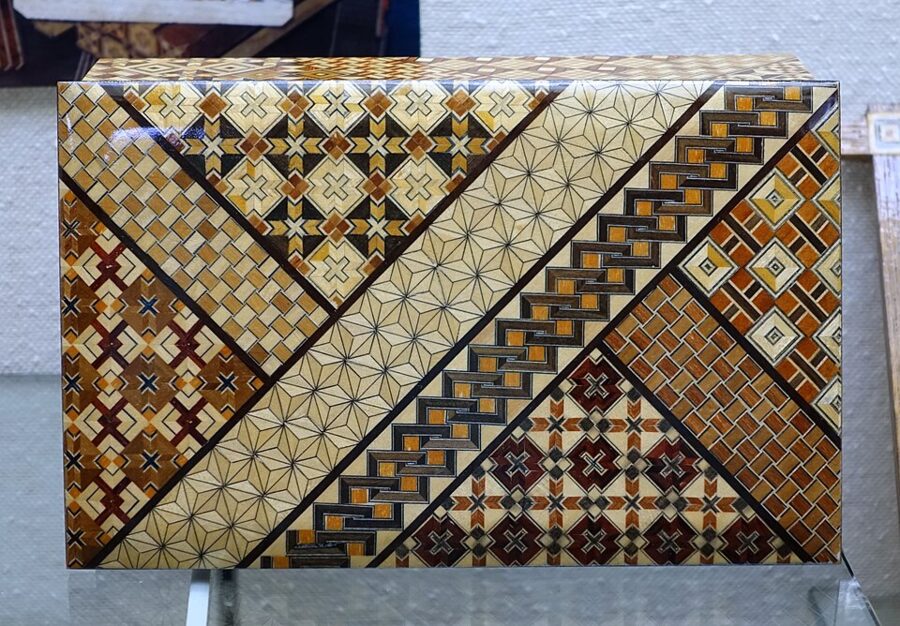
Hatajuku still has workshops on the old road. At Hamamatsuya’s workshop you can watch craftsmen at work (09:30–17:00, demonstrations until 16:30) and buy from them. The trophy for the team that wins the outbound leg of the Hakone Ekiden is made of yosegi.
Seasons, and the Ekiden
Each Hakone season has its own reason to go and its own catch. The general picture across Japan is in when to go; here is the mountain’s version.
Spring. Cherry blossom comes later than in Tokyo and works its way up the mountain through April, and the azaleas around Lake Ashi peak in May. Golden Week is the busiest time of the year.
Summer. From mid-June to mid-July the Tozan railway becomes the hydrangea train, as the more than 10,000 bushes planted along the track to hold the banks bloom. On some evenings the flowers are lit and special night trains run. July and August are cooler than Tokyo, wetter, and foggy.
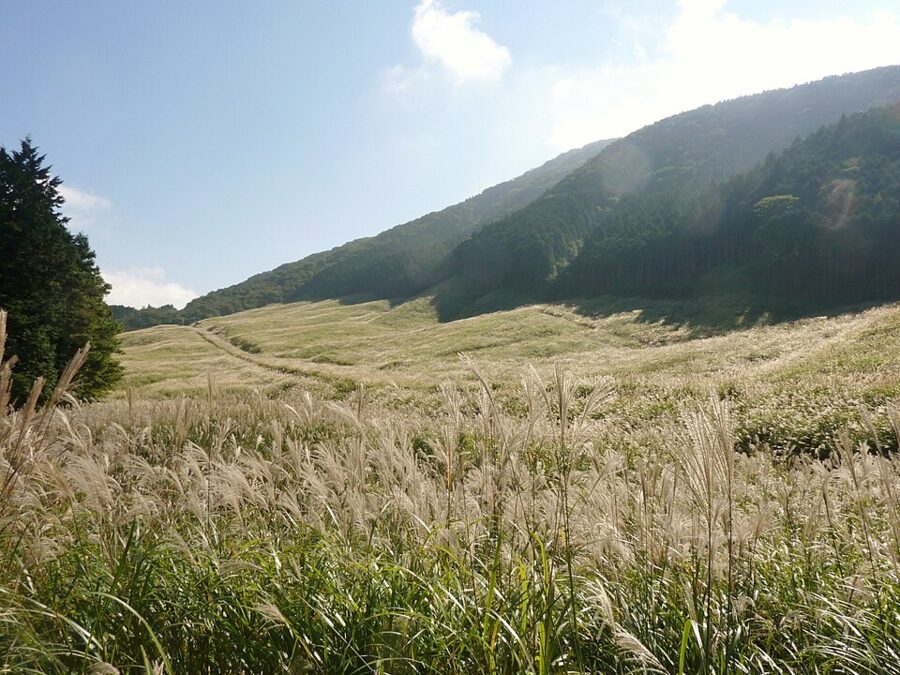
Autumn. The susuki grass at Sengokuhara turns silver and gold from late September to mid-November, and the maples colour from the tops down, usually reaching Gora and the lake in the first half of November and Yumoto later in the month. It is the most beautiful time and the most crowded.
Winter. Clear, cold and quiet, with the best chance of Fuji and the best reason to sit in an outdoor bath. Snow can close the higher roads.
The Hakone Ekiden
Every year on 2 and 3 January, university relay teams run from Otemachi in central Tokyo to the shore of Lake Ashi and back, about 217 kilometres over two days. The fifth leg, 20.8 kilometres from Odawara to the lake, climbs 864 metres up Route 1, past Miyanoshita and the Fujiya Hotel, and the best of the runners who take it are celebrated as “gods of the mountain”.
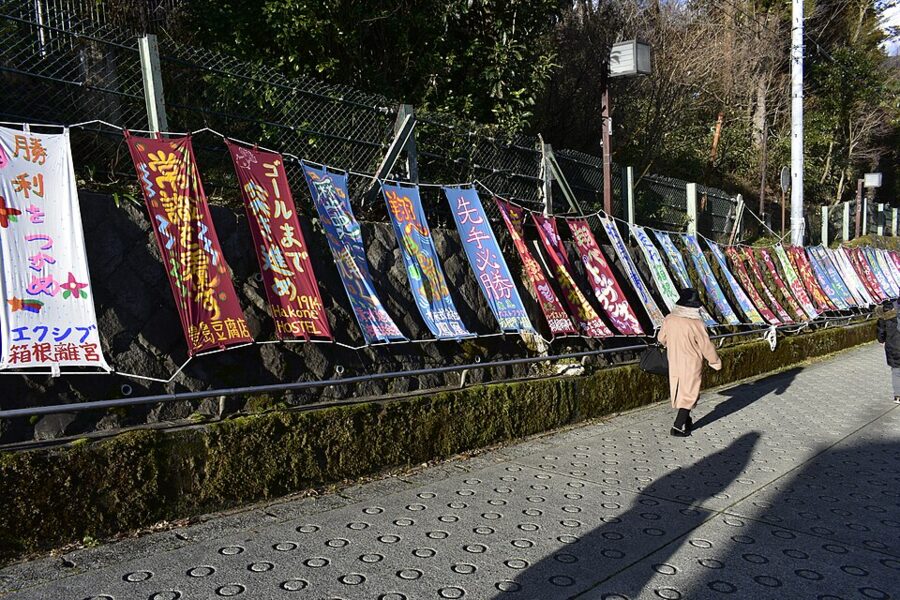

If you come for the race, stand somewhere on the climb and leave by train, since Route 1 is closed for hours. If not, avoid 2 and 3 January altogether.
Plans for a day and for two
One day from Tokyo
Take an early Romancecar to Yumoto, then the Tozan train to Gora and the cable car to Sounzan. Ride the ropeway to Owakudani, eat an egg, then continue to Togendai, take the boat to Moto-Hakone and walk the cedar avenue to the checkpoint. Take the bus down to Yumoto, bathe at a day spa near the town, and catch the Romancecar back in the evening. It is a full day with no museum in it; if you want one, drop the checkpoint and stop at the Open-Air Museum on the way up.
Two days
Day 1: Yumoto by mid-morning, bags to the luggage service. Tozan train to Miyanoshita for lunch and a look at the Fujiya, then the Open-Air Museum, and the Hakone Museum of Art or the Pola in the afternoon. Sleep in Gora or Miyanoshita.
Day 2: Up early to look for Fuji. Cable car and ropeway as soon as they open, Owakudani before the crowds, boat to Hakone-machi, checkpoint, cedar avenue, shrine. Then either the bus down, or the bus to Amazake Chaya and the walk down the stone road to Hatajuku, with an hour at the yosegi workshops, and the bus from there to Yumoto.
With a third day, climb Kintoki from Otome pass for the Fuji view over the rim, or walk the whole old road from Moto-Hakone to Yumoto. And if you have more time in the region, Hakone pairs well with Kamakura, which Odakyu sells on the same combined pass, or with the other great Tokyo getaway, Nikko, two hours north, for a week in Kanto.
Whichever way you go, take the train down at the end. The driver and the conductor change ends three times, the gorge drops away and then rises again outside the window, and at the last switchback the train turns to face Yumoto and runs down the 80 per mille grade into the town, the way the travellers on the stone road came down, a good deal faster.