
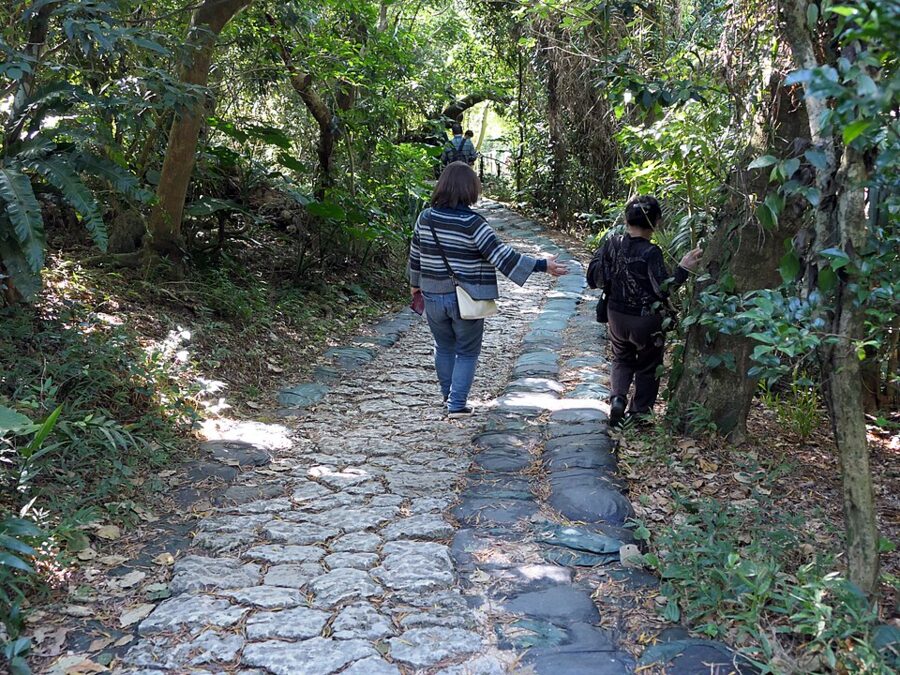

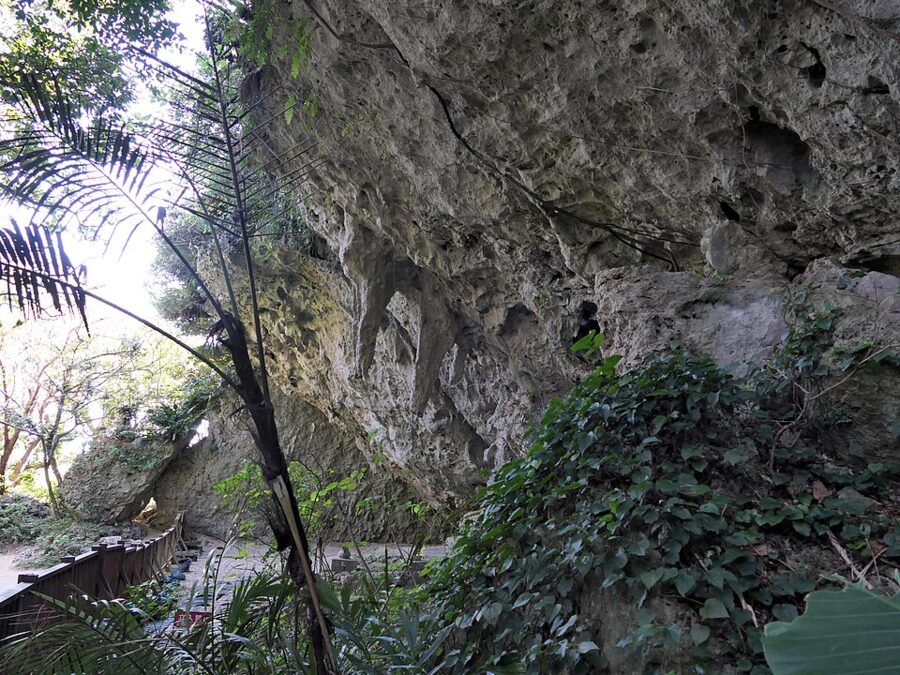
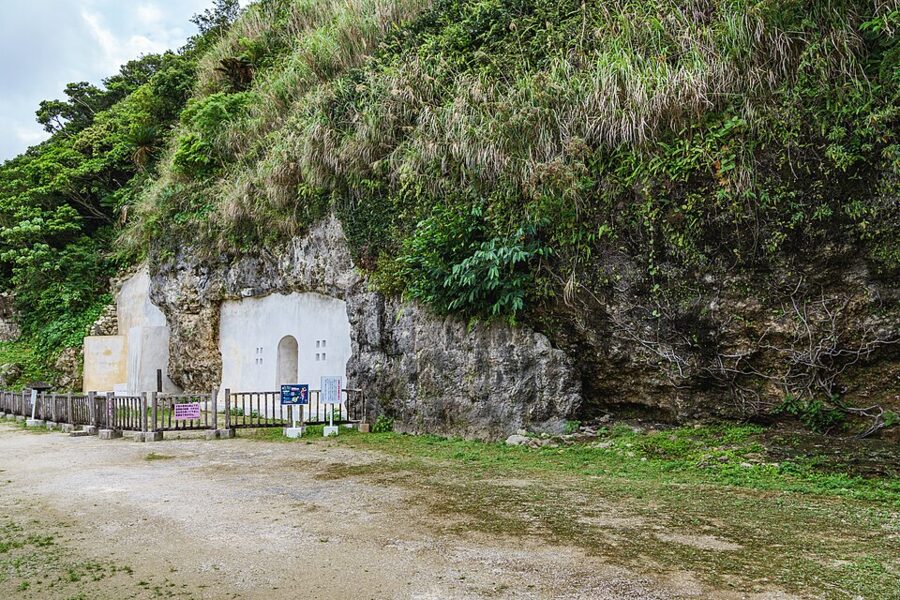
At the Ujoguchi, the gateway into the sacred grove of Sefa-utaki (斎場御嶽), the king of Ryukyu had to stop and refold the front of his robe the way a woman wore hers. Past that point the grove belonged to women. The man who ruled the islands from Shuri went in on their terms, to a sanctuary run by a woman of his own family, often his sister.
She was the Kikoe-okimi (聞得大君), the high priestess of the kingdom, ranked next after the king himself. Her installation took place here, among the limestone overhangs, and the sand spread on the ground for the great state rites was brought over by boat from Kudaka, the small flat island offshore that Okinawans still call the island of the gods.
The Ryukyu Kingdom (琉球王国) lasted 450 years, from 1429 to 1879, ruling a chain of islands whose population sources put at about 170,000 at its height. It had no gold, no silver and poor soil for rice. What it had was a position: halfway between China and Japan, and on the monsoon route to Siam and Malacca. Out of that it built a trading state, a court with its own theatre, music, cloth and cooking, and a religion led by women, and much of it can still be seen on Okinawa today.

Five castle sites and four related places were inscribed together in 2000 as the Gusuku Sites and Related Properties of the Kingdom of Ryukyu, one of Japan’s UNESCO World Heritage sites.

In this guide
Before the kingdom: castles and three mountains
From about the twelfth century, farming communities on Okinawa Island were led by local chiefs called aji (按司), and each built a gusuku, a walled stronghold on high ground. A gusuku was a fort, a residence and a sacred place at once, and most of them hold a grove of worship inside the walls. Archaeologists call the period the Gusuku age.
By the fourteenth century the aji had sorted themselves into three loose federations. Chinese records call them Shanbei, Zhongshan and Shannan, the north, middle and south “mountains”, read in Okinawa as Hokuzan (北山), Chuzan (中山) and Nanzan (南山). “Mountain” here probably meant island, a Chinese habit that also gave Yaeyama its name. The century of rivalry between them is the Sanzan, or Three Mountains, period.
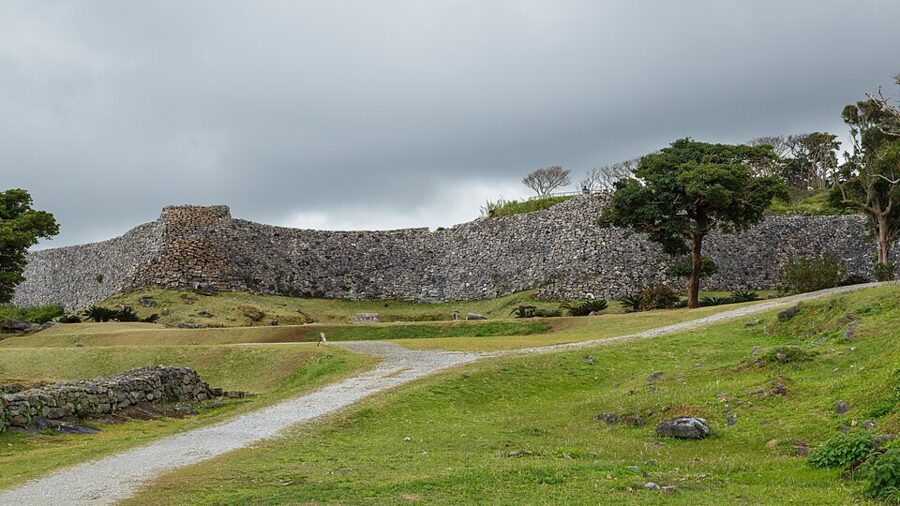

Hokuzan held the largest territory, the forested north, from Nakijin. Nanzan held the south. Chuzan, in the middle, had less land but the best harbour, at Naha, and in 1372 its king, Satto, answered a summons from the new Ming emperor and sent the first tribute mission to China. The other two followed, so for a few decades the Ming court received envoys from three kings of one small island.
Tribute was the key that opened Chinese ports. A ruler recognised by the emperor could send missions, and the missions traded. China supplied the ships and, from 1392 by Okinawan tradition, a community of Fujianese families who settled at Kume in Naha to run the paperwork, the navigation and the interpreting. Their descendants served the court as scholars and diplomats until the kingdom ended.
Sho Hashi and 1429
The man who joined the three was a minor lord from Sashiki, on the south-east coast. Sho Hashi (尚巴志) overthrew the king of Chuzan in 1406 and put his own father on the throne, then moved the capital from Urasoe to Shuri. He took Nakijin in 1416, became king himself in 1422 and destroyed Nanzan in 1429, the date taken as the founding of the kingdom. The Ming court gave the family the surname Sho.

Historians argue about how much “unification” meant. The title the kings kept was still King of Chuzan, and fighting among the great lords went on for decades. The rivalry between Gosamaru of Nakagusuku and Amawari of Katsuren, both nominally the king’s men, ended in 1458 with both of them dead. What 1429 really marks is the point after which only one king on Okinawa sent envoys to China.

A kingdom that lived by the sea
For the next century and a half Ryukyu made its living as a go-between. Ming China had closed its coast to private trade, and Japan was barred from the tribute system for long stretches, so goods that could not pass directly between them passed through Naha. Japanese swords, fans, lacquer, silver and copper went south and west; Chinese silk, porcelain, coins and medicines went north; and Ryukyuan ships went on to Southeast Asia for pepper, sappanwood for red dye, tin, ivory and spirits.
The kingdom’s own diplomatic archive, the Rekidai Hoan (歴代宝案), copies of letters sent and received, records about 150 voyages to Southeast Asia between 1424 and the 1630s. Sixty-one were to Siam, ten to Malacca, ten to Pattani and eight to Java. A Portuguese apothecary in Malacca, Tome Pires, wrote in about 1515 that the people he called Lequeos were truthful, better dressed than the Chinese and proud. Other Portuguese accounts of the time add that they sailed as soon as their business was done.
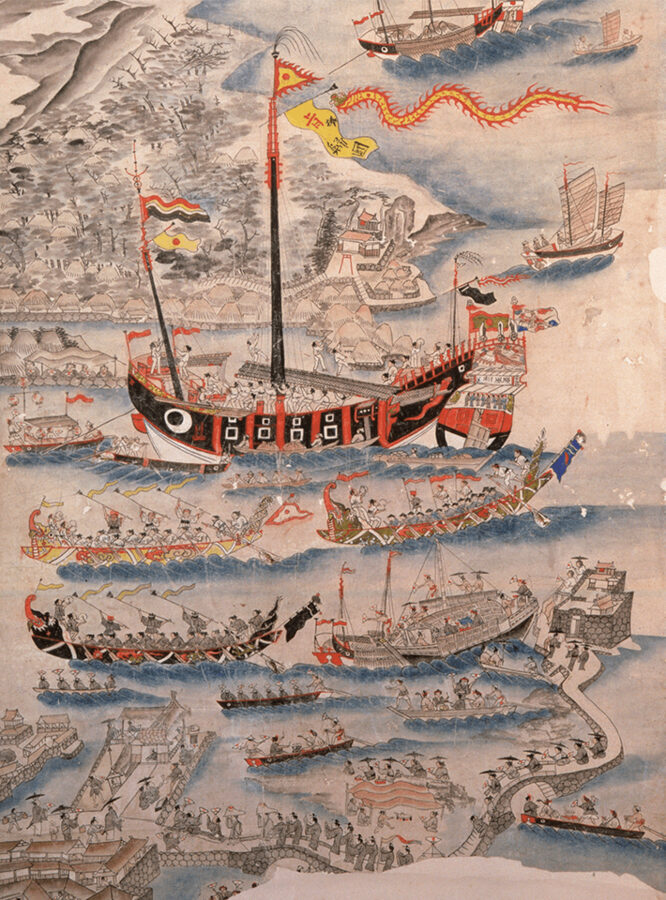
Missions to China landed at Fuzhou, in Fujian, where the Ming and later the Qing kept a compound for them. Envoys went on overland to Beijing, a journey of months; the rest stayed in Fuzhou to trade and study. Ryukyuans who died there were buried in Fuzhou, and their gravestones are still kept at the old compound.
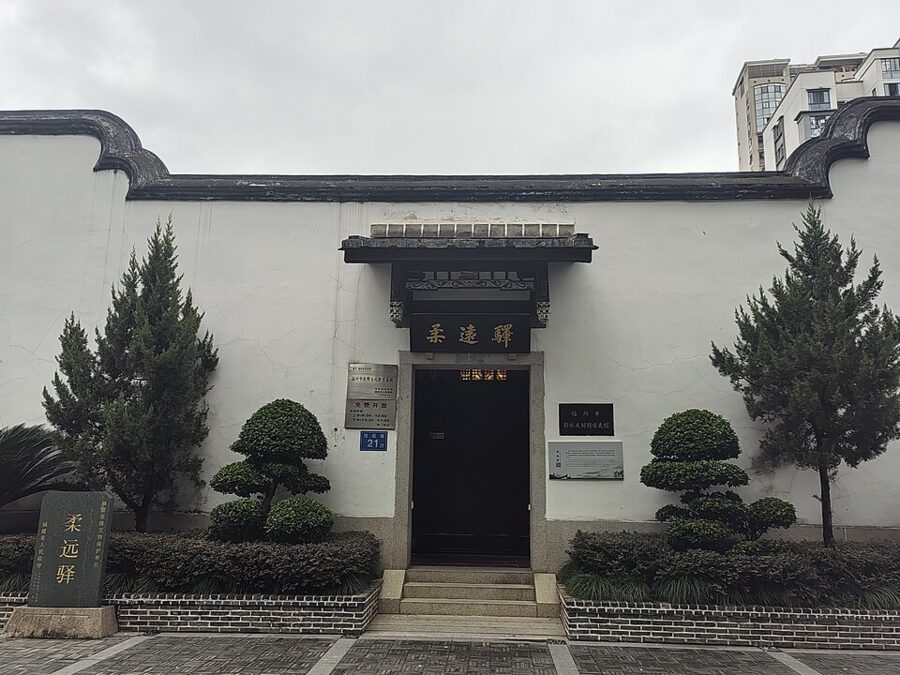

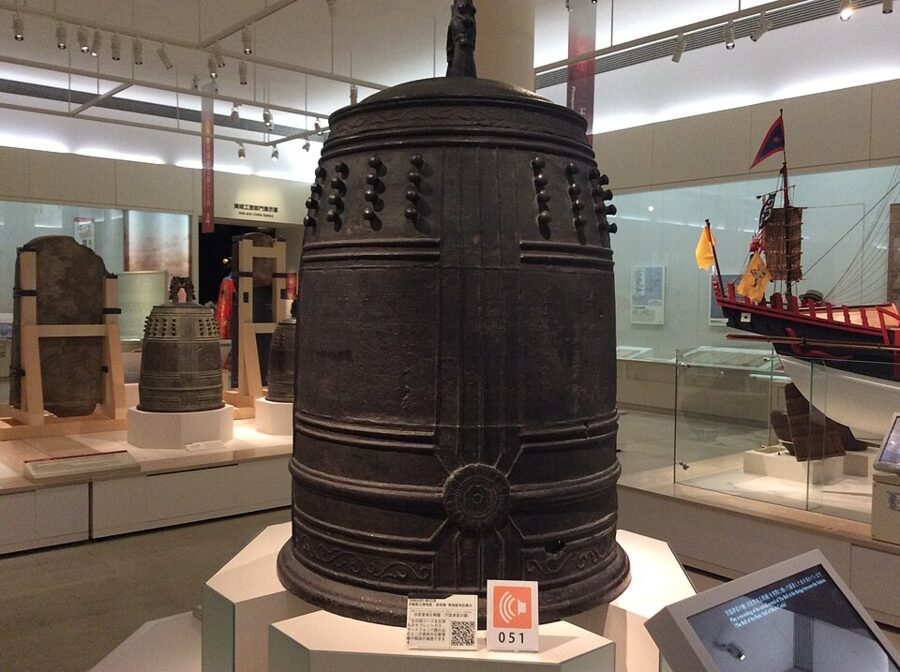
The Bridge of Nations bell
In 1458 King Sho Taikyu had a large bronze bell cast for Shuri. It stands 154.9 centimetres tall and weighs 721 kilograms, and its maker signed it Fujiwara Kuniyoshi, probably a founder from northern Kyushu. The inscription, by a Zen monk, opens with the lines that gave the bell its modern name, the Bankoku Shinryo no Kane (万国津梁の鐘), the Bridge of Nations bell.
Ryukyu, it says, is a fine land in the southern sea. It gathers the best of Korea, depends on Ming China as the jaw depends on the cheek, and is as close to Japan as lips to teeth; it is an island of immortals rising between the two, and it makes its ships a bridge to all nations. The rest of the text is about Buddhism, and it was a temple bell before it was a symbol. But that first passage now hangs as a screen in the Okinawa governor’s reception room, and the venue of the 2000 G8 summit in Nago was named after it.

Two Sho dynasties
The family of Sho Hashi did not last. His grandson Sho Toku led an expensive invasion of Kikai Island in the Amami group in 1466, and when he died in 1469 the court turned on his heir, who was killed. The throne went to Kanemaru, a farmer’s son from Izena Island who had risen to run the kingdom’s trade. He took the name Sho En (尚円), so the new line kept the old surname and presented itself to the Chinese court as the same royal house.
Historians call it the second Sho dynasty, and it ruled until 1879.
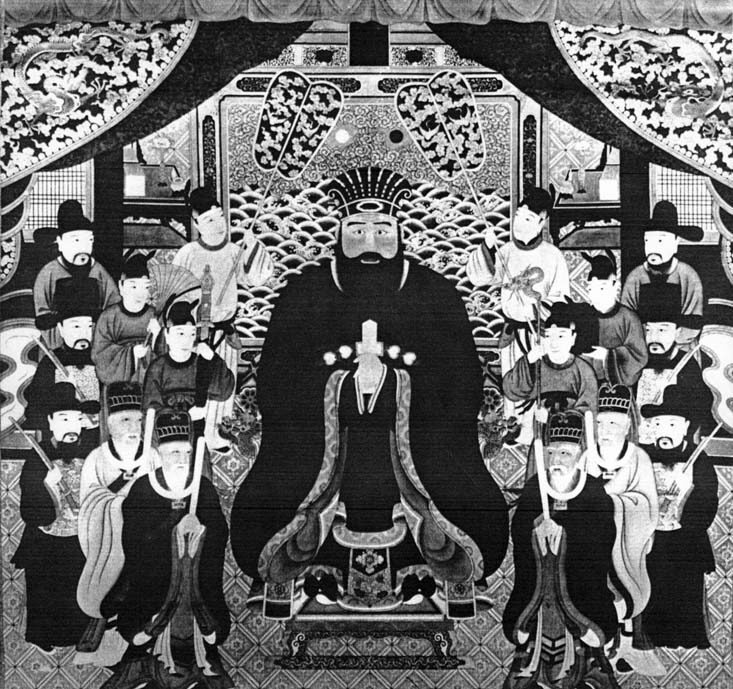
His son Sho Shin (尚真) took the throne as a boy in 1477 and reigned for fifty years, the longest of any king. He is the one who made the kingdom a state. The local lords were made to leave their castles and live at Shuri, near the king, and an inscription of 1509 on the palace balustrade records that weapons were gathered into the royal stores. He brought Yaeyama under control in 1500 after the rising led by Oyake Akahachi on Ishigaki, built temples and roads, and had the royal tomb of Tamaudun built in 1501 for his father’s bones.
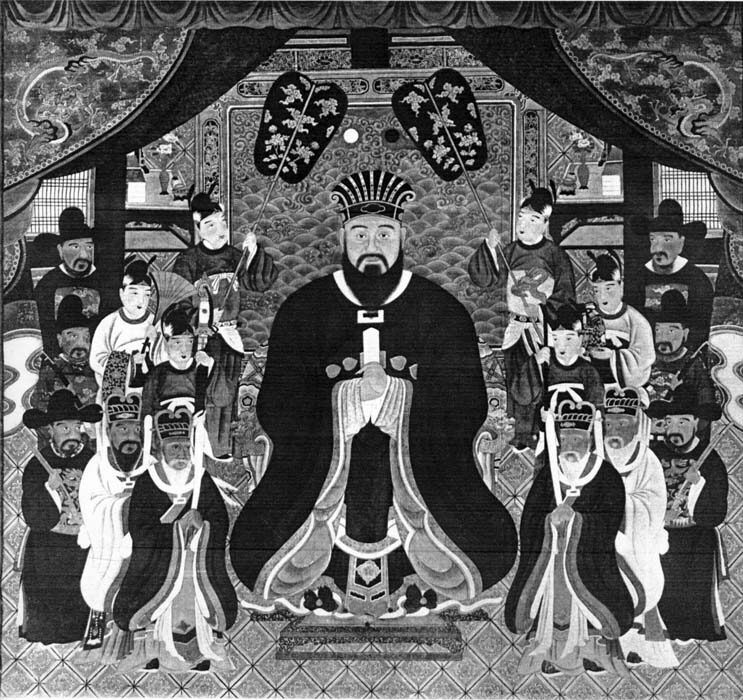
He also reorganised the gods. The village priestesses, the noro (祝女), were placed under a single hierarchy, and at its head he set a new office, the Kikoe-okimi, held by a woman of the royal house. The first was his sister. The king governed the living, and his sister protected him and the realm through the spirits, an idea of a sister’s sacred power over a brother that runs through Ryukyuan religion and is called onari-gami.
1609 and the years of two masters
The trade that made Ryukyu rich declined through the sixteenth century. Ming China eased its ban on private sailing in 1567, Portuguese ships took over the run between China and Japan, and Japanese merchants with silver from new mines went to Southeast Asia themselves. Then Japan, newly unified, began asking for things. Toyotomi Hideyoshi demanded troops and rice for his invasion of Korea, and Ryukyu, a vassal of the Ming, sent only part of the rice.
In 1609, with permission from the Tokugawa shogunate, the Shimazu lords of Satsuma, in southern Kyushu, sent about 3,000 men south. They left in early March by the lunar calendar, took the Amami islands, landed on Okinawa late in the month and reached Shuri at the start of the next; King Sho Nei surrendered within days. The Ryukyuans had raised more soldiers than Satsuma, but Satsuma’s men were veterans of the Korean campaigns and carried muskets.
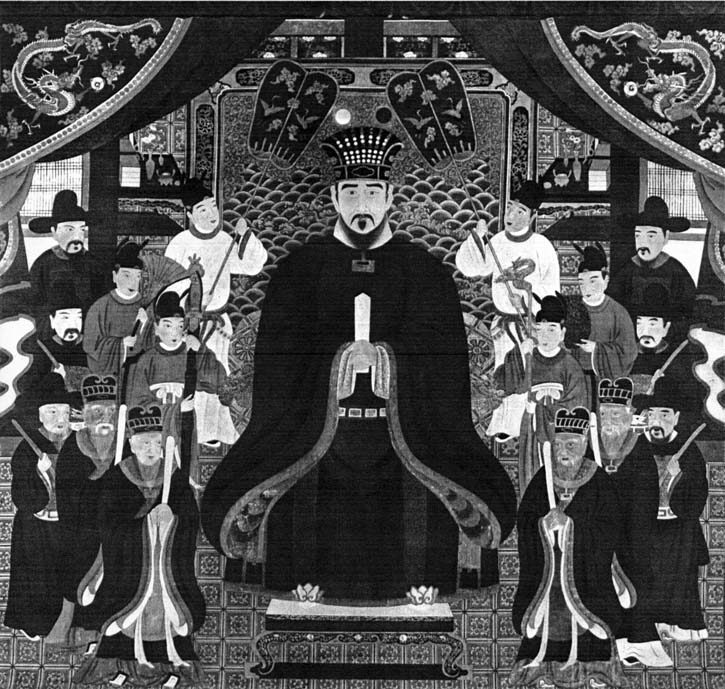
Sho Nei was taken to Kagoshima and then to meet Tokugawa Ieyasu at Sunpu and the shogun at Edo. He returned in 1611 having signed an oath and a set of fifteen rules that put Ryukyu’s foreign trade under Satsuma’s control. The Amami islands were cut away and ruled directly from Kagoshima, which is why they belong to Kagoshima Prefecture (鹿児島県) today. Satsuma kept a commissioner at Naha and took a yearly levy in rice.
China kept in view, Satsuma kept out of sight
Satsuma did not abolish the kingdom, and the reason was money. A kingdom could keep sending tribute to China, and the China trade continued under Satsuma’s eye, with Japanese silver flowing out through Ryukyuan missions. So the kings went on receiving investiture from the Ming and then, after 1644, the Qing, while bowing to Kagoshima and Edo. When Chinese envoys came to Shuri, Satsuma’s officials kept out of sight, signs of Japanese rule were put away, and everyone involved behaved as if the arrangement did not exist.
Each new king had to be confirmed by a Chinese envoy, the sappushi (冊封使), who arrived with a retinue of several hundred and stayed for months. The court staged its finest banquets, music and dance for them, and much of what is now called Ryukyuan court culture was made for these visits. The last investiture envoy came in 1866.
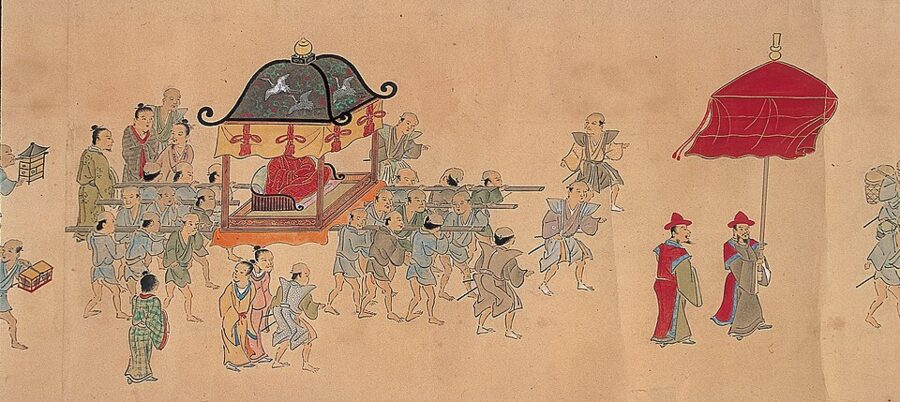
Edo saw the other face. Eighteen embassies went from Shuri to the shogun between 1634 and 1850, one at each new king’s accession and each new shogun’s. Satsuma made the delegates wear Chinese-style dress and play Chinese music on the road, so that the procession looked as foreign as possible. A lord who brought a foreign kingdom to pay its respects was a lord to be reckoned with.
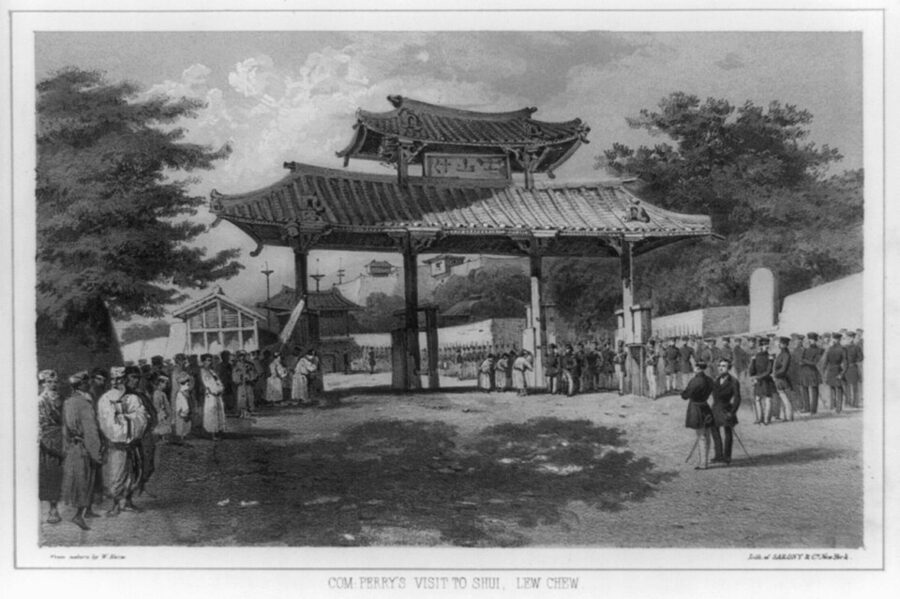
The last chapter before the end came from the sea. Commodore Matthew Perry anchored at Naha in May 1853, on his way to force Japan open, and on 6 June marched a party of marines and officers up to Shuri, uninvited, to call on the regent. He came back the next year and signed a compact with the kingdom in July 1854 that gave American ships the right to call at Naha. France and the Netherlands followed with treaties of their own in 1855 and 1859, signed by a kingdom that, in Satsuma’s eyes, had no foreign policy of its own.
The end of the kingdom
The Meiji government that took power in 1868 wanted fixed borders, and an island state with two overlords did not fit. When dozens of shipwrecked men from Miyako were killed in Taiwan in 1871, Tokyo pressed the case against China as the protector of Ryukyuan subjects. The next year it declared the kingdom the Ryukyu Domain, made King Sho Tai (尚泰) a domain lord and took over his foreign treaties, and three years after that it ordered an end to the tribute missions, the adoption of Japanese era names and a garrison in Naha.
The court refused most of it and sent secret appeals to China and to the American, French and Dutch legations.
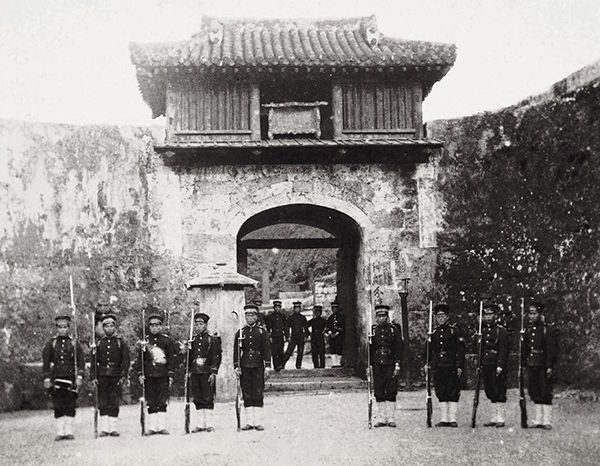
In March 1879 the official in charge, Matsuda Michiyuki, came back with about 160 police and 300 to 400 soldiers of the Kumamoto garrison. On 27 March he read the order abolishing the domain at Shuri Castle and told the king to leave by the end of the month. Sho Tai left on 29 March for his son’s residence in Shuri, Nakagusuku Udun, and on 4 April 1879 Okinawa Prefecture (沖縄県) was proclaimed. In Okinawa the whole process is called the Ryukyu Shobun (琉球処分), the “disposal” of Ryukyu.
Sho Tai sailed for Tokyo on 27 May 1879. He was given a mansion, a generous pension and, from 1885, the rank of marquis in the new peerage, and he died in Tokyo in 1901; his remains were brought home to Tamaudun. China protested for years, and a plan to split the islands between the two countries got as far as a draft treaty in 1880 before China refused to sign. The question was settled only by Japan’s victory over China in 1895.
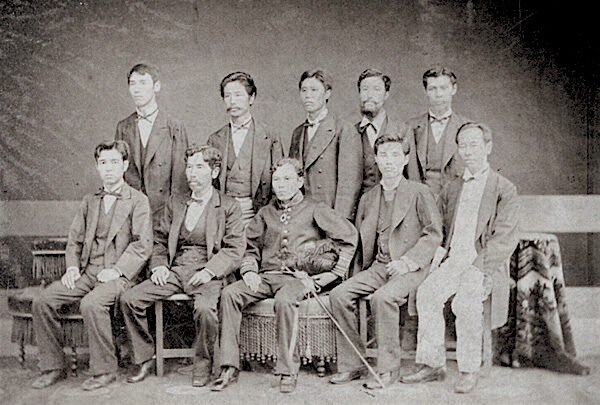
The Sho family stayed in Tokyo. In 1995 its twenty-second head gave the family papers, robes and regalia to Naha City, and they were designated a National Treasure in 2006. The old city museum that showed them closed in August 2025 while a new museum is prepared on the site of Nakagusuku Udun, the crown prince’s residence in Shuri.
The language
The people of the kingdom spoke Ryukyuan languages, related to Japanese but not mutually intelligible with it, while the court wrote in Japanese script for home affairs and classical Chinese for diplomacy. From the early twentieth century, Okinawan schools pushed standard Japanese hard, and a child caught speaking the local language could be made to wear a wooden hogen-fuda, a “dialect tag”, until another child slipped. The same decades brought similar pressure on the Ainu of Hokkaido, at the other end of the new state.
In 2009 UNESCO listed six Ryukyuan languages as endangered, among them Okinawan, Kunigami, Miyako, Yaeyama and Yonaguni. They survive most strongly on the stage, in the old court dramas and songs, which gives the court theatre a weight well beyond entertainment.
What the court left behind
The palace at Shuri
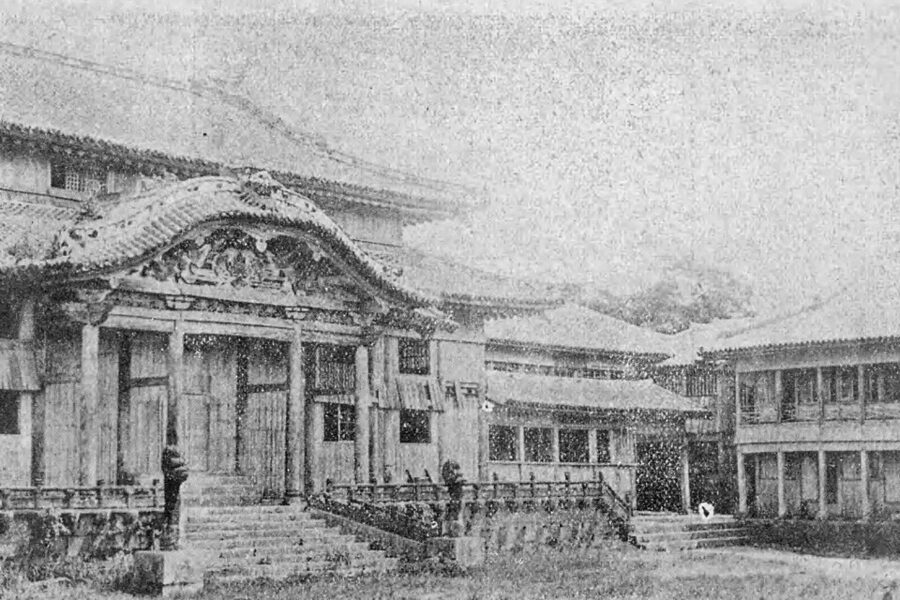
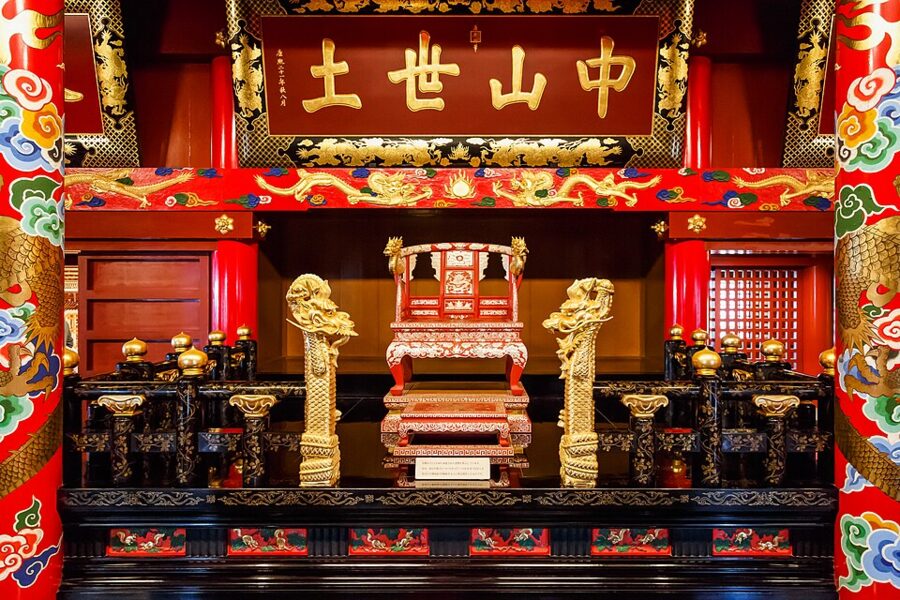
Shuri Castle (首里城) was palace, government office and religious centre for the whole life of the kingdom. The main hall, the Seiden, faces west towards China across a striped courtyard where officials lined up in rank for ceremonies. It has burned and been rebuilt more often than any building in Okinawa: in the succession fight of 1453, in 1660 and 1709, in the shelling of May 1945, when the Japanese army’s headquarters lay in tunnels beneath it, and again in a night fire on 31 October 2019.
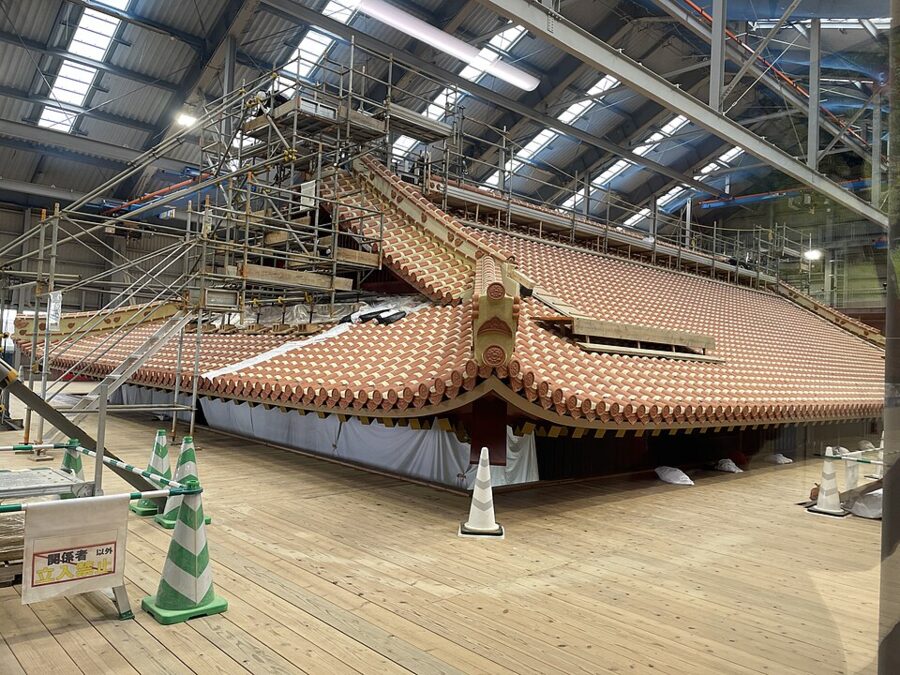
The hall that stands now is the fifth rebuilding. It follows the plan of the hall rebuilt in 1992, itself based on the measured drawings made during the 1920s repairs, with corrections from documents and photographs found since. Its red is a lacquer coloured with iron-oxide pigment from Kushi in the north of the island, the source the kingdom’s own records name.

The priestesses
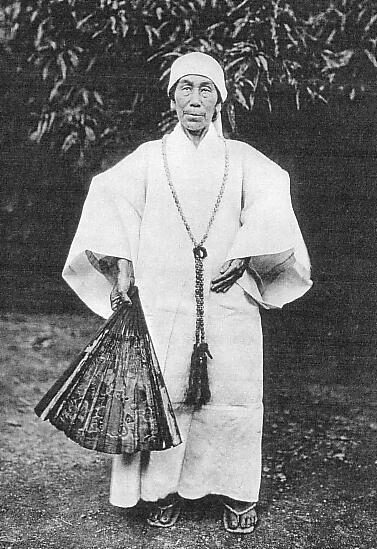
Every village had its noro, a priestess appointed by the king who led the community’s prayers at its sacred grove, the utaki (御嶽). Above them sat the Kikoe-okimi, who ran the rites at the shrines inside Shuri Castle and was installed at Sefa-utaki in a ceremony called the oaraori, a sacred marriage to the god of the place. Once installed, she held the office for life.
The office outlived the kingdom. Women of the Sho family carried it on in Tokyo, and the last appointment in the old line was made in 1944. Village noro survived into living memory in many places, and in parts of Okinawa women still lead the rites at the local utaki.
Kumiodori, court music and the sanshin
Music at court came in two kinds: uzagaku (御座楽), indoor Chinese-style ensemble music, and rujigaku, the processional band. Both went to Edo with the embassies. The singing that mattered most at home, though, was to the sanshin.
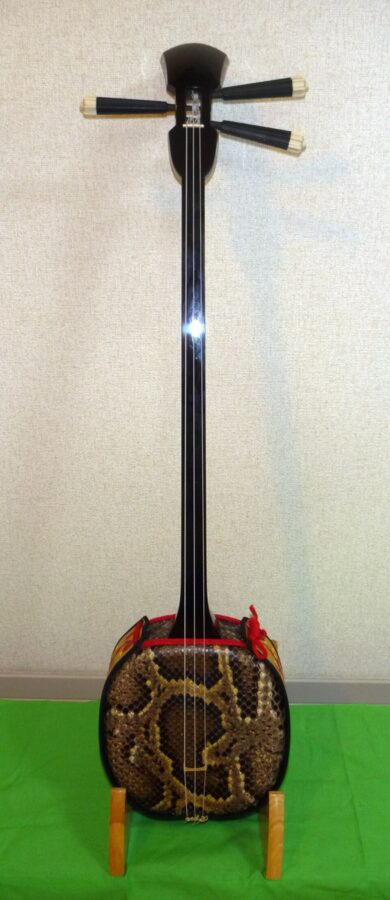
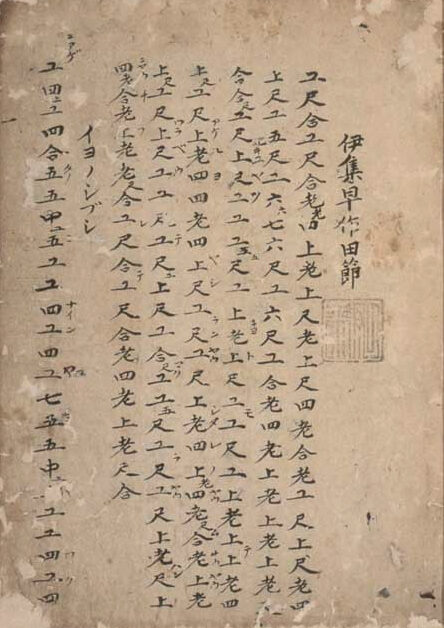
The sanshin (三線) is a three-stringed lute with a snakeskin belly, descended from the Fujian sanxian. It reached Ryukyu during the trading years, went on from Naha to mainland Japan in the sixteenth century and grew into the shamisen there. The court made it the instrument of gentlemen, and Okinawan players still read music from a notation called kunkunshi, a grid of Chinese characters, one character to each finger position.

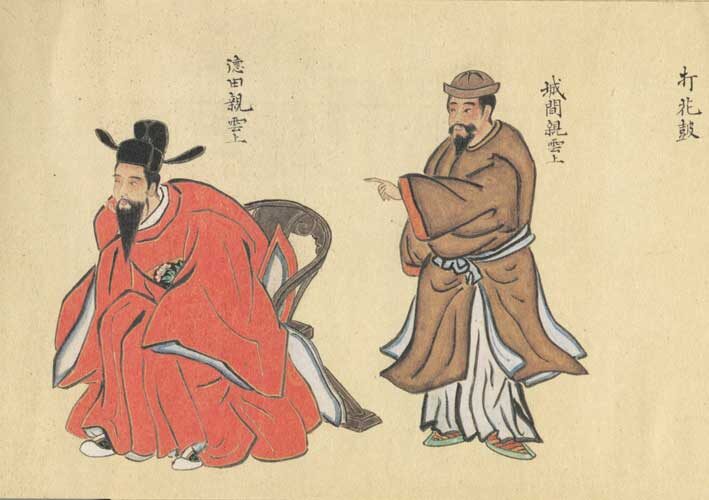
In 1719 the court official Tamagusuku Chokun, put in charge of entertaining the envoys at King Sho Kei’s investiture, staged two plays of his own at the Double Ninth banquet: Nido Tichiuchi (two boys avenge their father) and Shushin Kaneiri (a young man hides in a temple bell from a woman possessed by love). This was kumiodori (組踊), a dance-drama sung and spoken in the Shuri court language, with roots in Noh and Kabuki as much as in Chinese opera. In the kingdom’s time it was played only by men of the gentry, and UNESCO listed it as intangible heritage in 2010.
Bingata and lacquer
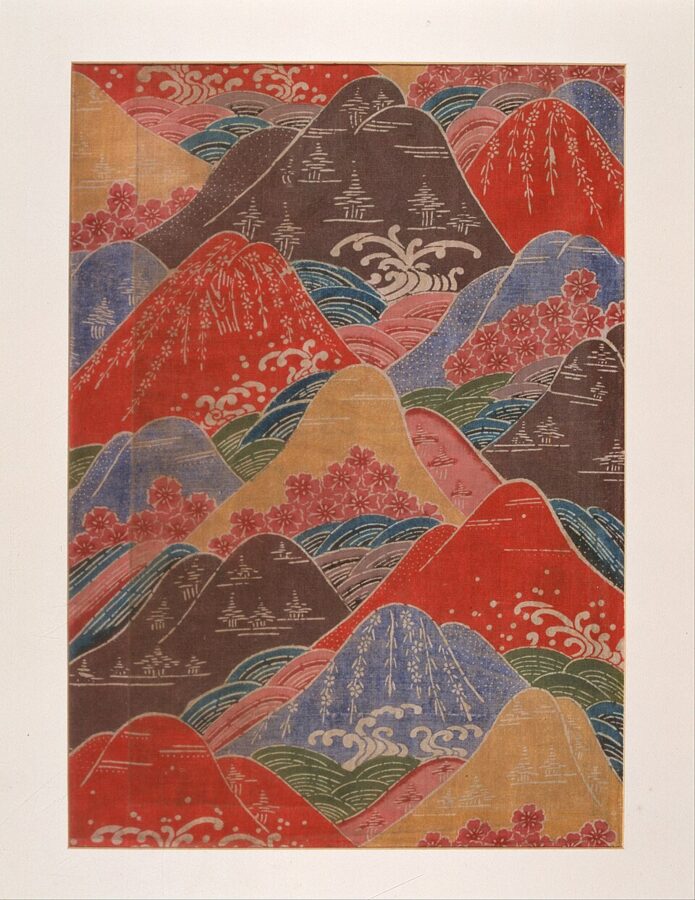
Bingata (紅型) is stencil-dyed cloth in yellow, red, blue and purple, worn at court by royal and gentry women and by boys before coming of age. The dyers worked around Shuri under royal patronage, using pigments that the trade brought in. After 1879 the court and its clients were gone, the dyers drifted away, and the war destroyed most of the stencils.
Its revival is one of the better post-war stories. Two families who had dyed for the court since the kingdom’s time, the Shiroma and the Chinen, started again in the ruins: they cut stencils from discarded army maps, used broken gramophone records as spatulas for the resist paste and spent cartridge cases as nozzles. Bingata was designated a traditional craft in 1984.
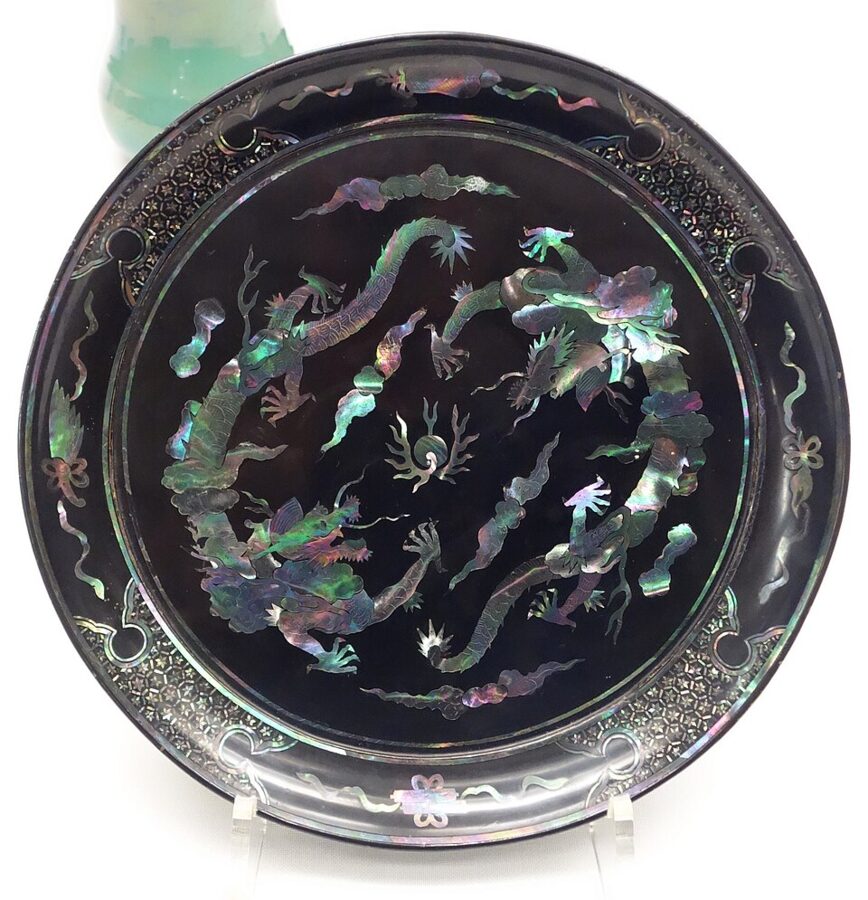
Lacquer was a diplomatic craft. A royal workshop, the Kaizuri Bugyosho, made inlaid and carved pieces for gifts to China and Japan under the king’s own officials, and the kingdom’s diplomatic archive lists lacquer among the tribute sent to China. In the eighteenth century a craftsman named Higa Josho invented tsuikin, raised designs built from pressed lacquer, and it is still the commonest decoration on Okinawan lacquerware.
Awamori and the royal table
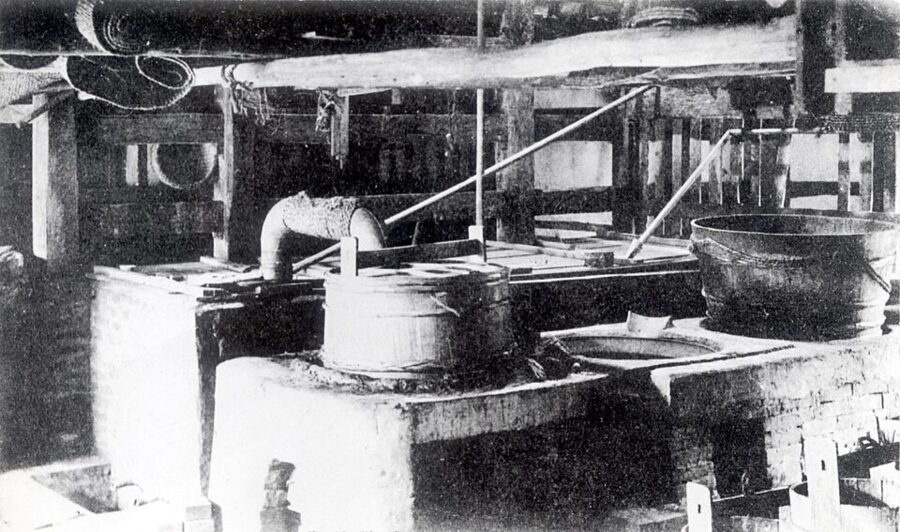
Distilling came from Siam. Siamese spirit, together with the stills and the big storage jars, reached Ryukyu in the fifteenth century, and a Chinese envoy of 1534, Chen Kan, wrote of a “southern barbarian wine” brought from Siam. Okinawan distillers adapted it with Thai rice and a black koji mould suited to the heat, and the result is awamori (泡盛). Under the kingdom only three districts of Shuri, Akata, Sakiyama and Torihori, were licensed to make it.
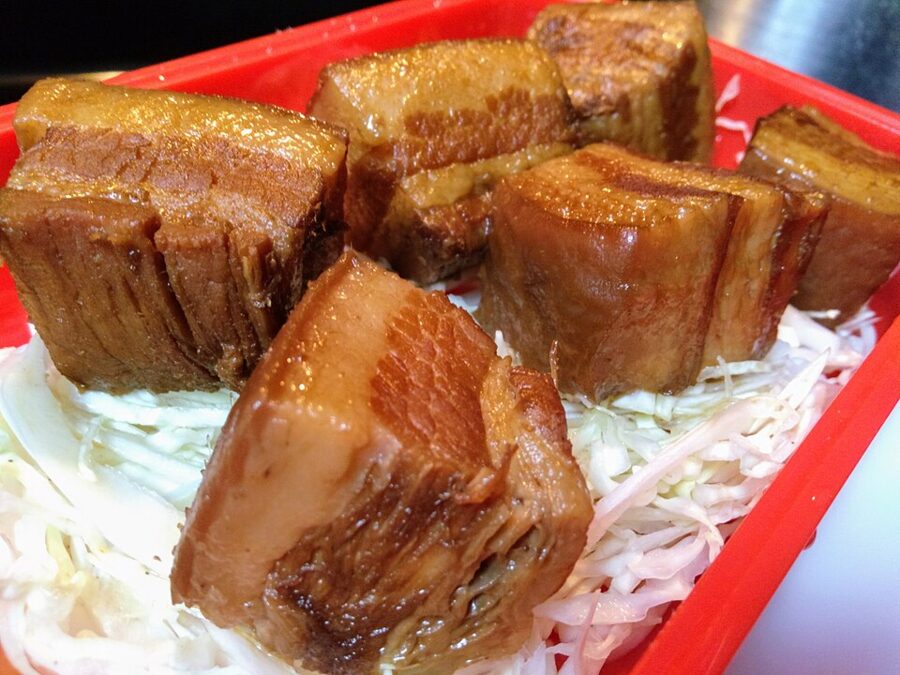
Court cooking, made for the investiture banquets, borrowed from China and Japan and went light on seasoning, a style Shuri people describe with the word afai, plain. Pork belly braised in awamori and soy, rafute, was part of it, as was a lacquered tiered box of small dishes, the tundabun. In 2019 the government designated Ryukyuan cooking, awamori and the performing arts together as Japan Heritage, a reminder that the three grew up for the same guests.

Where to see the kingdom today
Shuri, Tamaudun, Shikinaen, the museum and the theatre are all in or beside Naha; Sefa-utaki and Katsuren are an hour or so out, and Nakijin is a day trip. I’d give Shuri a full day with the museum, put Sefa-utaki with the south coast, and pair Katsuren with Nakijin only if you have a car and an early start.
Shuri Castle: tickets and timed entry
The castle stands on a ridge about 4 kilometres east of the port. The Yui Rail monorail runs from Naha Airport to Shuri Station in about 27 minutes for ¥360; from there it is about 15 minutes’ walk, past Ryutan pond, to Shureimon, or a few minutes on Naha Bus routes 7 and 8 to the Shurijo-mae stop. Leaving the car is wise: the park’s own car parks fill in the mornings.
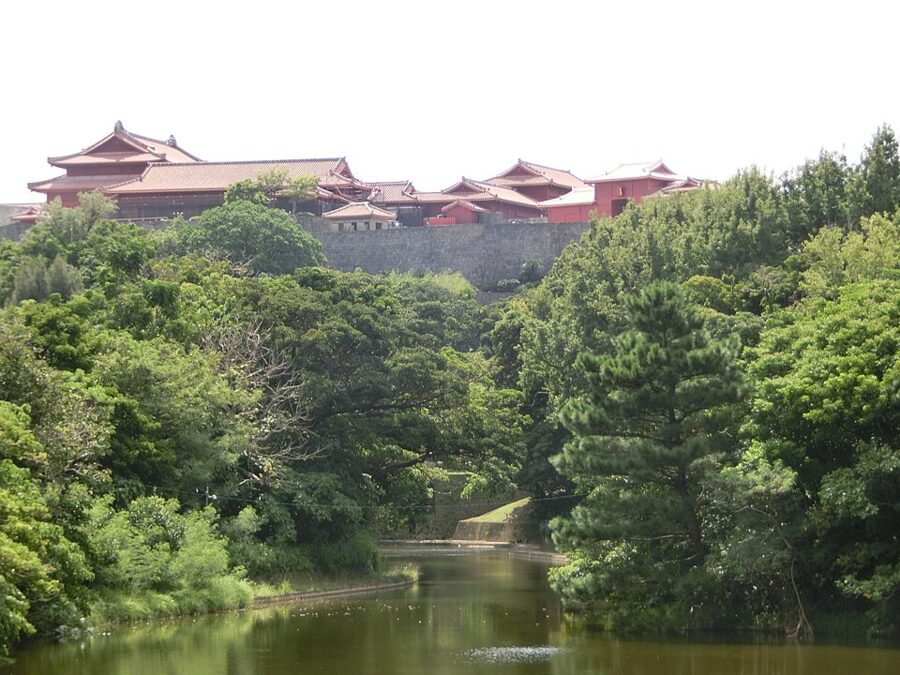
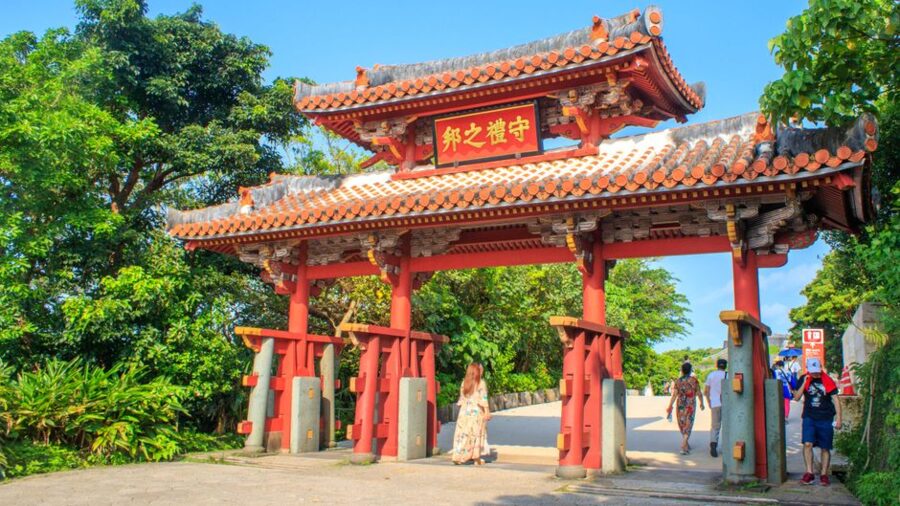
The gates and walls are free from 08:00. The paid area beyond Hoshinmon, which includes the courtyard and the main hall, opens 08:30–19:00 from April to November (last entry 18:30) and 08:30–18:00 from December to March (last entry 17:30). Admission is ¥1,000 for adults, ¥760 for high-school students and ¥370 for primary and junior-high pupils.
Seeing inside the main hall needs a ticket with a timed slot. Slots run every 30 minutes, cost nothing extra and go on sale online at 13:00 on the first day of the month two months ahead; any left on the day are sold up to 15 minutes before the slot, online or at the Kofukumon ticket office. Without a slot you can still walk the paid area, see the hall from outside and visit the reconstruction exhibits. The castle’s own estimate is 90 to 120 minutes for the whole visit, of which the hall takes about 15.
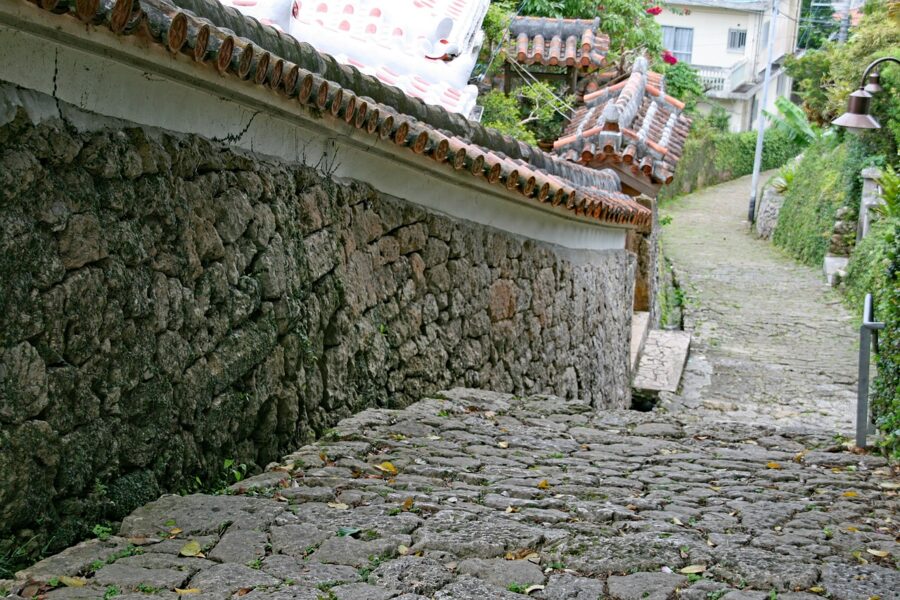
Leave by the back of the castle and walk down the Shuri Kinjo-cho stone road, one of the few stretches of old Shuri to survive the war. It was part of the road from the palace to the port at Naha, paved in limestone in the early sixteenth century.
Tamaudun
Tamaudun (玉陵), the royal mausoleum, is a few minutes’ walk west of Shureimon. Built in 1501, it copies a palace in stone: three chambers behind a wall, the middle one for the body while it decayed, the east for the washed bones of kings and queens, the west for other royals. Most of it was rebuilt after war damage, finished in 1974, and it is a National Treasure. Admission is ¥300, and the small exhibition room at the entrance explains who lies where.
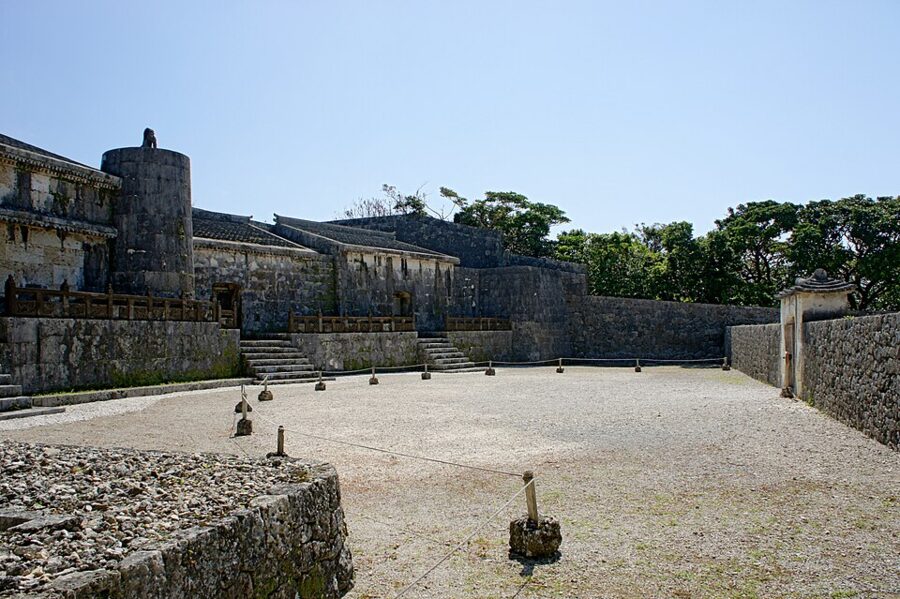

Shikinaen
Shikinaen (識名園), the royal villa south of Shuri, was finished in 1799 and used to entertain the Chinese envoys. Paths circle a pond with a hexagonal pavilion and Chinese-style stone bridges; the house is Okinawan, with red tiles and a raised wooden floor. The lookout called Kankodai was placed so that the sea cannot be seen from it, which tradition explains as a way of making a small country look large to its guests.
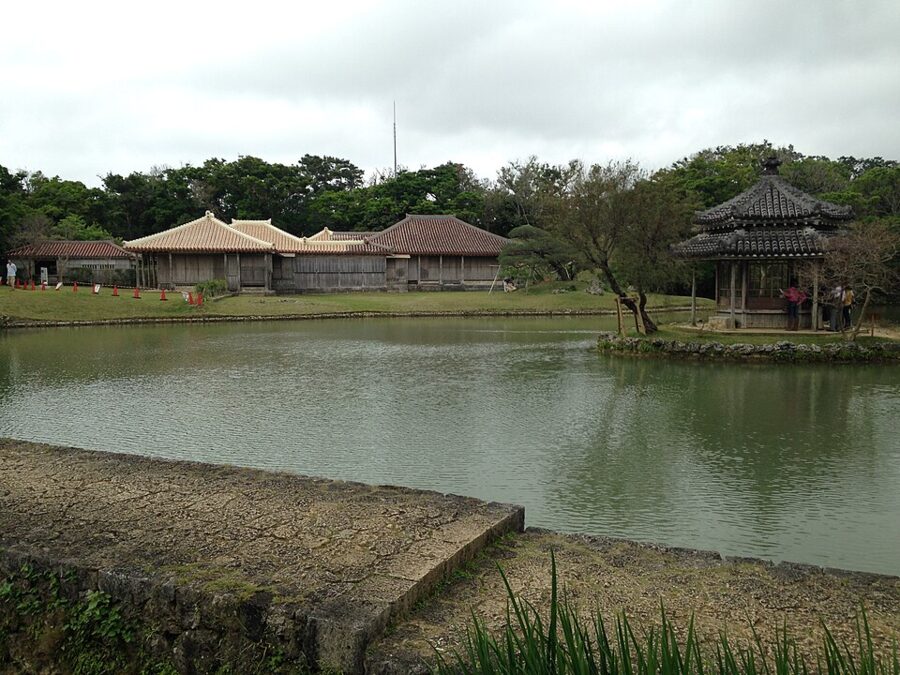

Everything was destroyed in 1945 and restored between 1975 and 1995. Opening hours are 09:00–18:00 from April to September and 09:00–17:30 from October to March; it closes on Wednesdays, or the next day when Wednesday is a holiday. Admission is ¥400. Naha Bus routes 2, 3, 5 and 14 stop at Shikinaen-mae.
Sefa-utaki
Sefa-utaki is at Chinen in Nanjo, on the south-east coast. From Naha Bus Terminal, Toyo Bus route 338 runs direct to the Sefa-utaki-iriguchi stop in about an hour; by car it is about 50 minutes from the airport. Tickets are sold at the car park, and the grove itself is about 500 metres away, a walk of 7 to 10 minutes. Admission is ¥600 for adults. Drainage works close everything past the Ujoguchi from 2 November 2026 to 5 January 2027, and entry is free while they last.
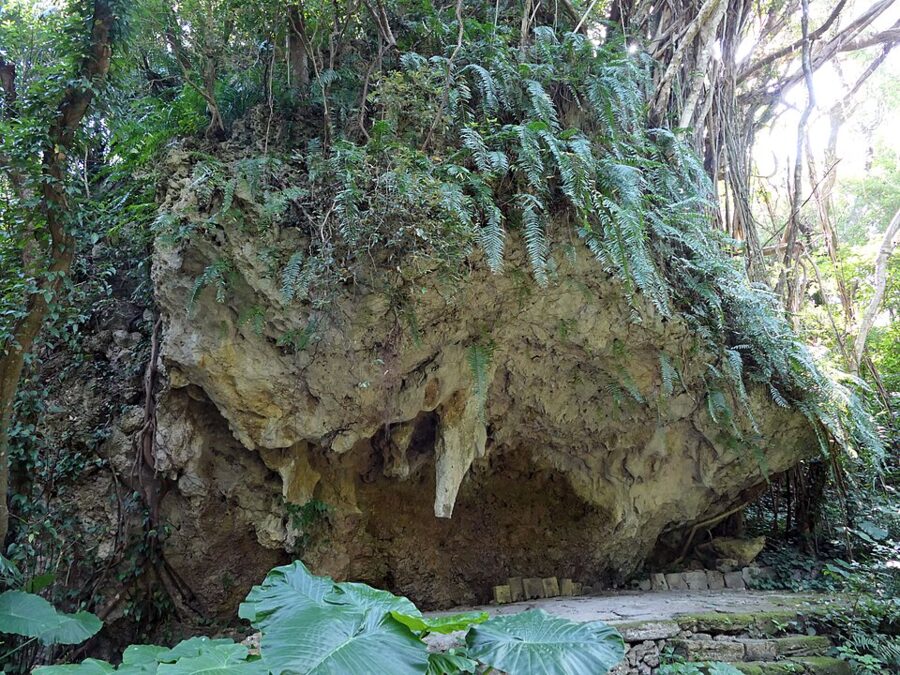

Opening hours are 09:00–18:00 from March to October (last entry 17:30) and 09:00–17:30 from November to February (last entry 17:00). The grove also closes completely for six days a year, the first three days of the fifth and the tenth lunar months, so the dates move; the next are 5–7 June and 29–31 October 2027. Drainage works close everything beyond the Ujoguchi from 2 November 2026 to 5 January 2027 (planned), and admission is free while they last. Check before you go, wear shoes that grip on wet stone, and remember that people still come here to pray.
Nakijin and Katsuren
Nakijin Castle (今帰仁城), on the Motobu Peninsula in the north, is the grandest of the castle ruins: long curving walls around terraces where Hokuzan’s kings lived, with a view to the sea. After 1416 Shuri kept a governor here until 1665. Admission is ¥1,000 for adults, which includes the village history centre, and it opens 08:00–18:00 (last entry 17:30), an hour later in May to August. The cherry trees along the approach flower in late January, among the first in Japan.
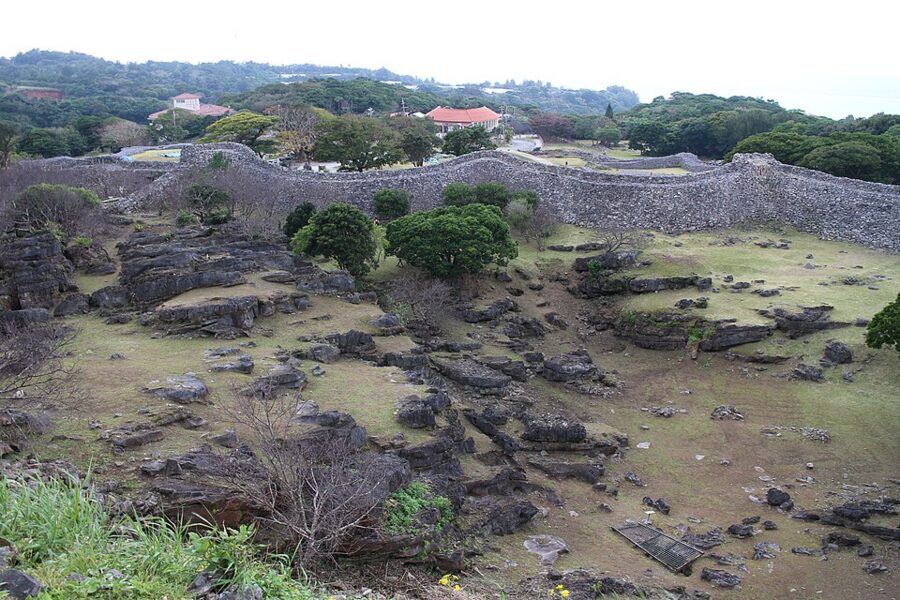

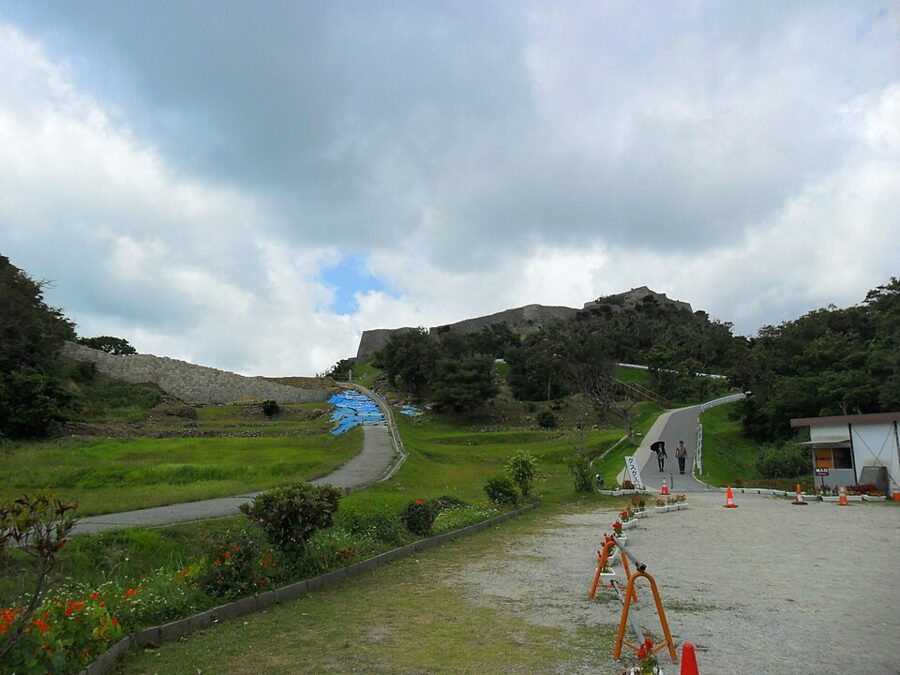
Katsuren Castle (勝連城) in Uruma, on the east coast, is the oldest of the listed castles and the one with the widest view. Its walls climb in steps to a summit where Amawari’s hall stood, with the sea on both sides. Admission is ¥850, including the exhibition at Amawari Park at the foot of the hill, and it is open every day 09:00–18:00 (last entry 17:30). Naha Bus route 52 from Naha Bus Terminal stops nearby; driving takes about 80 minutes from the airport.
The Okinawa Prefectural Museum
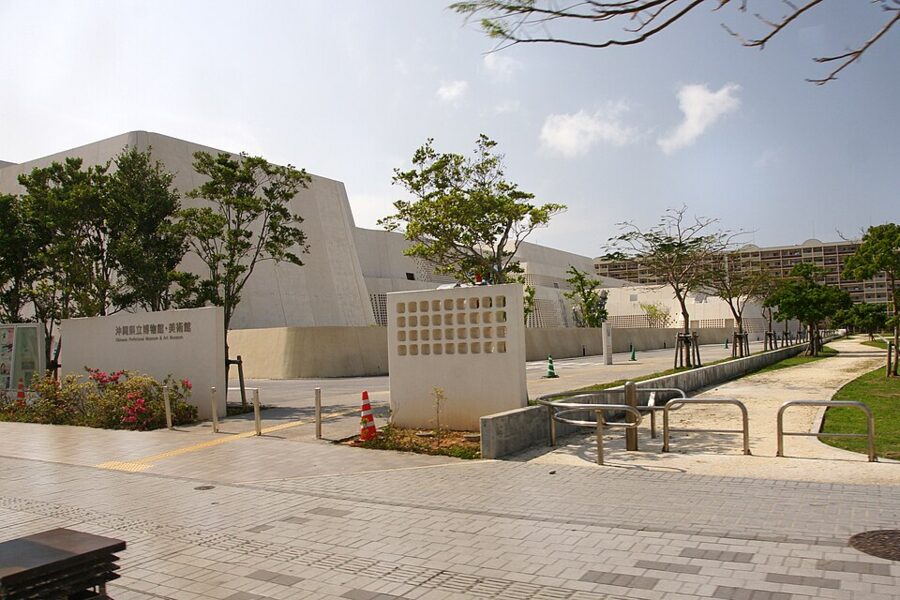
The Okinawa Prefectural Museum and Art Museum in Omoromachi, Naha, is where most of the objects are kept: the Bridge of Nations bell, royal documents, lacquer, bingata and the 1832 embassy scroll. I’d go before the castle rather than after, so the rebuilt halls have something behind them. It opens 09:00–18:00, to 20:00 on Fridays and Saturdays (last entry 30 minutes before), and closes on Mondays. The permanent exhibition costs ¥530.

The National Theatre Okinawa
The National Theatre Okinawa in Urasoe, just north of Naha, opened in 2004 to keep kumiodori alive. The theatre’s own kumiodori performances, usually on Saturday afternoons, cost ¥4,000 for adults; other companies hire the stage for dance, music and kumiodori of their own at their own prices. Buses stop at Kokuritsu Gekijo-mae and Kokuritsu Gekijo Okinawa (Yui no Machi), a minute’s walk away.
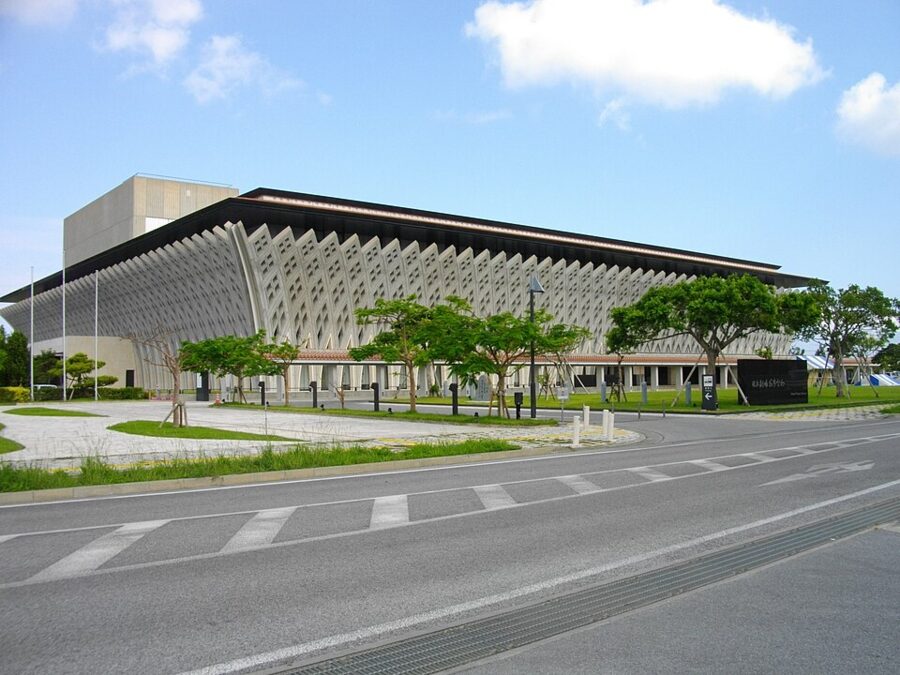
Kumiodori is the one survival of the court that you cannot see in a museum, and if you see one thing from this list, I’d make it a performance here. The plays are slow, the language is three hundred years old and the gestures are tiny, and it is still the nearest thing there is to sitting at an envoy’s banquet in Shuri.
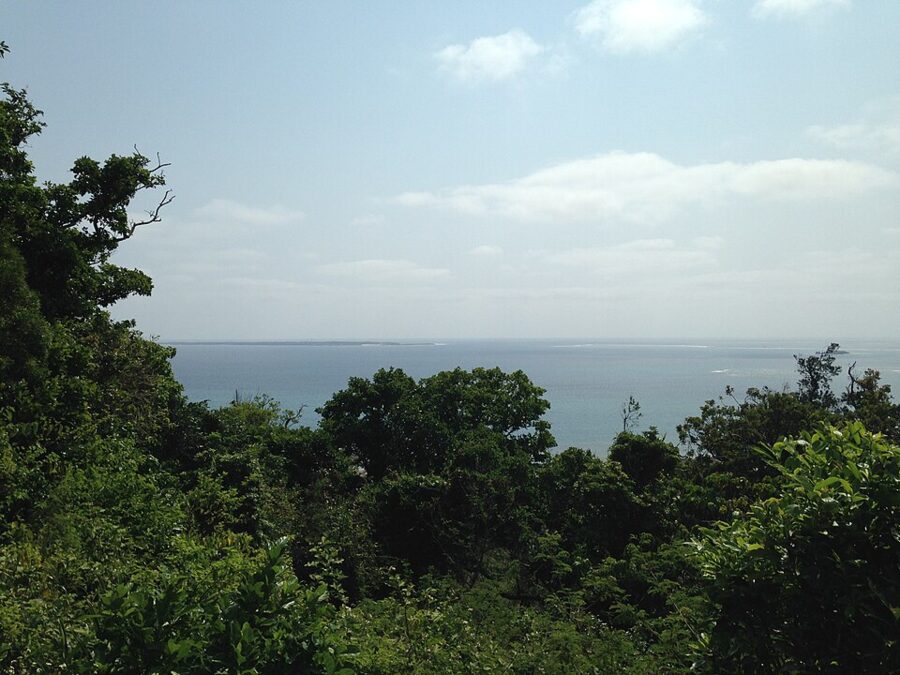
Then go south to Sefa-utaki late in the afternoon, when the coach parties have gone. Walk up to the Ujoguchi, where the king refolded his robe, and stand at the edge of the women’s grove with Kudaka on the horizon. Nothing in the kingdom’s long story explains it better than that small change of dress at the door.