

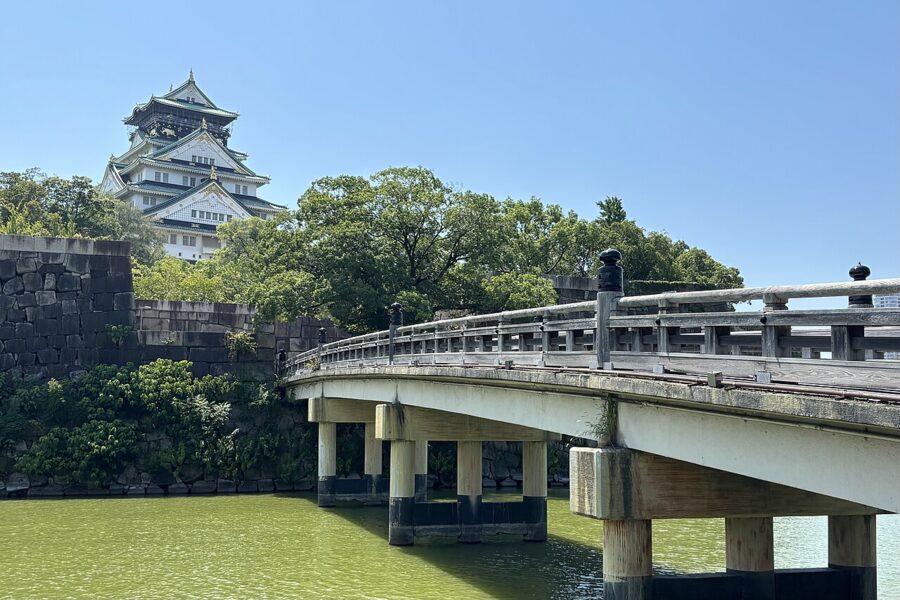
The keep of Osaka Castle is built of steel-reinforced concrete, has a lift, and was finished on 7 November 1931 with ¥1.5 million raised from the people of Osaka in about six months. In 2026 the Council for Cultural Affairs recommended it for designation as an Important Cultural Property, which puts a museum building with a gift shop on the same national register as temple halls twelve centuries old. It has also now stood longer than the two keeps before it put together. Toyotomi Hideyoshi’s burned about 30 years after it went up, and the Tokugawa replacement was hit by lightning after 39.
That is a fair introduction to Kansai (関西). For most of recorded history the emperor lived within a day’s walk of Osaka Bay, and the region is layered with the remains of capitals that were built, abandoned, burned, rebuilt and, quite often, rebuilt again in concrete. Seven prefectures make it up: Osaka, Kyoto, Hyogo, Nara, Wakayama, Shiga and Mie. Between them they hold seven of Japan’s World Heritage listings, the country’s second-largest city region, and the food culture the rest of Japan likes to tease.
My advice for a first visit is simple and slightly unpopular: sleep in Osaka, not Kyoto. Osaka has the airport trains, the Shinkansen at Shin-Osaka and the terminus of every private railway in the region, so Kyoto is about 30 minutes away, Nara under an hour and Kobe about 20 minutes. Kyoto is the better city to wake up in. It is a worse one to travel from.
In this guide
Kinki, Kansai and a barrier on a hill
There are two names for the place. Kinki (近畿), “the provinces near the capital”, is the official one, used by the Japan Meteorological Agency and school textbooks since about 1900, and it always means the same seven prefectures. Kansai means “west of the barrier”, after the checkpoints that once guarded the roads into the capital region. It is the name people use, and depending on who is talking it may leave out Mie, sweep in Fukui or Tokushima, or mean nothing beyond Osaka.
Mie is the awkward one. Most of it looks east to Nagoya for work and television, so it is often counted with Aichi and Gifu in the Tokai region of Chubu, and the prefectural government says on its own site that it belongs to both. The old name causes trouble in English too. Kinki University renamed itself Kindai University in 2016, and Kinki Nippon Railway had already shortened itself to Kintetsu in 2003.
Of the eight traditional regions of Japan, Kansai is the one with the deepest written past. No other region holds as many National Treasures and Important Cultural Properties. That concentration is the reason to come.
A thousand years of capitals
Before Kyoto there was a whole sequence of capitals, and most of them moved because an emperor died, a faction won, or the old site had become too crowded with temples to govern from. The early courts of the late 6th and 7th centuries sat in the Asuka valley in what is now southern Nara Prefecture. In 694 Empress Jito moved the court a few kilometres north to Fujiwara-kyo, the first capital laid out on a Chinese-style grid, with the three hills of Yamato inside its boundary. It lasted 16 years.
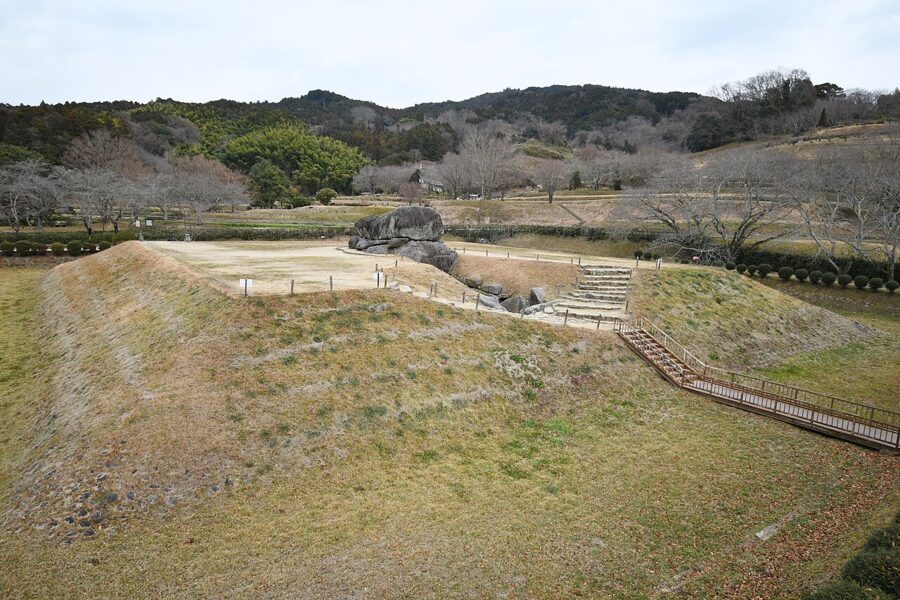
On 26 July 2026 the World Heritage Committee, meeting in Busan, inscribed “Asuka-Fujiwara” on the World Heritage List: palace sites, temple foundations, tombs and the garden ponds of the Asuka court, in Asuka village and the cities of Kashihara and Sakurai. Nara Prefecture now has four World Heritage listings, more than any other prefecture. Little stands above ground. What you see are rice fields, low mounds, foundation stones laid out on grass and the hills themselves, which is precisely why the site was listed: no later city was built on top.
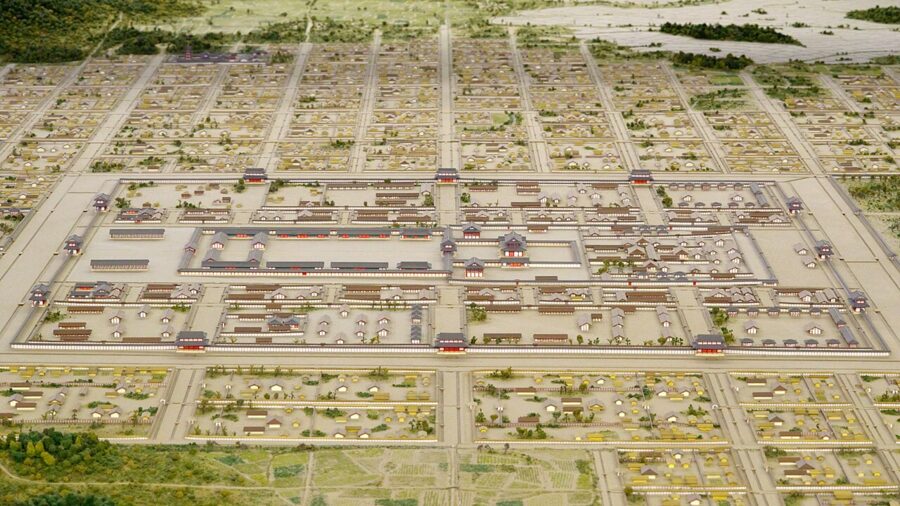
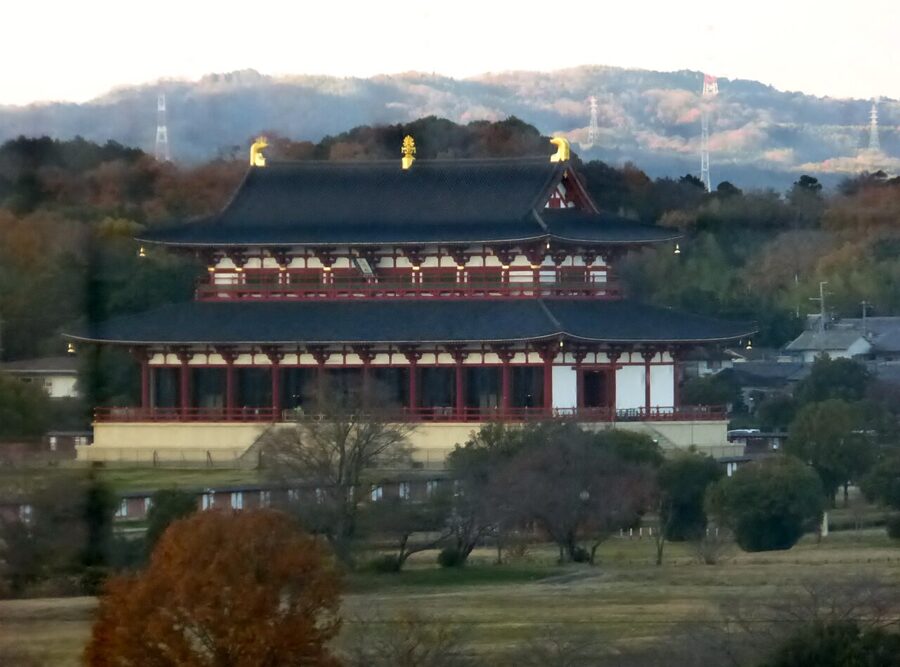
In 710 the court moved north to Heijo-kyo, the city now called Nara, and stayed until Emperor Kammu left in 784, partly to escape the political weight of the Nara monasteries. His new capital at Nagaoka lasted ten years. In 794 he moved again to Heian-kyo, today’s Kyoto, and apart from six months in 1180, when the Taira clan took the court to Fukuhara in what is now Kobe, the emperors stayed there until 1869.

The merchants’ city and the treaty port
Osaka’s history runs on a different track. Hideyoshi began his castle there in 1583, and after the Tokugawa took it in 1615 they rebuilt the city as a merchant town under direct shogunal rule. Feudal lords across western Japan shipped their tax rice to warehouses along its canals, and the rice brokers of Dojima were trading contracts for future delivery from 1730, well before Chicago. Osaka called itself tenka no daidokoro, the kitchen of the realm, and it still talks about money and food with an ease that Kyoto finds slightly vulgar.
Kobe is the newcomer. Its port opened to foreign ships on 1 January 1868, in the last days of the shogunate, and merchants from Britain, Germany, the United States, China and India built houses on the hillside and godowns by the water. The city grew around that trade, was flattened in the air raids of 1945, and was badly damaged again by the Great Hanshin earthquake of 17 January 1995, which killed 6,434 people.
The way Kansai talks
Kansai-ben, the dialect of the region, is the one most Japanese people can imitate, because Osaka’s comedians have been on national television for decades. The negative of a verb ends in -hen rather than -nai (ikahen, “I’m not going”), “really” is honma, “no good” is akan, and “how much?” is nanbo. “Thank you” in an older Osaka shop is still sometimes ookini.
Kyoto has a softer variety, with an honorific -haru ending used about almost anyone (kiharu, “they’re coming”). You do not need any of it. You will hear all of it.
Getting there and getting around
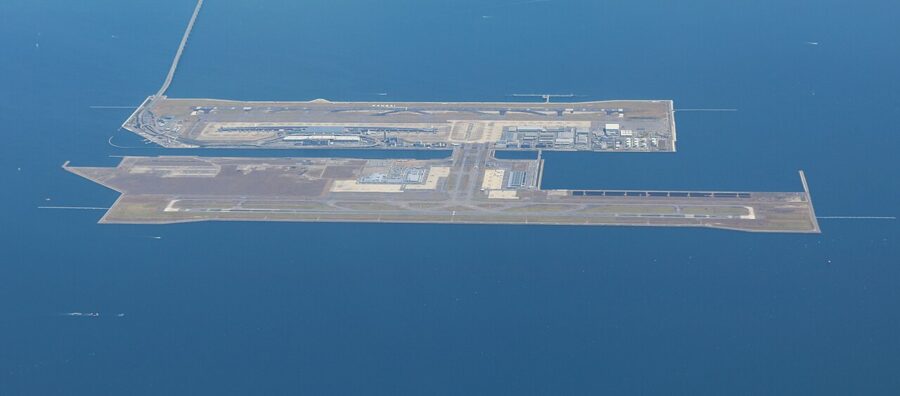
Most people arrive at Kansai International Airport (関西国際空港), always called KIX, which opened on 4 September 1994 on an artificial island in Osaka Bay. It handles international flights and a share of domestic ones. Osaka International Airport at Itami, north of the city, is domestic only and much closer to the centre, and Kobe has a third, smaller airport on its own island.

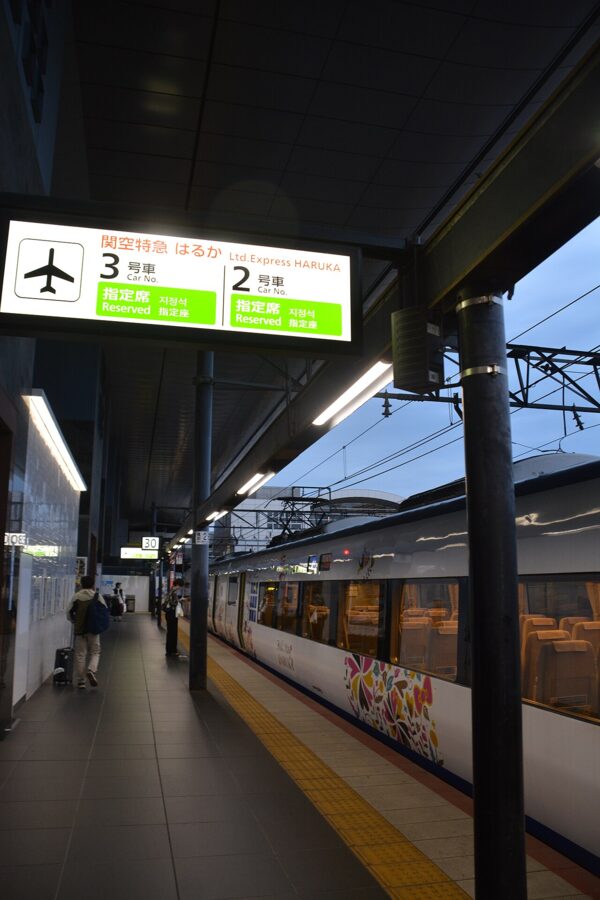
From KIX two railways compete. JR West’s Haruka limited express runs via Tennoji, Osaka and Shin-Osaka to Kyoto, about 80 minutes away in the middle of the day. Nankai’s Rapi:t runs to Namba in south Osaka; a discount ticket covering fare and reserved seat costs ¥1,560 at the station, or ¥1,410 as a digital ticket. Staying near Namba, take the Rapi:t; heading for Kyoto, take the Haruka.

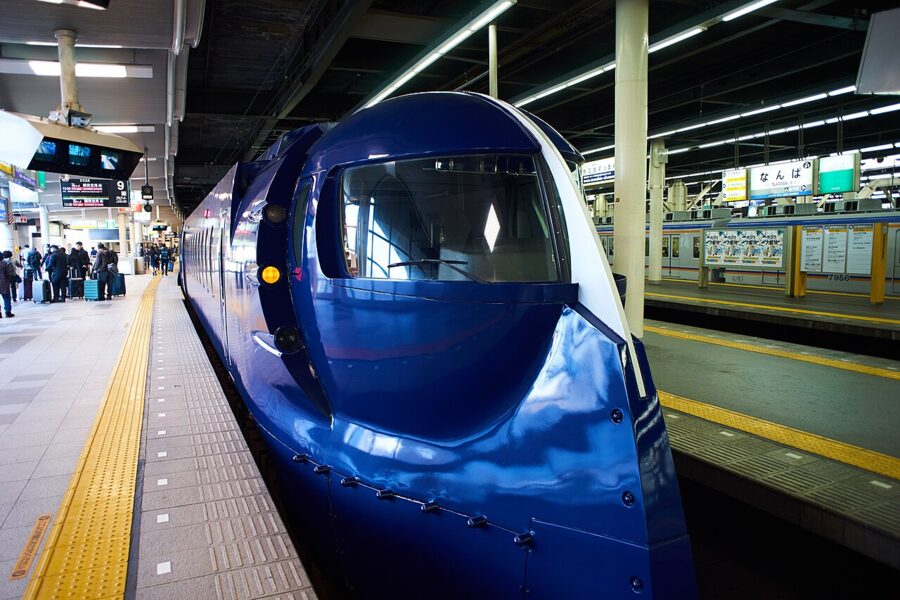

From Tokyo the Tokaido Shinkansen reaches Shin-Osaka in about 2 hours 30 minutes on a Nozomi, with Kyoto about 15 minutes before it. The Sanyo Shinkansen continues west from Shin-Osaka to Himeji, Hiroshima and Kyushu. Shin-Osaka is a station for changing trains, not for staying near; the city’s centres are Umeda in the north and Namba in the south.
Five private railways and a card
What sets Kansai apart is its private railways, built by companies that also built the department stores, suburbs and baseball stadiums along their lines. Hankyu runs from Umeda to Kyoto’s Kawaramachi and to Kobe, and Keihan follows the Yodo River to Kyoto’s Gion-Shijo. Kintetsu, the largest private railway in Japan, is the one for Nara, Asuka and Ise, and Nankai serves the airport and Koyasan. Hanshin runs along the shore to Kobe, past the Koshien stadium it built in 1924.
Very often the private line is the better choice. Kintetsu takes you into the middle of Nara, about five minutes’ walk from Kofukuji, while JR Nara station is about 10 minutes’ walk further west. Hankyu and Keihan drop you in central Kyoto, while JR leaves you at Kyoto Station on the southern edge.
All of them, and the buses and subways, take ICOCA (イコカ), JR West’s prepaid IC card, and the other national cards such as Suica. A new card costs ¥2,000, including a ¥500 refundable deposit; on an iPhone you can add ICOCA to Apple Pay instead. Tap in, tap out, and stop thinking about fares.
Which passes pay
The national Japan Rail Pass rose sharply in price in October 2023, and for a trip based in Kansai it rarely pays any more. The regional passes do, if you plan around them. These are the current prices for adults; all are valid on consecutive days.
| Pass | Price | Covers | Pays when |
|---|---|---|---|
| JR Kansai Area Pass | 1 day ¥2,800; 2 days ¥4,800; 3 days ¥5,800; 4 days ¥7,000 | JR local and rapid trains around Osaka, Kyoto, Kobe, Nara, Himeji, Wakayama and Otsu; reserved seats on the Haruka; no Shinkansen | Your arrival day includes the Haruka plus another long ride, such as Himeji |
| JR Kansai WIDE Area Pass | 5 days ¥12,000 | Adds the Sanyo Shinkansen from Shin-Osaka to Okayama and limited expresses to Kinosaki, Shirahama, Amanohashidate and Takamatsu on Shikoku | You go to Kinosaki or Shirahama and Himeji in the same five days |
| Kintetsu Rail Pass | 1 day ¥1,900; 2 days ¥3,700; 5 days ¥4,900; 5 days plus buses ¥6,700 | Kintetsu trains; the 1- and 2-day passes cover Osaka, Nara and Kyoto, the 5-day pass adds Ise-Shima and Nagoya | Nara and Asuka over two days, or any trip that includes Ise |
The Kintetsu passes don’t include the limited express surcharge, so on the fast trains to Ise you pay the limited express charge on top. For Kyoto and Osaka themselves, a day pass rarely beats an ICOCA card unless you ride a lot.
Osaka (大阪)
Osaka is loud, friendly and organised around eating, and it is the place in Japan where a stranger is most likely to start talking to you, usually about food.
The castle
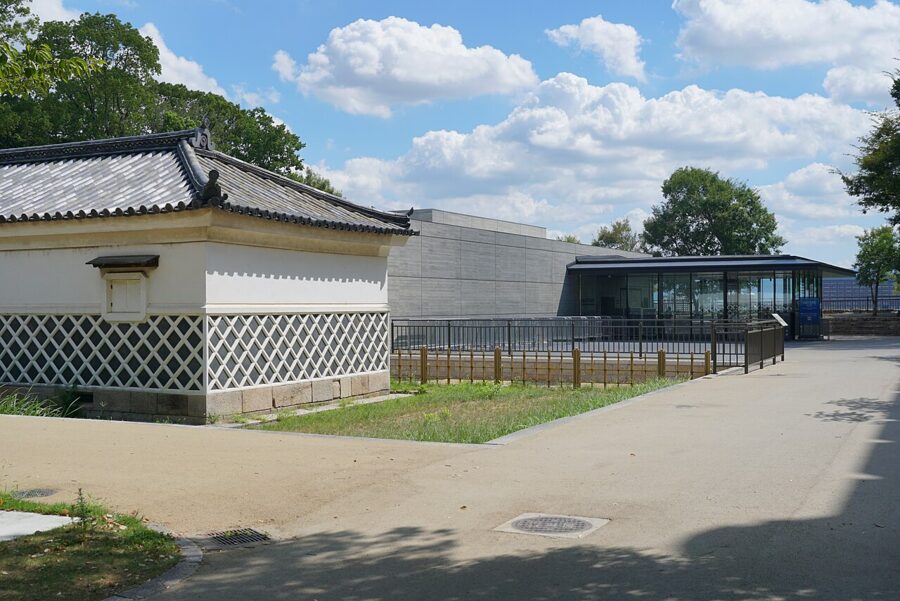
Osaka Castle (大阪城) sits in a park of about 100 hectares east of the centre, a 15-minute walk from Tanimachi 4-chome station on the Osaka Metro. Admission to the keep is ¥1,200, and the museum inside tells the Toyotomi story with screens, armour and letters. Take the stairs if the lift queue is long; the view from the top floor is over the moats and the glass towers of Osaka Business Park.
The better visit is now underground. In 2025 the city opened the Toyotomi Stone Wall Museum in the main compound, built over a section of Hideyoshi’s original wall that was found in 1984 under metres of Tokugawa infill. After taking Osaka the shogunate buried the Toyotomi castle completely and built a new one on top, and from the museum’s walkway you can see how deep. It is included in the keep ticket.

Dotonbori and Namba
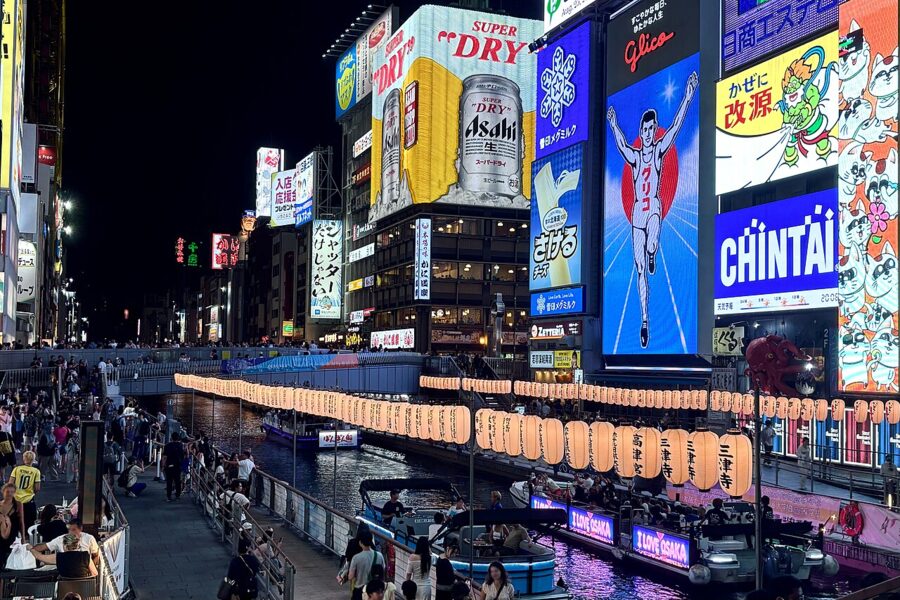
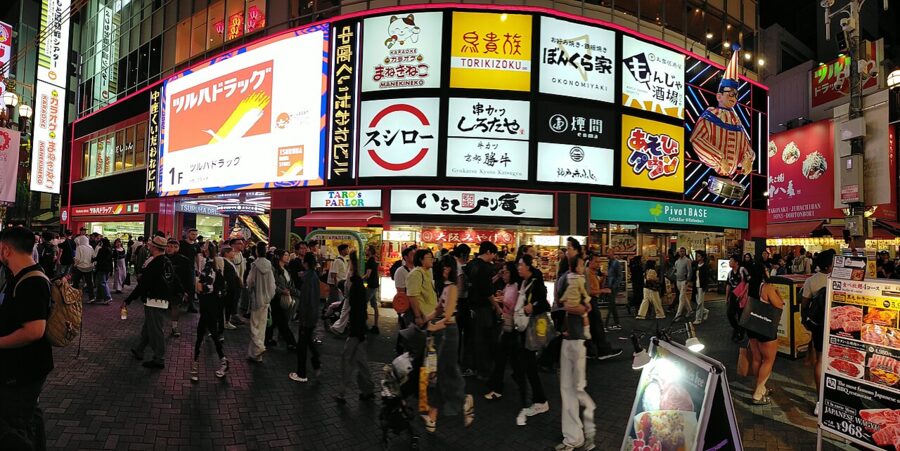
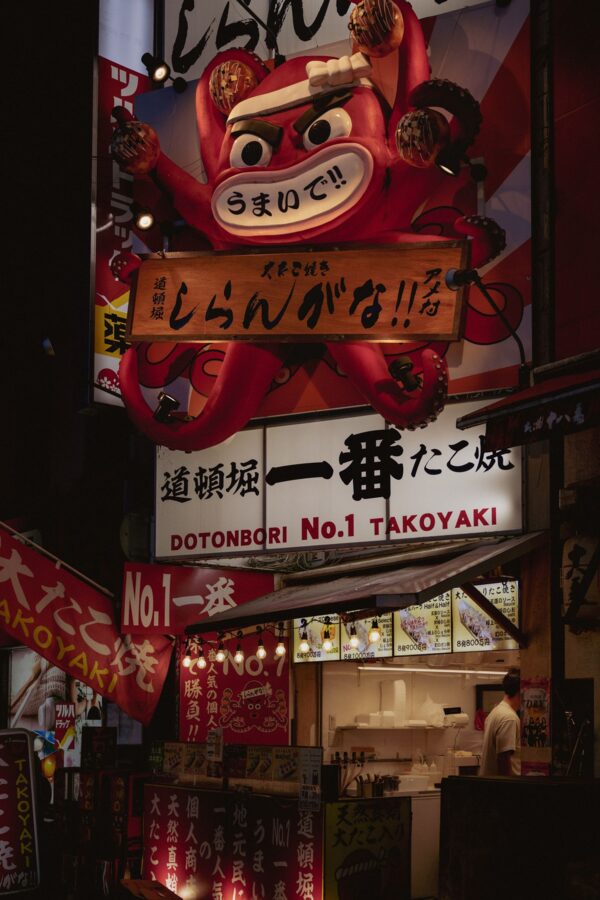
Dotonbori is a canal with a street along it, lined with restaurant signs the size of houses: a mechanical crab, a giant octopus, the running man of a confectionery company. The neon is what everyone photographs; walk along the canal-side path after dark instead of the main street and it is quieter by half. The theatres that made Dotonbori an entertainment district in the 17th century are gone. The last of them, the Osaka Shochikuza, closed in May 2026.
The word that goes with it is kuidaore, roughly “eating yourself into ruin”. The old saying runs Kyo no kidaore, Osaka no kuidaore: people in Kyoto bankrupt themselves on clothes, people in Osaka on food. Longer versions add that Kobe people are ruined by shoes and Nara people by sleeping in.

Shinsekai and Kuromon
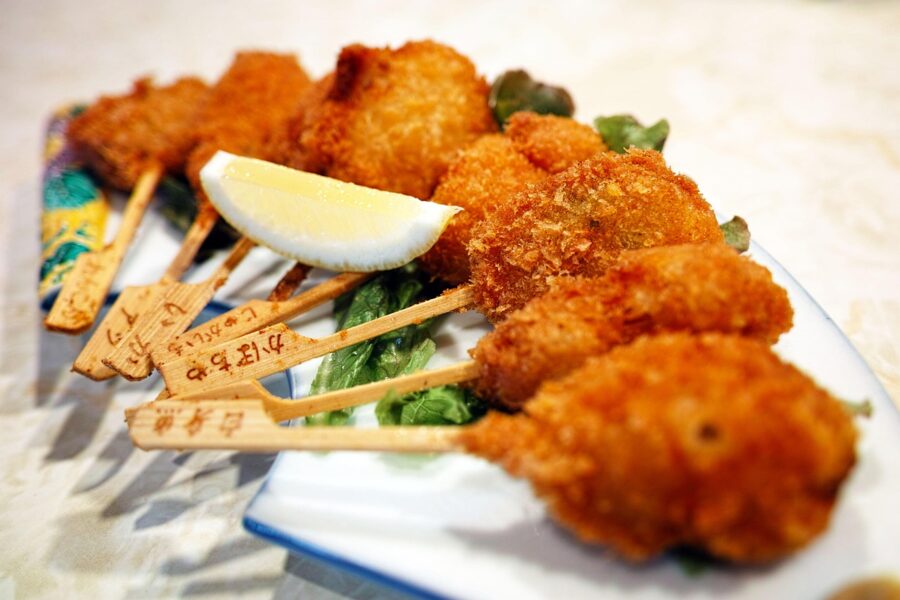
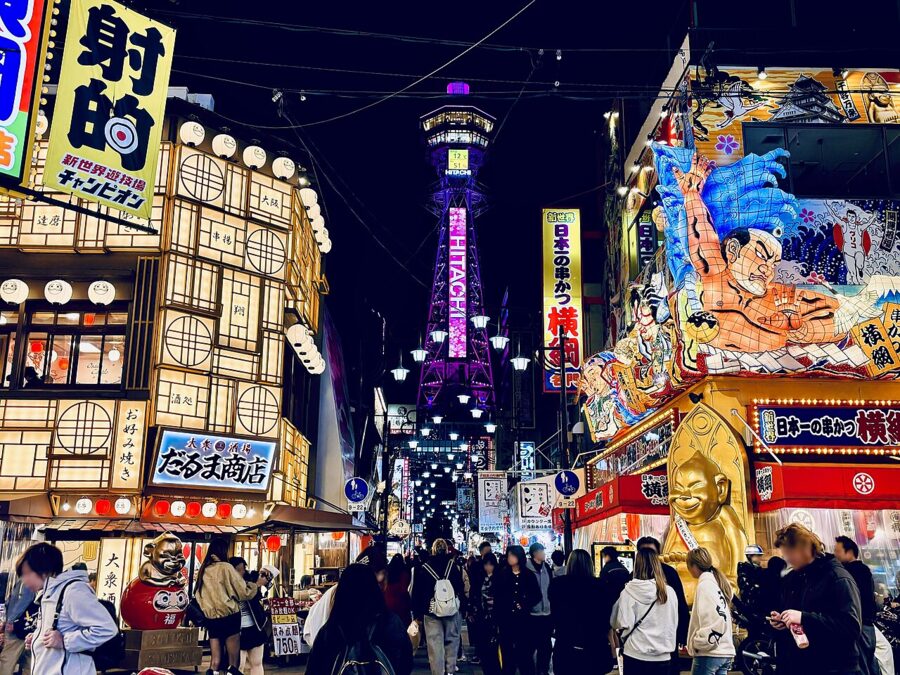
Shinsekai, “New World”, was laid out in 1912 with a tower modelled on the Eiffel Tower at one end and an amusement park at the other. The present Tsutenkaku tower dates from 1956. The district went down in the world after the war and has been slowly coming back up; today it is a few streets of kushikatsu restaurants, skewers of meat and vegetables fried in batter, with a rule against dipping your skewer in the shared sauce twice. It’s near Shin-Imamiya and Dobutsuen-mae stations, and it is at its best in the early evening.
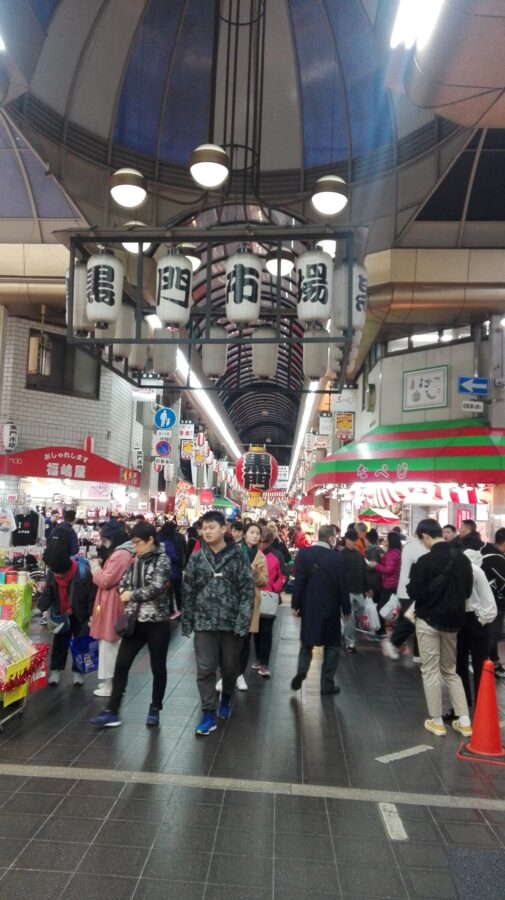
Kuromon Ichiba, the covered market near Nipponbashi, has been feeding south Osaka for generations. Most of its stalls now sell to visitors: grilled scallops, sea urchin in the shell and wagyu skewers at prices well above what you would pay in a restaurant. I’d walk through for the look of it and eat somewhere else.

Yumeshima, a year after the Expo
Expo 2025 Osaka, Kansai ran from 13 April to 13 October 2025 on Yumeshima, a reclaimed island in the bay, and drew 25,578,986 ticketed visitors. Its centrepiece was the Grand Ring, a timber frame about 2 kilometres round, certified as the largest wooden building in the world. Most of it has been taken down. Some of the timber went to build public housing in Suzu, on the earthquake-damaged Noto Peninsula, and some to other prefectures for parks and stages.
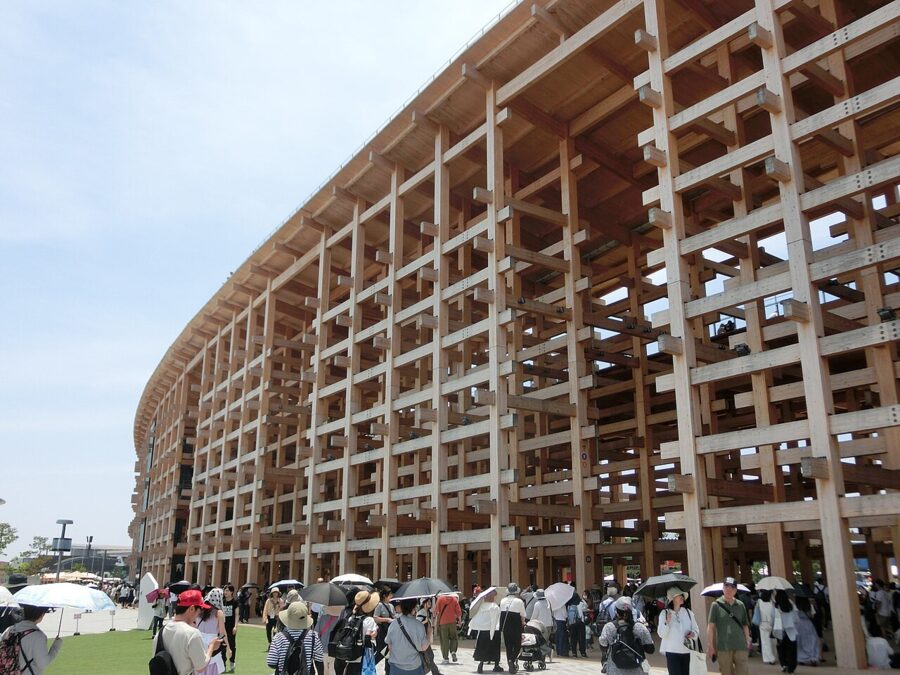
The plan agreed in 2025 keeps that 200-metre section, climbable and close to its original form, inside a new city park. As of late 2026 most of the site is fenced off for demolition and for Osaka’s casino resort, due to open around autumn 2030. Yumeshima station is still open, and the convenience store outside it still sells drinks. There is not much else to go for yet.
Kyoto (京都)
Kyoto’s temples and shrines are listed together as the Historic Monuments of Ancient Kyoto, 17 places in Kyoto, Uji and Otsu, from Kiyomizu-dera and Kinkaku-ji to Byodoin and Enryaku-ji on Mount Hiei. Around them is a working city, and the trick is knowing where to stay, how to move and how to avoid spending a day in a queue.
Neighbourhoods
Kyoto is a grid, still recognisably the one laid out in 794, with mountains on three sides. Higashiyama, the eastern hills, holds the old wooden streets around Kiyomizu-dera and Yasaka Shrine, and Gion beside the Kamo River. It is the most beautiful part of the city and, from mid-morning to late afternoon, the most crowded. Stay there and you get it at 07:00 and after dark, which is when it is worth seeing.
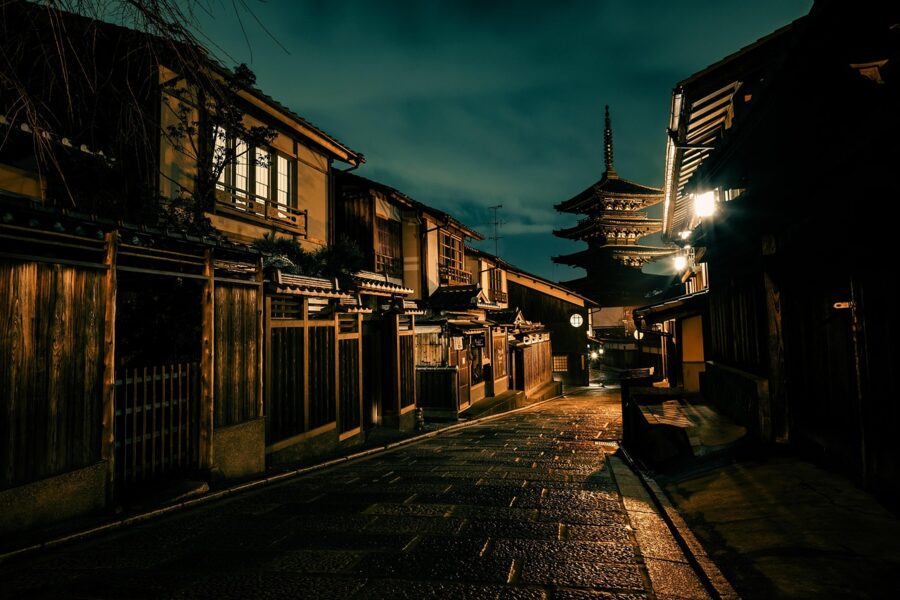
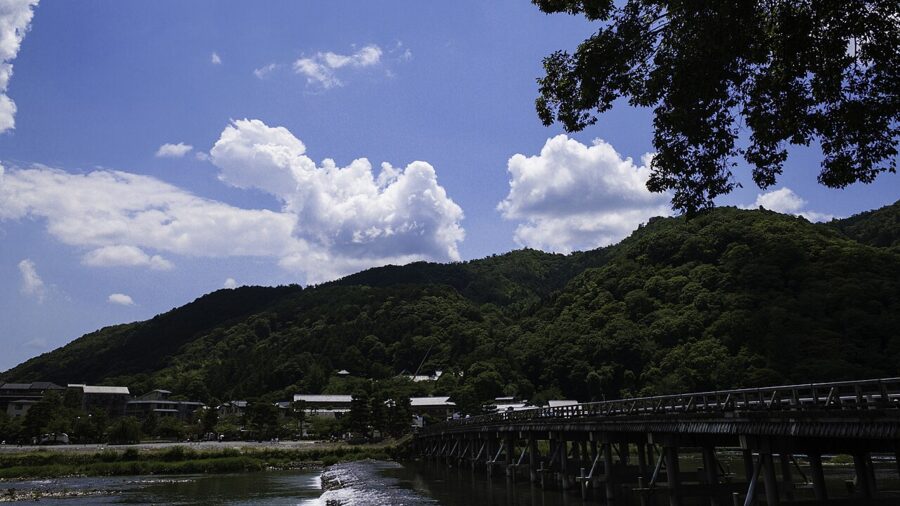
Arashiyama in the west has the bamboo grove and the Togetsukyo bridge, and by day it is as crowded as Gion. Demachiyanagi in the north, where the Kamo and Takano rivers meet, has student cafes, the Shimogamo shrine forest and the Eizan line to Kurama. Fushimi, in the south, is a sake town with a canal; Uji, a further 20 minutes by train, is a tea town with a river.

Moving around the city
Kyoto’s buses are the weak point. A flat fare of ¥230 covers most of the city, and the routes reach everything, but the main lines to Kiyomizu-dera, Gion and Kinkaku-ji are so crowded with visitors that residents sometimes cannot get on. The city stopped selling its bus-only day pass in September 2023, partly to push visitors onto the subway. In June 2024 it added two tourist express routes with their own higher fare, running between Kyoto Station and the main eastern and western sights.
Use the two subway lines, the Karasuma line north to south and the Tozai line east to west, with the Keihan and Hankyu lines, and walk the last stretch. A subway-and-bus day pass costs ¥1,100 and covers buses beyond the flat-fare zone, including Ohara. Or rent a bicycle: the city is flat inside the mountains, and it is the fastest way across the grid.
Kyoto also charges a city tax per guest per night. Since the 2026 revision it runs from ¥200 for rooms under ¥6,000 to ¥10,000 for rooms over ¥100,000, the highest such tax in Japan; most travellers pay ¥400 or ¥1,000 a night.
The crowds
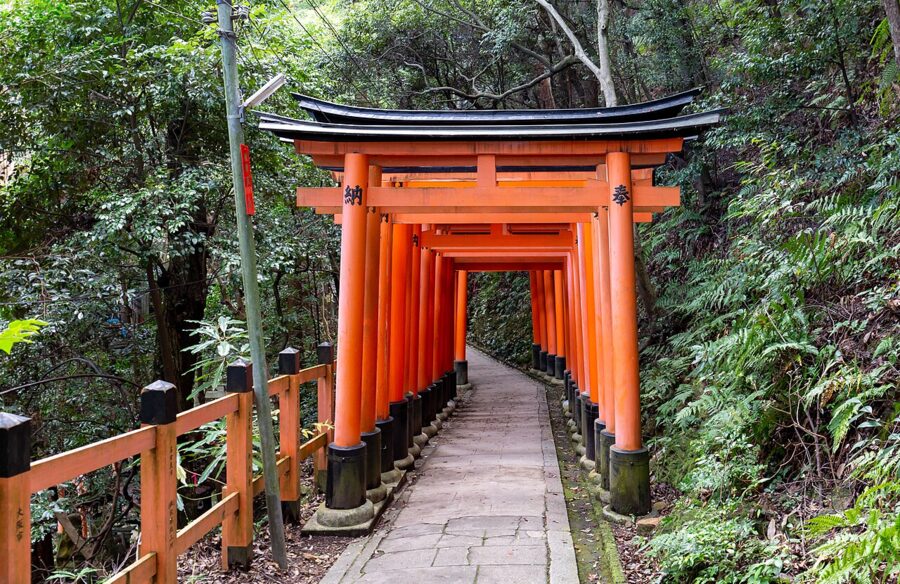
The famous sights fill from about 09:30 to 16:00, with school groups in late spring and autumn. Fushimi Inari and the Higashiyama streets are best at first light, and Kiyomizu-dera opens at 06:00. In the autumn colour, which in the Kyoto basin usually peaks in the second half of November, do the famous gardens at opening time and spend the rest of the day somewhere nobody has heard of.
Nara (奈良)
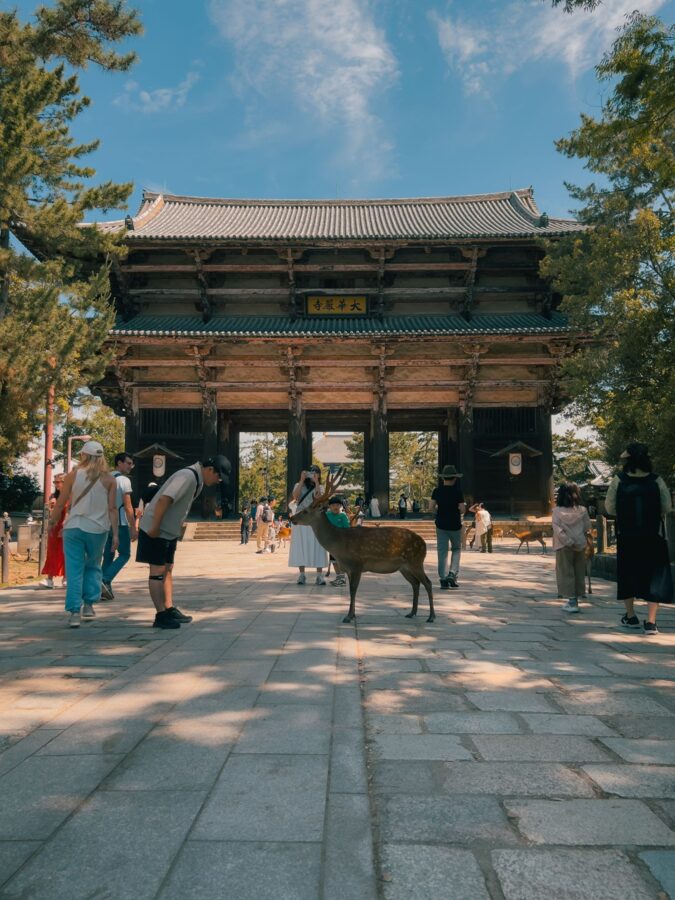
Nara is a small city with a very large park, and most of what people come for is inside it: Todaiji, Kofukuji, Kasuga Taisha, the National Museum and about 1,300 deer. It’s a day trip from Osaka or Kyoto, and a day is enough for the park. Stay a night, though, and you can be at Todaiji at opening time, with the deer still asleep on the lawns.
Todaiji and Kasuga
Todaiji (東大寺) was founded by Emperor Shomu in the 740s as the head of a network of state temples, and its Great Buddha was dedicated in 752. The present Daibutsuden, rebuilt in 1709 after the earlier halls were burned in the wars of 1180 and 1567, is about two-thirds the width of the original and was for centuries the largest wooden building in the world. Entry to the hall is ¥800; a combined ticket with the Todaiji Museum costs ¥1,200 and lets you skip the ticket queue at the hall, which on a spring weekend is worth having.
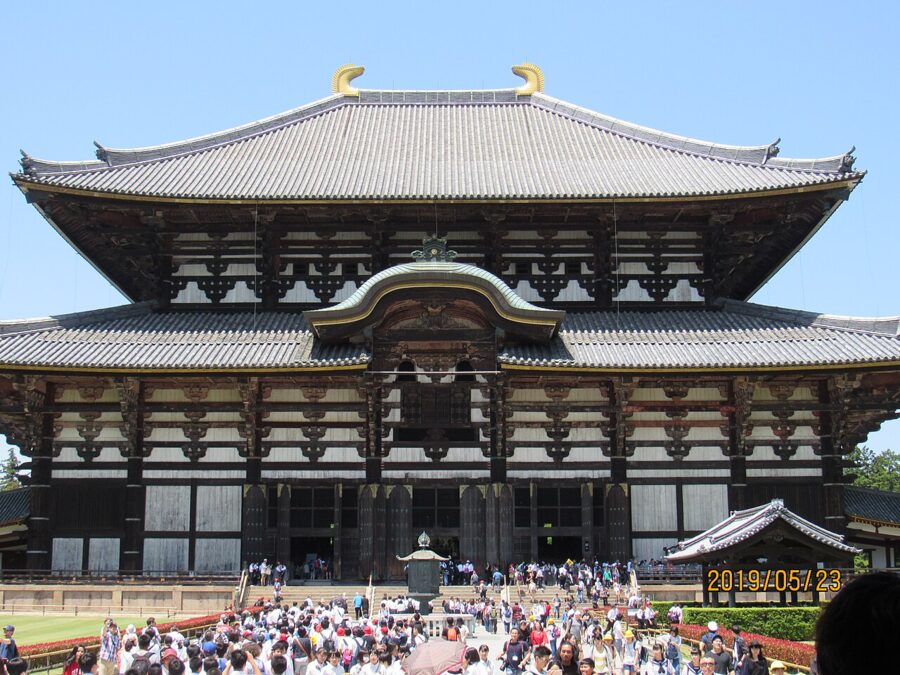

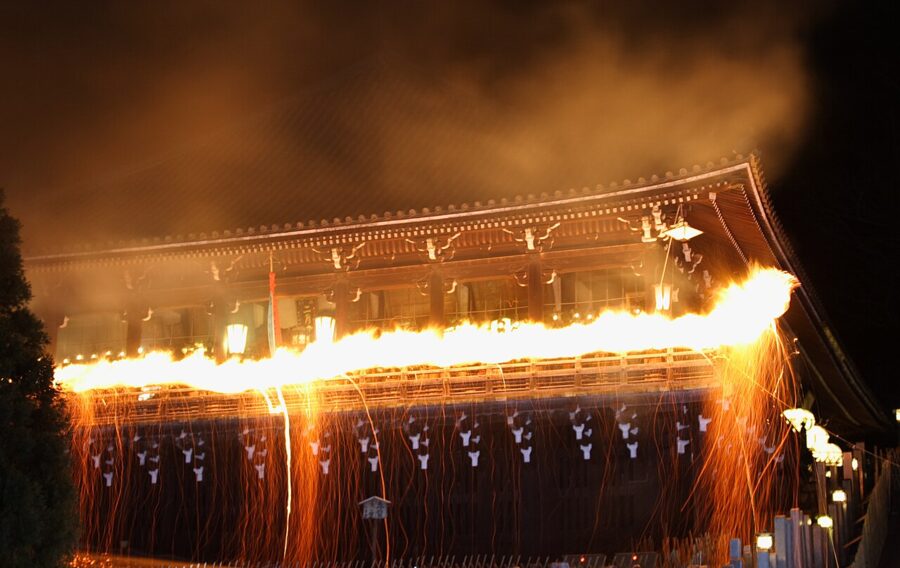
Up the hill behind it, the Nigatsudo hall hosts Omizutori, the water-drawing rite, from 1 to 14 March each year. Monks have performed it every year since 752, by the temple’s count without a single break. In the evenings huge burning torches are run along the balcony and shaken over the crowd below.
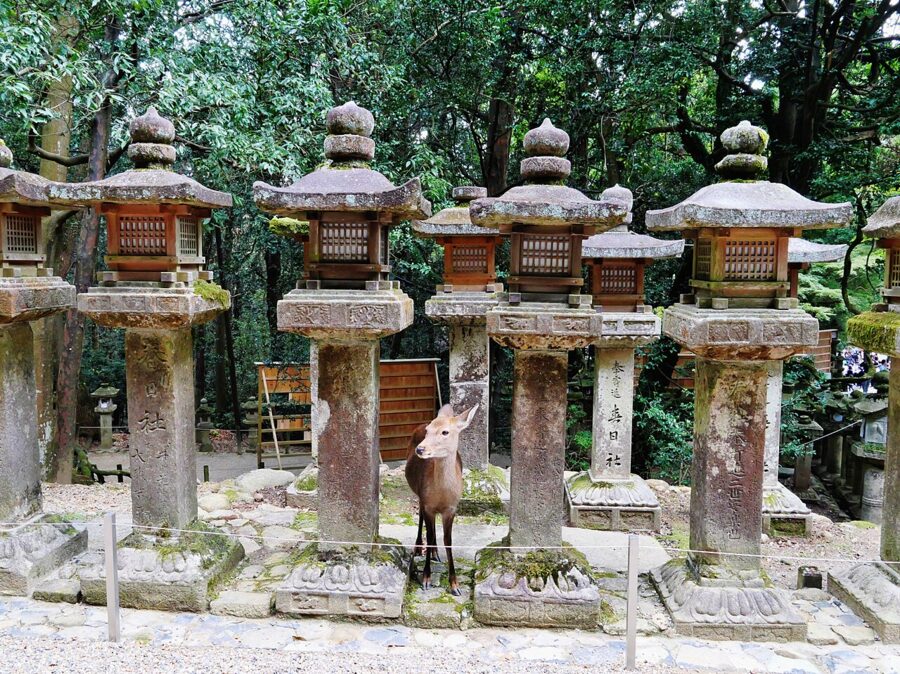
East of Todaiji, Kasuga Taisha (春日大社) was founded in 768 as the shrine of the Fujiwara family. Its approach and inner corridors hold about 3,000 stone and bronze lanterns, donated over a thousand years, and they are all lit only twice a year, at the beginning of February and in mid-August.

The deer
The deer of Nara Park are wild animals and a Natural Monument, protected because Kasuga’s god is said to have arrived on a white deer; a 2024 count found 1,325. They bow for shika senbei, crackers sold around the park to fund their care. They also bite, butt and chase, so keep your distance in the autumn rut and in early summer, when the does have fawns.
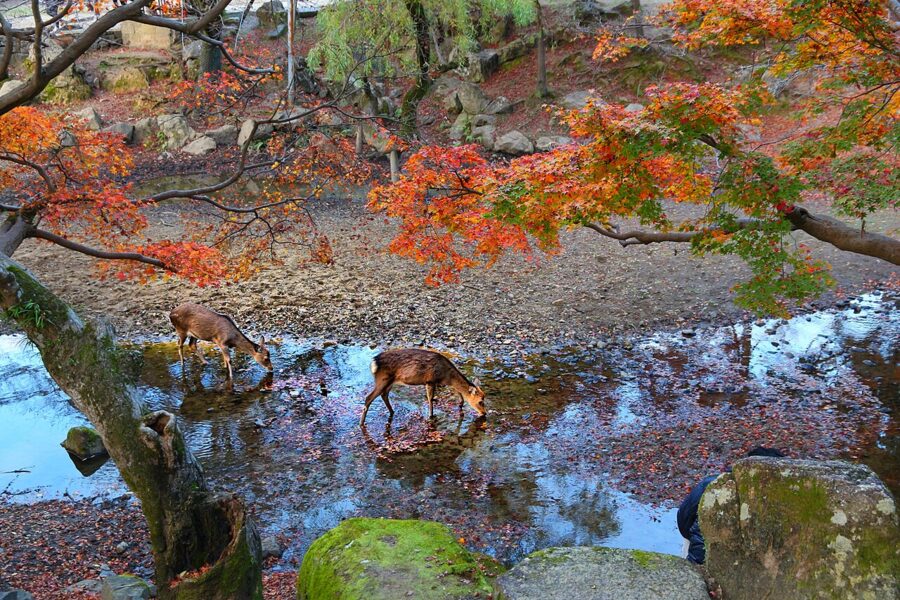

Occasionally one leaves. In March 2026 a deer that had been seen walking through Higashi-Osaka turned up at a police building in Osaka city, about 30 kilometres from the park. The governor of Nara declined to take it back, on the grounds that a deer outside the park is just a deer, and a hot-spring inn in the hills north of Osaka offered it a home.
Horyuji and Asuka
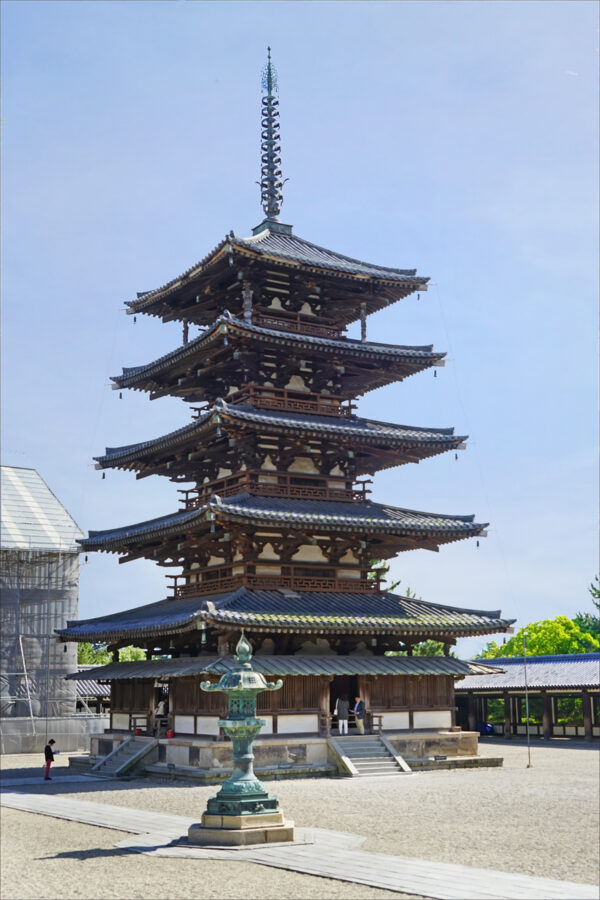
Horyuji (法隆寺), in Ikaruga, 12 kilometres south-west of Nara, has the oldest wooden buildings in the world: the Kondo and the five-storey pagoda of its western compound, rebuilt after a fire recorded for 670. Entry is ¥2,000. Take the JR Yamatoji line to Horyuji station and walk 20 minutes up the road, or take the bus; the temple is quiet by Nara standards, and the pagoda alone justifies the trip.

Asuka is further south: Asuka station is a few minutes beyond Kashiharajingu-mae on the Kintetsu Yoshino line, about 40 minutes from Osaka-Abenobashi. Rent a bicycle there and spend a day on the tombs, the Great Buddha of Asuka-dera (cast in the early 7th century and much repaired, the oldest dated Buddhist statue in Japan) and the rice fields where the palaces stood. With the new World Heritage listing, Asuka will be busier than it was. It is still mostly fields.
Hyogo (兵庫)
Hyogo is a big prefecture that runs from the Inland Sea to the Sea of Japan, with Kobe on its southern shore, Himeji further west, and the hot-spring towns of Arima and Kinosaki in its hills.
Kobe
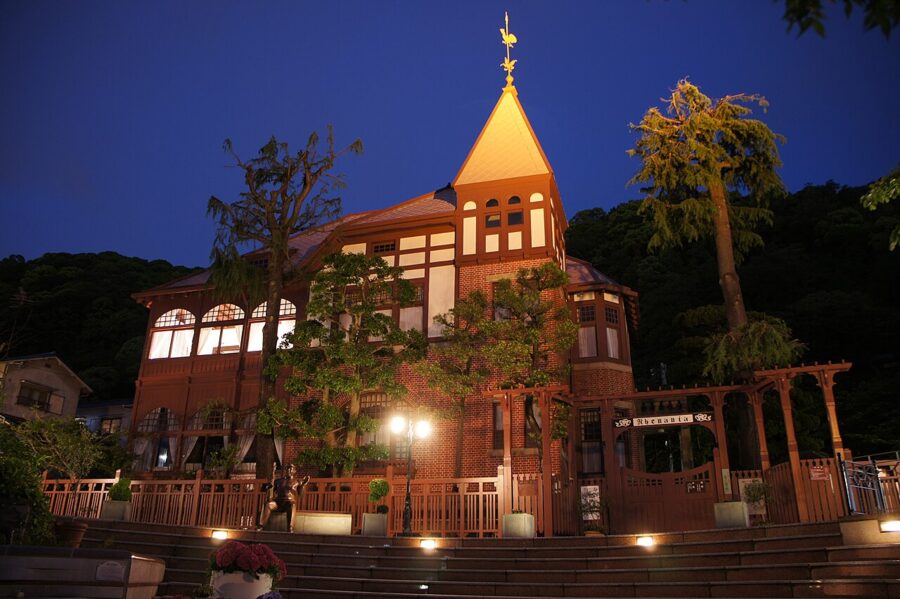
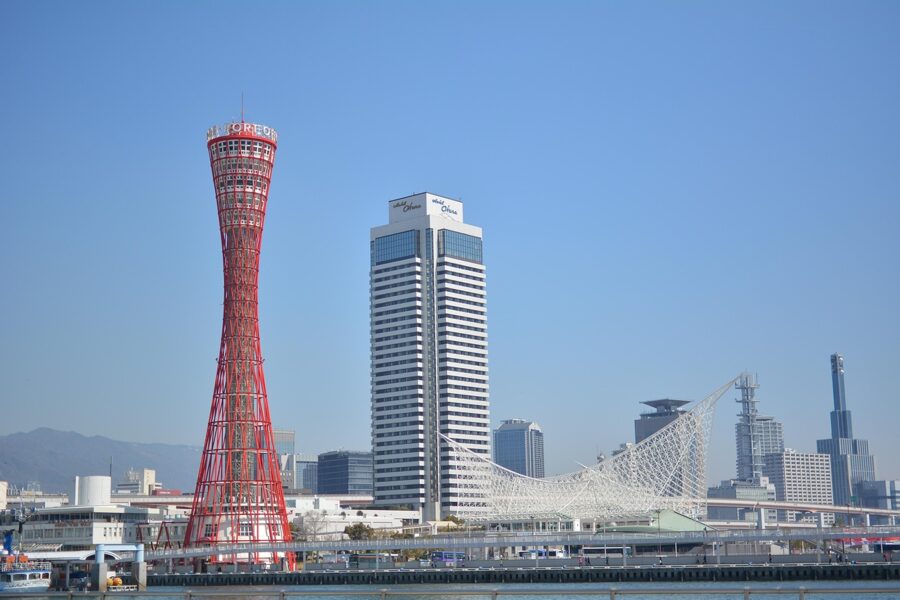
Kobe (神戸) is a long city squeezed between Mount Rokko and the sea, so you walk uphill to the north and downhill to the harbour. The Kitano district on the hillside keeps some of the wooden houses of the foreign merchants. Nankinmachi, the Chinatown, is a few streets of steamed buns. The harbour front at Meriken Park has the red Port Tower and the Port of Kobe Earthquake Memorial Park, where a stretch of quay is left as the 1995 earthquake broke it.

East along the shore lie the five sake districts of Nada, which make about a quarter of Japan’s sake. The cold winter wind off Mount Rokko, the hard well water of Nishinomiya called miyamizu, Harima rice and a port to ship from made it a brewing centre in the Edo period.
Himeji Castle
Himeji Castle (姫路城) is the one original castle in Japan that you should go out of your way for. Its five-storey main keep was finished in 1609 by Ikeda Terumasa, and it has never been destroyed by fire, war or earthquake; the 1945 air raids burned the town around it, and an incendiary bomb that hit the keep failed to go off. It was one of Japan’s first two World Heritage cultural sites in 1993.
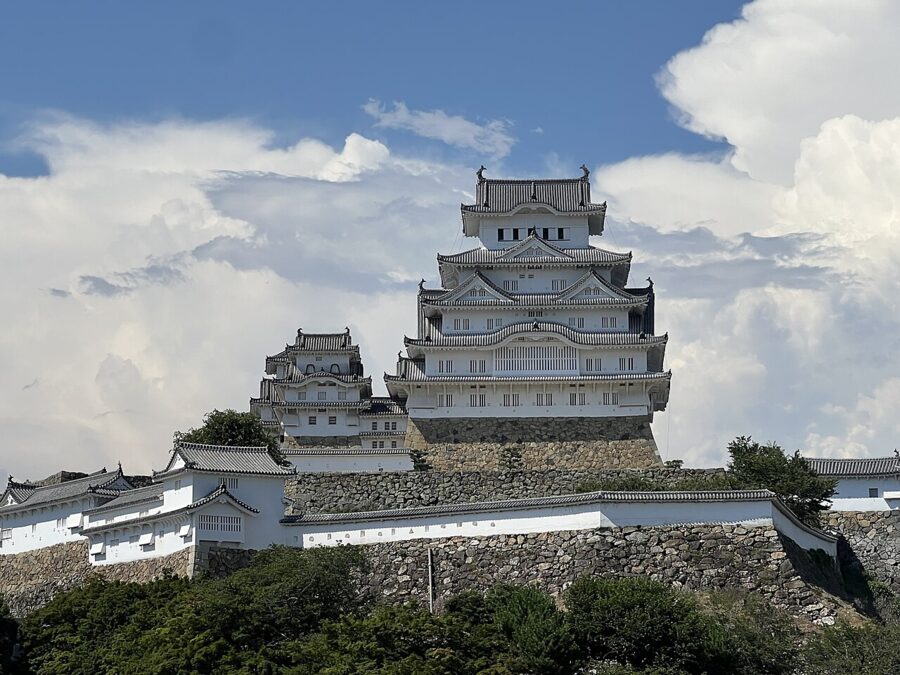
From 1 March 2026 Himeji charges non-residents ¥2,500 for entry, while residents of the city still pay ¥1,000; under-18s go free. The castle is a 15-minute walk straight up the avenue from the north exit of JR Himeji station, about 30 minutes from Shin-Osaka by Shinkansen or about an hour by JR Special Rapid. Allow an hour and a half for the walk to the top of the keep and back, and a second hour for the Nishinomaru corridor and the Koko-en gardens next door.
Arima and Kinosaki
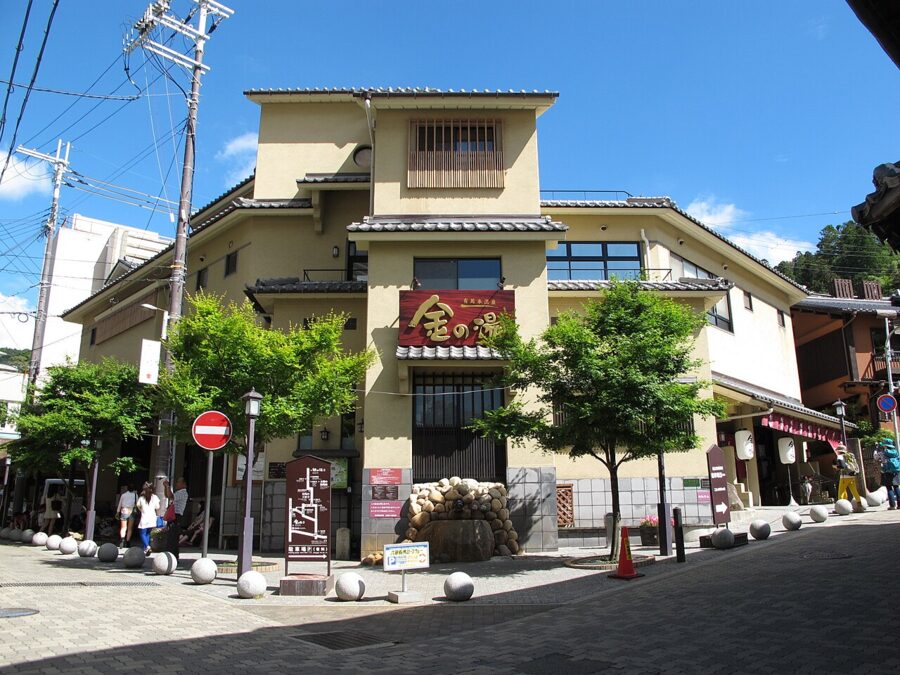
Arima Onsen, behind Mount Rokko in Kobe’s Kita ward, is one of the oldest spa towns in Japan and was a favourite of Hideyoshi. Its water comes in two kinds: kinsen, “gold water”, a salty iron spring that turns rust-brown in the air, and ginsen, “silver water”, clear and carbonated. The two municipal bathhouses, Kin no Yu and Gin no Yu, let you try both without staying in an inn.

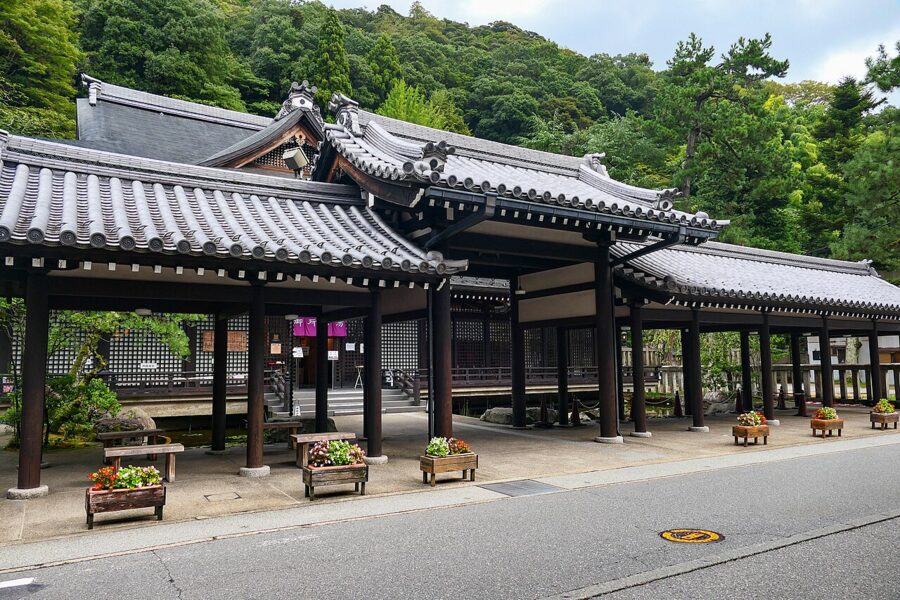
Kinosaki Onsen, on the Sea of Japan side, is about 2 hours 40 minutes from Osaka by the Konotori limited express. It is a town of three-storey wooden inns along a willow-lined stream, and the custom is to walk in a yukata, a cotton robe, and wooden sandals between its seven public baths. The writer Shiga Naoya stayed here in 1913 while recovering from being hit by a Yamanote line train in Tokyo, and his short story Kinosaki nite made the place famous. Go in winter for the snow crab season, which runs from November to March.
Wakayama (和歌山)
Wakayama, the mountainous south of the Kii Peninsula, is where Kansai stops being a set of cities. Two of the three sacred sites of the Kii Mountains World Heritage listing are here.
Koyasan
Koyasan (高野山) is a temple town on a high basin at about 800 metres, founded by the monk Kukai in 816 as the centre of Shingon Buddhism. Around the head temple, Kongobu-ji, there are 117 subtemples, and about half of them take overnight guests in shukubo, temple lodgings, with vegetarian shojin ryori for dinner and the morning service at dawn. Staying the night is the point of going.
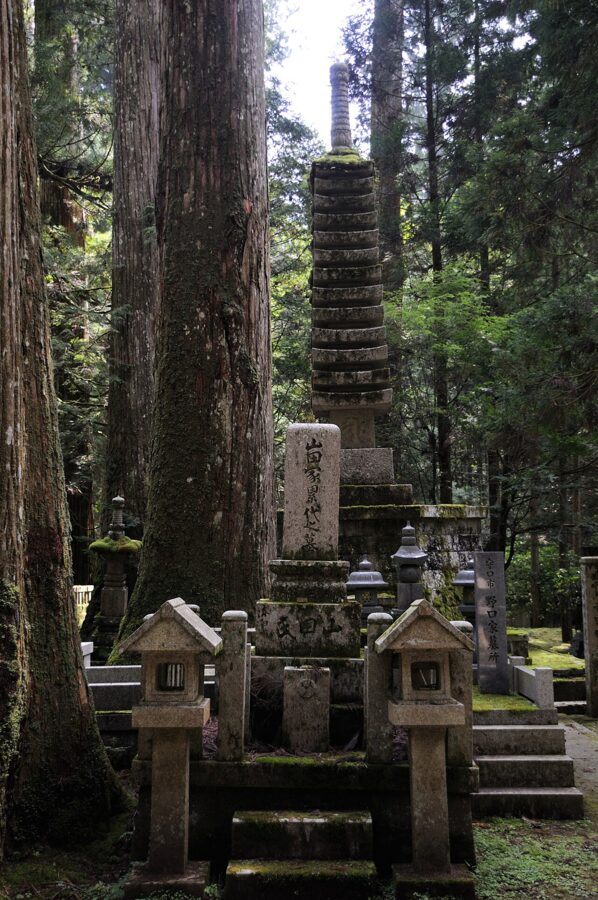

Okunoin is the cemetery that leads to Kukai’s mausoleum, about 2 kilometres from the Ichi-no-hashi bridge through old cedars. Among the feudal lords are modern company memorials, including one in the shape of a giant Yakult bottle. Walk it at dusk, when the lanterns come on.
Getting there is part of it. Nankai trains from Namba climb into the mountains to Gokurakubashi, about 1 hour 30 minutes on the express, then a cable car hauls you 328 metres up a 568 per mil slope in five minutes, and a bus runs into town. ICOCA works on the train and the cable car.
The Kumano Kodo and the three shrines
The Kumano Kodo are the old pilgrim roads to the Kumano Sanzan, three great shrines in the south of the peninsula: Kumano Hongu Taisha, Kumano Hayatama Taisha at Shingu and Kumano Nachi Taisha. Emperors walked them from the 10th century onwards, and so, later, did almost everyone else. The most walked route today is the Nakahechi from Takijiri, inland from Kii-Tanabe, to Hongu, about 40 kilometres over two or three days with nights in small inns along the way.
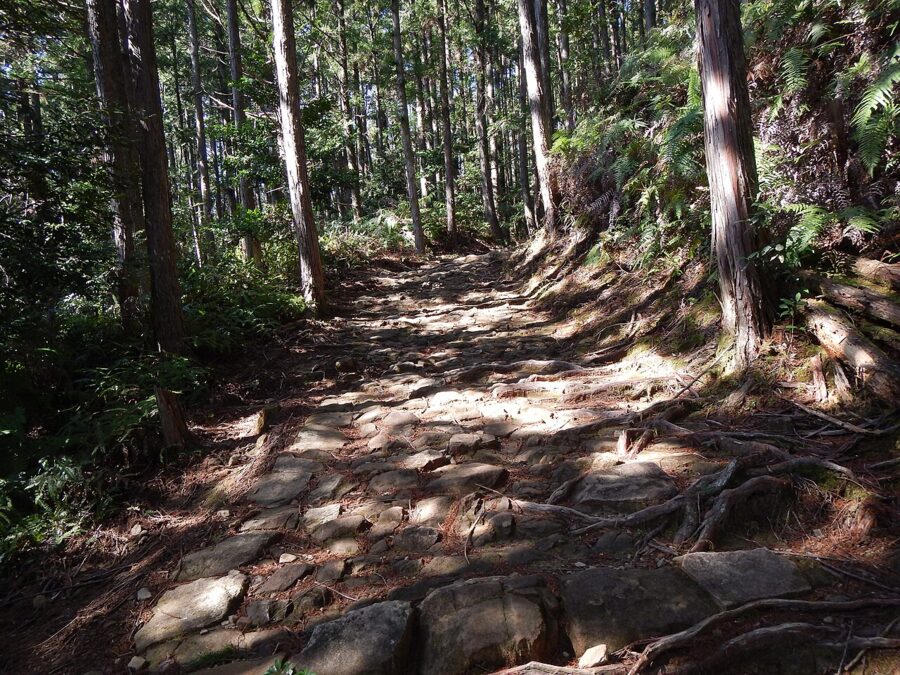

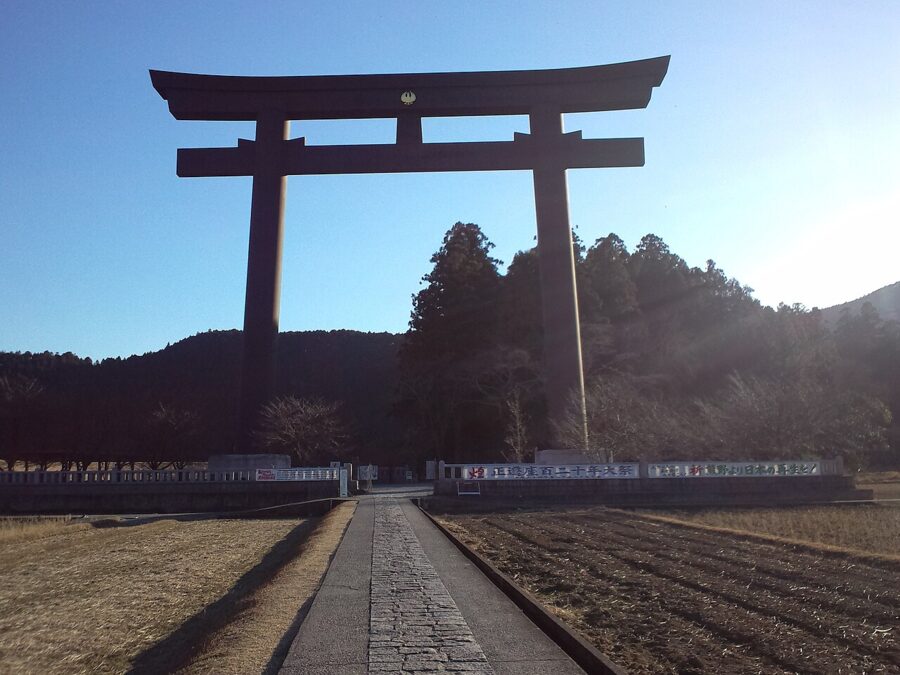
Kumano Hongu Taisha stood on a sandbank in the river until the flood of August 1889 washed most of it away. The surviving halls were moved up the hill, and the old site, Oyunohara, is marked by a 33.9-metre torii put up in 2000.

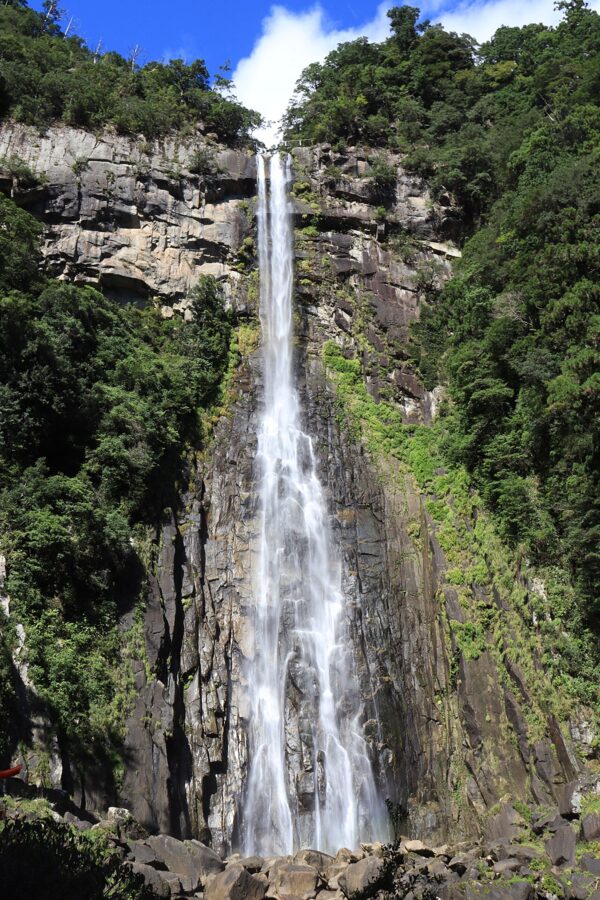
Kumano Nachi Taisha stands beside Nachi Falls, 133 metres high, the tallest single-drop waterfall in Japan, which is itself worshipped as a god. The view everyone takes, of the vermilion three-storey pagoda of Seiganto-ji with the falls behind it, is from the temple grounds next door.
Shirahama
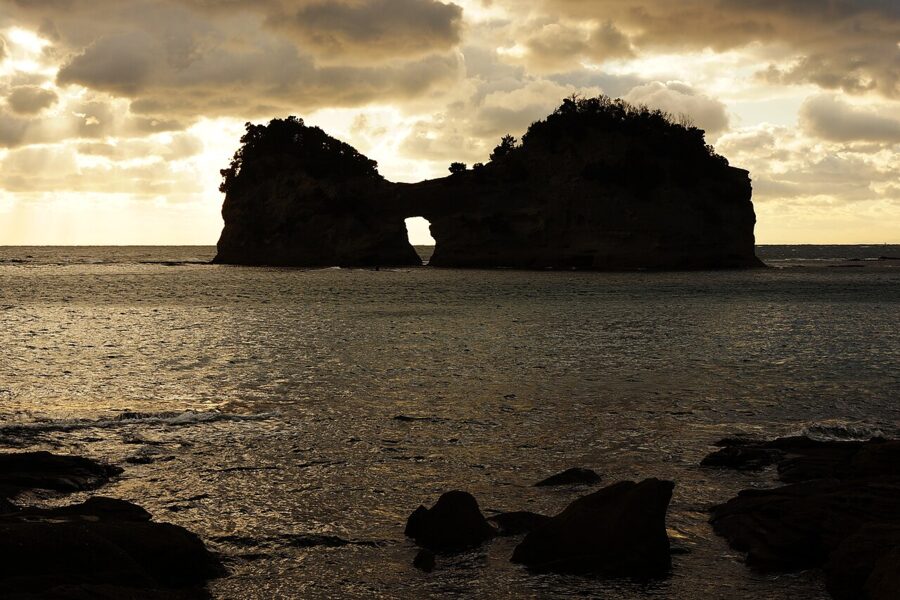
Shirahama is a hot-spring resort on the west coast with a white sand beach and the sea arch of Engetsu Island. It also had giant pandas: Adventure World kept them from 1994, bred cubs there, and sent the last four back to China on 28 June 2025. The park still runs, now with red pandas as the consolation. The town is about 2 hours 30 minutes from Osaka by the Kuroshio limited express.

Shiga and Mie
Kansai’s two least visited prefectures are on the way to somewhere else, and each has one thing worth stopping for.
Lake Biwa and Hikone
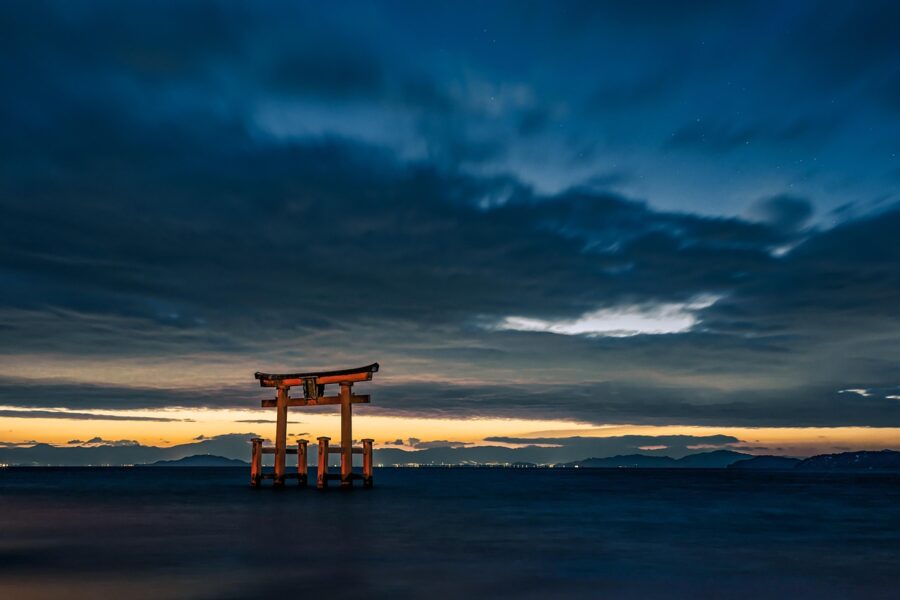
Lake Biwa (琵琶湖) covers 669 square kilometres, a sixth of Shiga Prefecture, and is Japan’s largest lake. It supplies the drinking water for Kyoto, Osaka and Kobe, which is why people downstream take a close interest in what Shiga does. The lake is ten minutes from Kyoto by JR to Otsu. On the west shore, near Takashima, the torii of Shirahige Shrine stands in the water.
Hikone Castle (彦根城), on the east shore, is one of only five castles whose keeps are National Treasures. Its small keep dates from 1606, and several of its buildings were moved here from older castles nearby. Entry is ¥800, including the Genkyu-en garden, and the keep lets in at most 80 people at a time.
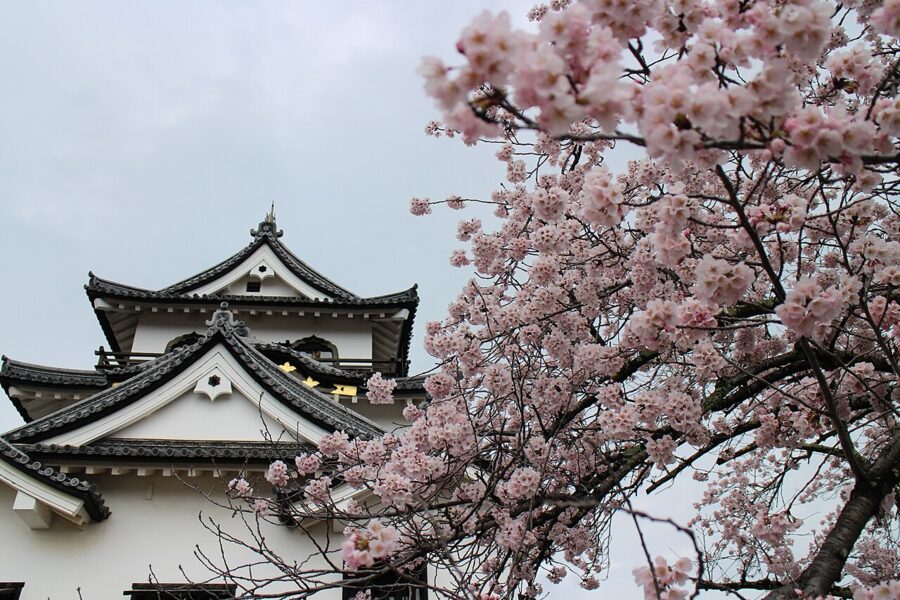

Hikone has been on Japan’s World Heritage tentative list since 1992, as the country’s first candidate, and has never been nominated; its fifth draft went to the Agency for Cultural Affairs in May 2026, aiming for 2027. In June 2026 heavy rain brought down part of a stone wall that had been repaired after a collapse in 2024.
Ise Jingu
Ise Jingu (伊勢神宮), on the Shima Peninsula in Mie, is the shrine of Amaterasu, the sun goddess from whom the imperial family claims descent. It has two main sanctuaries, the Inner Shrine (Naiku) and the Outer Shrine (Geku), about 5 kilometres apart. Every 20 years both are rebuilt from new cypress on the plot next door, a rite called Shikinen Sengu first held in 690. The 62nd was in 2013, and the 63rd is set for 2033.
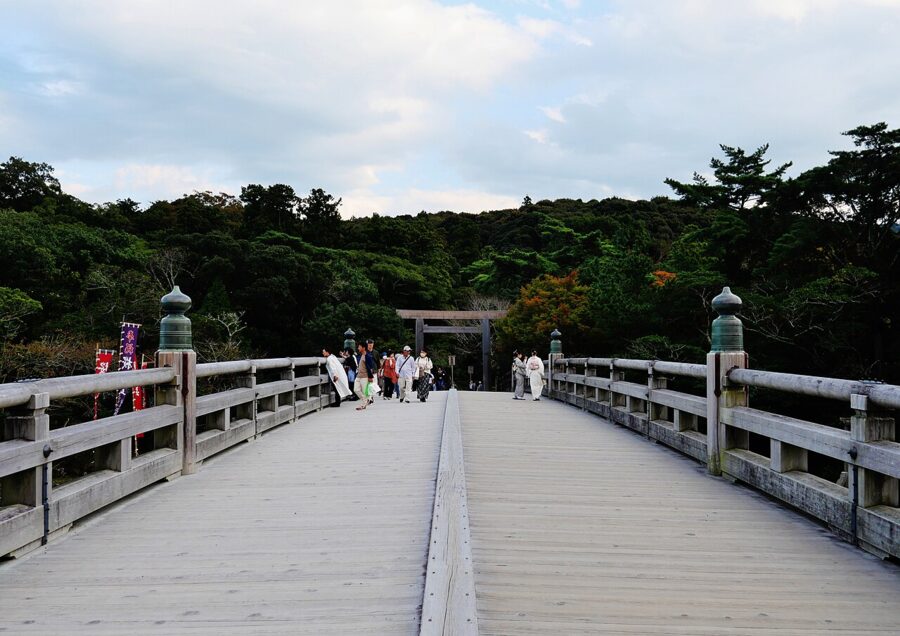

The ceremonies to fell and haul the timber for 2033 began in 2025, and in spring 2026 the first ceremonial logs were dragged into both shrines, by river to the Inner and by land to the Outer. Visit the Outer Shrine first, as is customary, then take the bus to the Inner. From Osaka-Namba or Kyoto it is about two hours by Kintetsu limited express.
What to eat and drink
Kansai cooking builds on dashi, stock made from kelp and dried bonito, and is lighter in colour than Tokyo’s: a bowl of noodle soup in Osaka is pale gold where in Tokyo it would be dark brown.
Osaka: flour and sauce
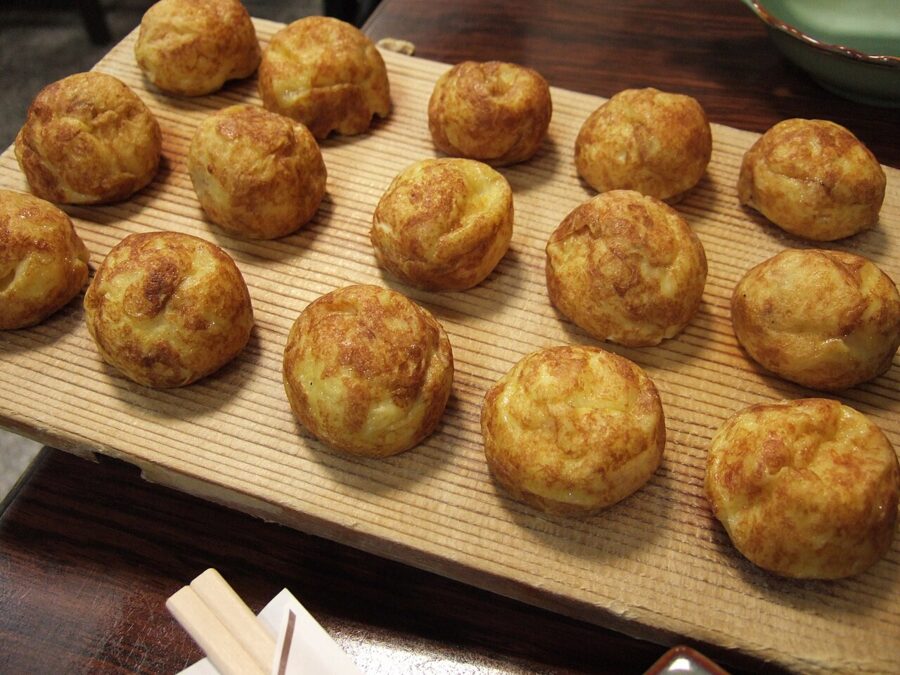
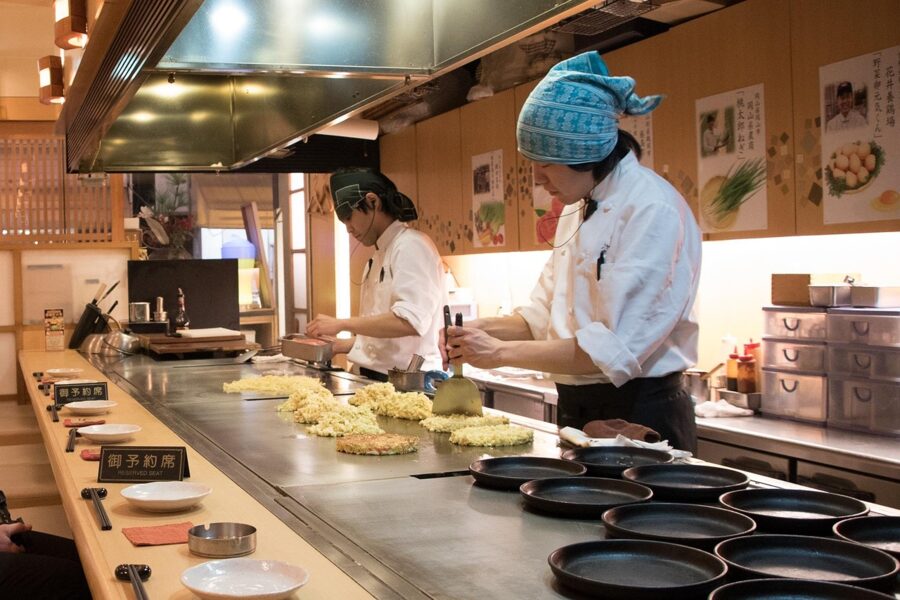
Takoyaki, balls of batter with octopus inside, were made in their present form in 1935 by Endo Tomekichi, whose shop Aizuya still trades in Tamade, south Osaka, and still serves them without sauce. He had been selling beef-filled balls until a customer told him that in Akashi, west of Kobe, they put octopus in. Okonomiyaki, a griddled pancake of cabbage, batter and whatever you choose, is the other Osaka standard, often cooked at the table on a hotplate.

Kyoto: kaiseki and tofu
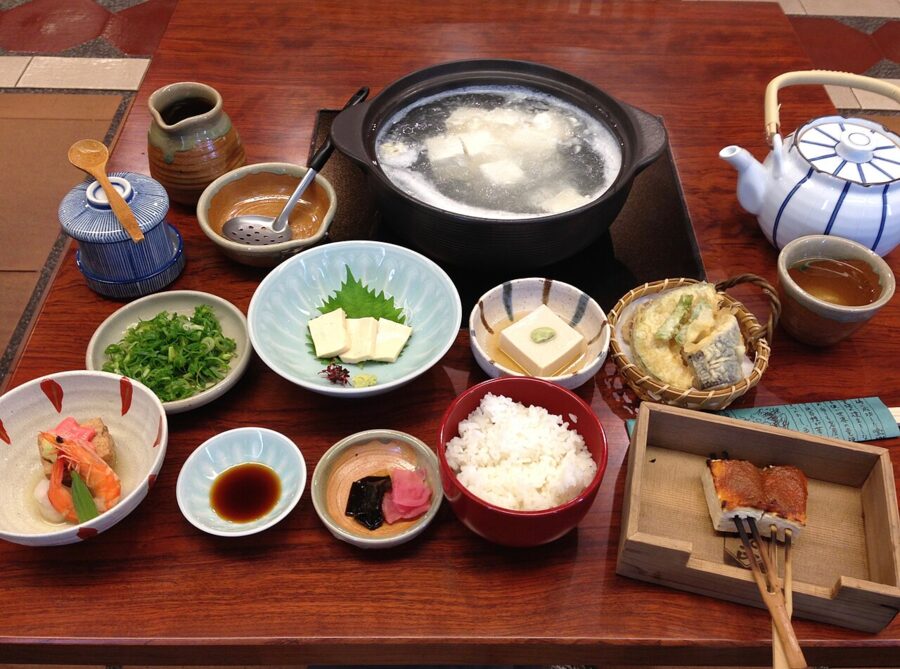
Kyoto is the home of kaiseki, the multi-course meal that grew out of the tea ceremony, built on seasonal vegetables, fish from the coast and an obsession with the right plate for each dish. A dinner in a good restaurant often costs ¥20,000 or more; lunch at the same places is often half that and the better way in. The everyday Kyoto dish is tofu, made with the soft well water under the city: yudofu, tofu simmered in kelp broth, is the classic meal near the Zen temples of Nanzen-ji and Arashiyama.

Kobe beef and Nara pickles
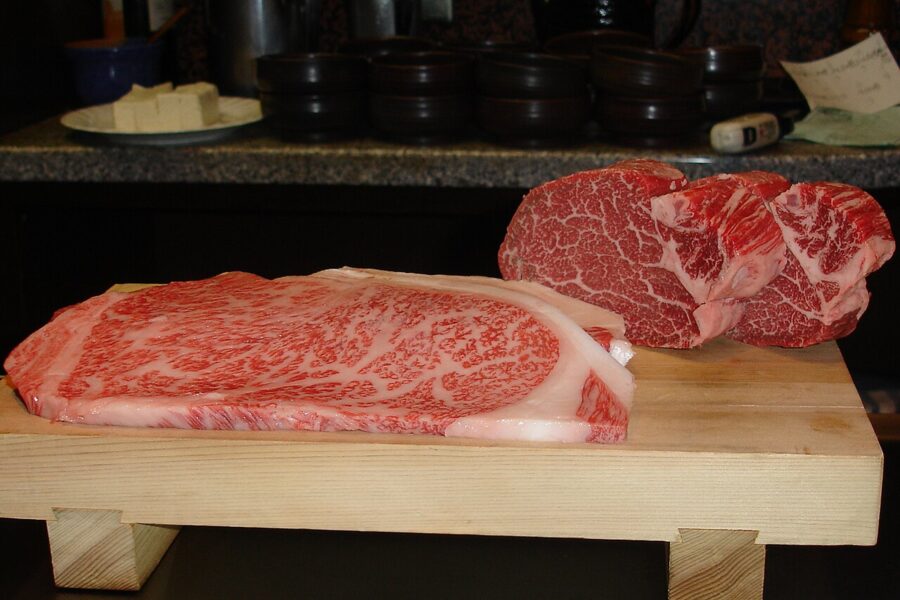
Kobe beef is a brand, not a breed: Tajima cattle raised in Hyogo, graded and registered, with a certificate to prove it. Most of what is sold abroad as Kobe is not. In Kobe itself, the steak restaurants around Sannomiya cook it on an iron hotplate in front of you, and a lunch set costs a good deal less than dinner.

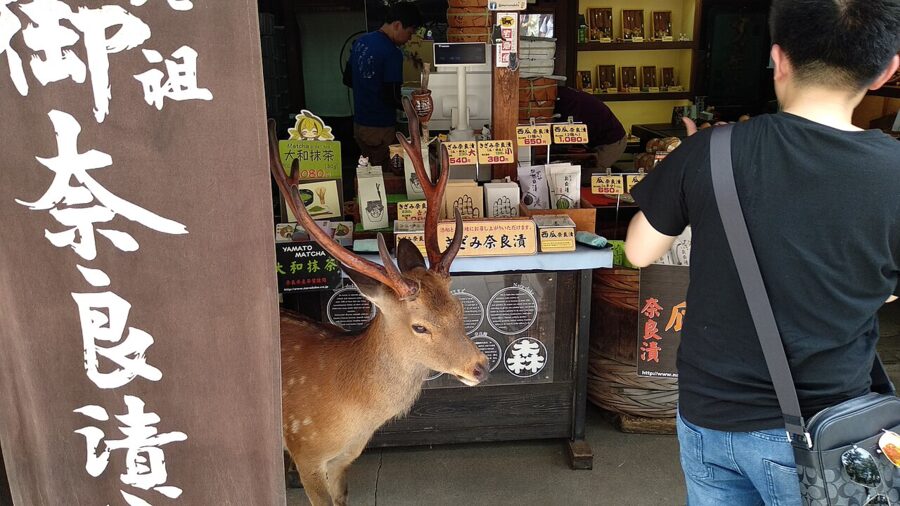
Narazuke is vegetables, usually white gourd, pickled again and again in fresh sake lees until it turns dark brown and smells strongly of alcohol. Wooden tablets from an 8th-century nobleman’s household in Nara already record gourds in sake lees, and a study published in December 2025 found that the pickle is genuinely fermented by lactic bacteria, not just flavoured by the lees. It is an acquired taste. Buy a small packet, not a gift box.

Sake from Nada and Fushimi
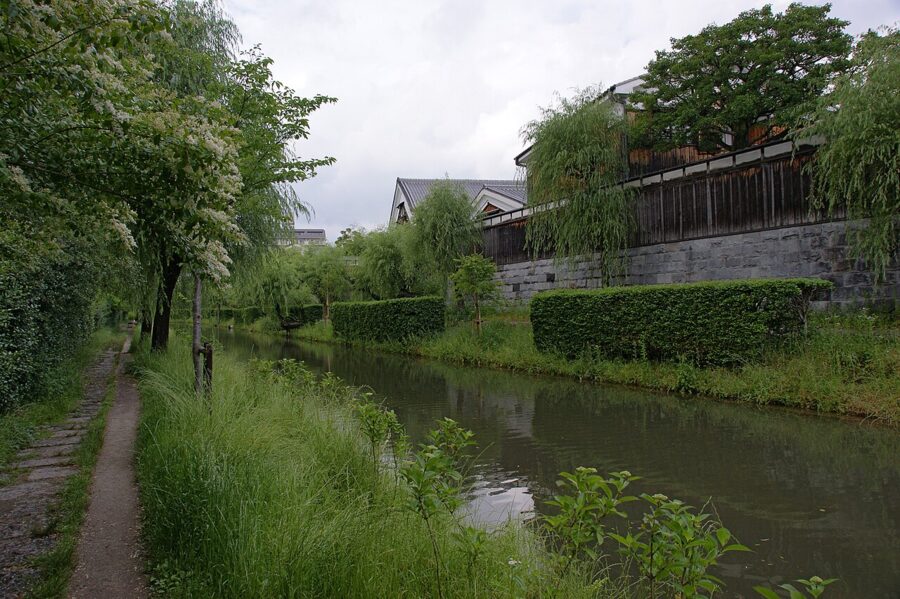
Nada makes a firm, dry sake from hard water. Fushimi in Kyoto has softer water and a softer style, and its brewery warehouses line a canal that once carried their barrels to the river. Both make easy half days: in Nada, ride the Hanshin line and walk between the brewers’ museums; in Fushimi, get off at Chushojima and follow the canal.

Seasons and festivals
Spring, from late March to early April, is the cherry blossom and Kyoto at its busiest, with hotels full months ahead. May is the most comfortable month, and Kyoto’s Aoi Matsuri procession is on 15 May.

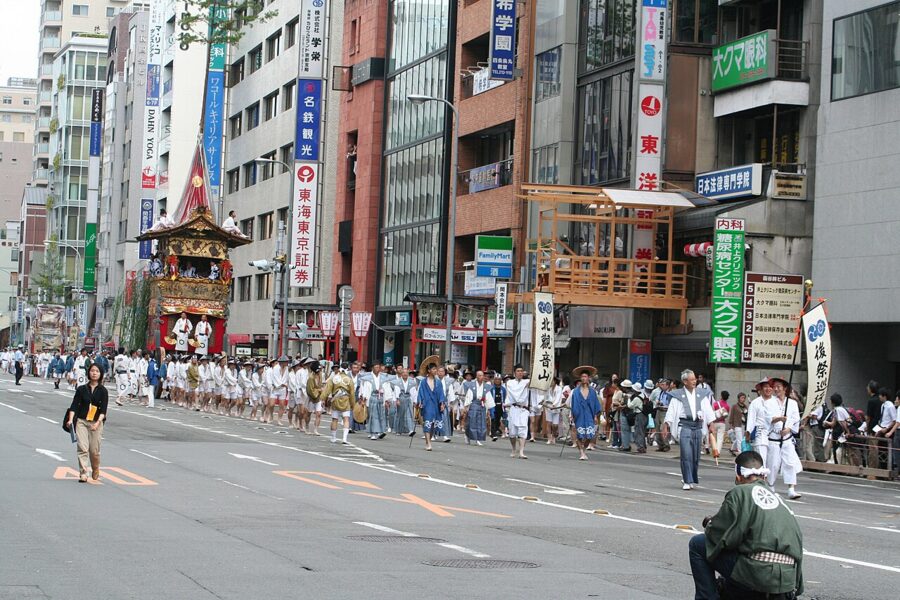
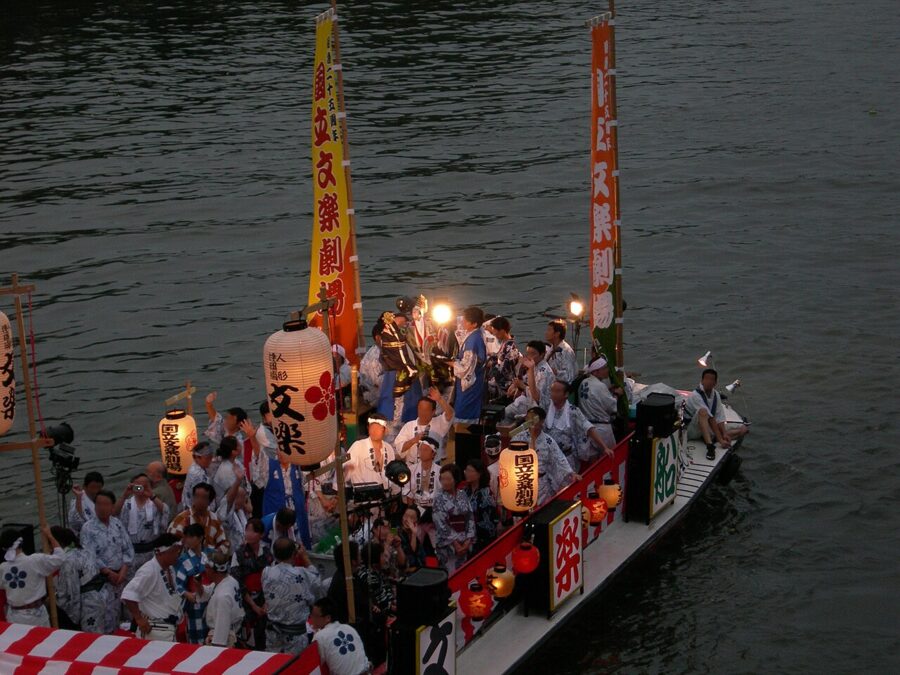
Summer is hard: the rainy season runs from early June to mid-July, and after it the Kyoto basin regularly passes 35°C. It is also festival season. Kyoto’s Gion Matsuri fills July, with the great float processions on 17 and 24 July, and Osaka’s Tenjin Matsuri puts about 100 boats on the river on 24 and 25 July.


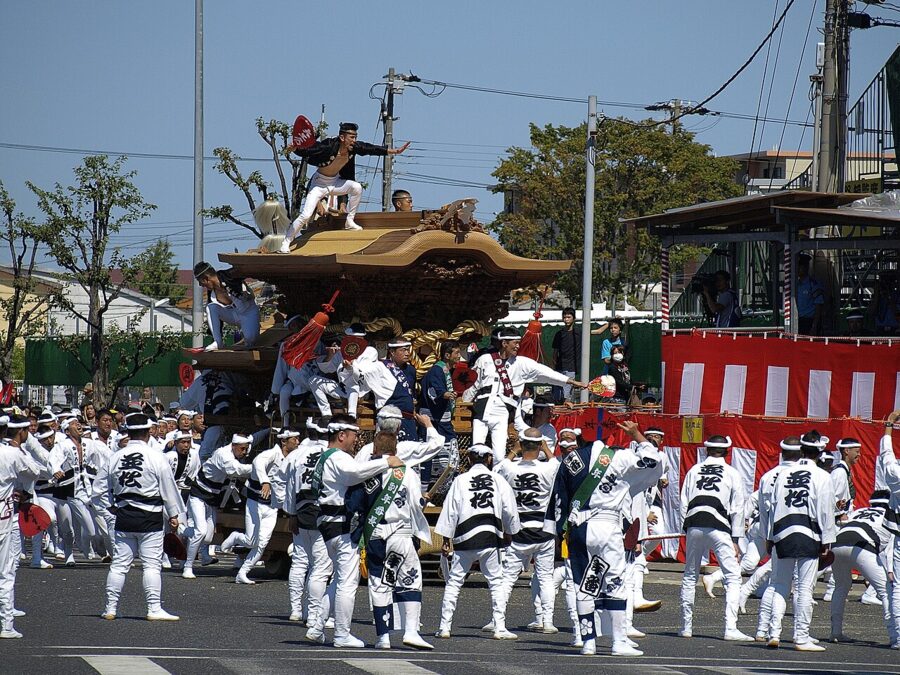
Autumn is the best time to come. September still brings typhoons, but by October the air is dry and clear. In mid-September the town of Kishiwada, south of Osaka, runs its danjiri festival, hauling four-tonne wooden floats around corners at a run. The autumn colour reaches Kyoto and Nara in the second half of November, and Koyasan a few weeks earlier.

Winter is cold, rarely snowy in the cities, and quiet: the season for Kinosaki crab, Koyasan under snow and a Kyoto garden to yourself.
Five days, or ten
Both plans assume you arrive at KIX and sleep in Osaka unless they say otherwise.
Five days
- Day 1: Arrive; Rapi:t to Namba. Dotonbori and Shinsekai in the evening.
- Day 2: Osaka Castle and the Toyotomi Stone Wall Museum in the morning; Kuromon and Namba in the afternoon. Or Kobe: Kitano, the harbour and a beef lunch.
- Day 3: Kyoto. Fushimi Inari first, at 08:00; Keihan line to Gion-Shijo; Higashiyama on foot; dinner in Gion and the Keihan back.
- Day 4: Nara by Kintetsu. Todaiji, Kasuga, the park; Horyuji by JR in the afternoon if you start early.
- Day 5: Himeji by Shinkansen or Special Rapid in the morning; back to KIX on the Haruka.
For this trip a 1-day Kintetsu pass for Nara and a 1-day JR Kansai Area Pass for the Himeji and Haruka day are about right, with an ICOCA card for everything else.
Ten days
- Days 1–3: Osaka, with a day in Kobe and an evening in Arima.
- Days 4–6: move to Kyoto for three nights. Higashiyama early, Arashiyama early, Fushimi and Uji one afternoon, Lake Biwa or Hikone one day.
- Day 7: Nara, and on to Asuka by Kintetsu; a night in Nara or Kashihara.
- Days 8–9: Koyasan for a night, then either back down to Osaka or on by train via Hashimoto and Wakayama to Kii-Tanabe for the Kumano Kodo.
- Day 10: Himeji on the way to the airport, or Ise from Nara by Kintetsu if you skipped Kumano.
Here the 5-day Kintetsu pass (¥4,900) covers Nara, Asuka and Ise, and a 5-day JR Kansai WIDE Area Pass (¥12,000) is worth buying only if Kinosaki or Shirahama goes in. If you would rather sleep in a hot-spring town than walk, swap Kumano for two nights in Kinosaki, and on the WIDE pass add Himeji on the way back.
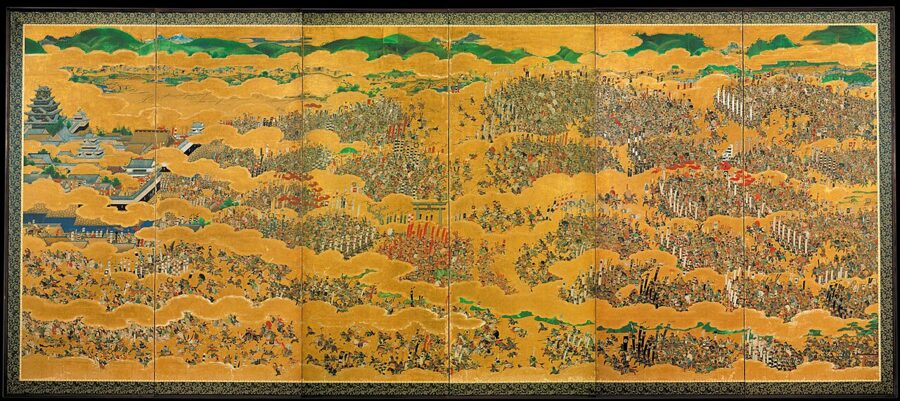
Whichever plan you follow, keep one evening for the castle. The park stays open after the keep closes, and from the Gokurakubashi bridge you can see what the builders of 1931 did: white Tokugawa-style walls below, and a black and gold top storey copied from the keep on the 1615 screen. It is a portrait of two castles that never stood at the same time, and it has now outlasted both of them.